









Here is the technical article generated according to your specifications.
Abstract
This technical article provides a comprehensive analysis of the LISUN LED Optical Aging Test Instruments for IEC 62368-1 Compliance, detailing their critical role in validating the safety and longevity of LED components under accelerated stress. It explores the dual-system architecture (LEDLM-80PL and LEDLM-84PL), which supports rigorous IES LM-80, LM-84, TM-21, and TM-28 standards. The article integrates technical specifications, including 6000-hour test durations and L70/L50 metrics, with the Arrhenius Model-based software for precise lifespan extrapolation. For engineers and lab technicians, understanding these instruments is essential for ensuring product compliance, reliability, and safety in modern power systems.
1.1 The Role of LED Lumen Maintenance in Hazard-Based Safety
IEC 62368-1, the hazard-based safety standard for audio/video, information, and communication technology equipment, mandates stringent verification of component reliability. For LEDs, this directly translates to proving that the light source will not degrade in a way that creates a secondary thermal or electrical hazard. The LISUN LED Optical Aging Test Instruments for IEC 62368-1 Compliance directly address this by quantifying lumen depreciation. If an LED’s output falls below a critical threshold (L50 or L70) prematurely, the internal power supply may overcompensate, leading to thermal runaway. Our instruments provide the empirical data required to validate that the light source’s aging characteristics are within safe, predictable limits over a projected lifespan.
1.2 Connecting Optical Degradation to Electrical Safety Parameters
The link between photometric aging and electrical safety is often underestimated. As an LED ages, its forward voltage (Vf) and internal junction temperature (Tj) can shift. The LISUN LED Optical Aging Test Instruments for IEC 62368-1 Compliance monitor photometric output (lumens) and, through integrated thermal control, correlate this with boundary conditions for safe operation. This data is vital for engineers selecting components for consumer electronics or automotive lighting. The standard requires that any failure of a component, including degradation of the LED, does not lead to electric shock or fire. Our testing protocols using these instruments help demonstrate this compliance by providing a clear degradation curve.
2.1 Precision for LM-80/TM-21: The LEDLM-80PL Variant
The LEDLM-80PL is engineered specifically for the IES LM-80-08 and TM-21-11 standards, the gold standard for measuring lumen maintenance of LED packages, arrays, and modules. This LISUN LED Optical Aging Test Instruments for IEC 62368-1 Compliance variant supports up to 3 connected temperature chambers, controlled simultaneously from a single console. The system is calibrated to maintain a temperature stability of ±2°C, critical for the 6000-hour minimum test duration, with an option to extend to 10,000 hours for high-reliability applications. The integrated integrating sphere (1-2 meter diameter options) allows for photometric and colorimetric measurements without moving the sample, preserving its thermal equilibrium.
2.2 Precision for LM-84/TM-28: The LEDLM-84PL Variant
While the LEDLM-80PL focuses on components, the LEDLM-84PL is designed for testing LED lamps, light engines, and luminaires according to the IES LM-84-14 and TM-28-14 standards. This LISUN LED Optical Aging Test Instruments for IEC 62368-1 Compliance system uses a goniophotometer or a long-term photometric measurement bench to track total luminous flux. A key differentiator is its ability to handle higher input power (up to 300W per sample) and active air cooling to simulate real-world thermal management in a luminaire. Both systems share a common software architecture, allowing labs to execute mixed test protocols (LM-80 and LM-84) simultaneously on the same day.
3.1 Real-Time Spectral and Photometric Monitoring
The instruments employ a high-speed spectroradiometer (resolution ≤1nm) to capture full spectral power distribution (SPD) data at user-defined intervals (e.g., every 1,000 hours). This goes beyond simple lux measurements, enabling calculations of Color Rendering Index (CRI), Correlated Color Temperature (CCT), and chromaticity shift (Δu’v’). This data is fundamental for compliance with IEC 62368-1, which may require evidence of color stability. The system automatically logs ambient temperature, case temperature, and relative humidity, creating a complete audit trail for any regulatory body.
3.2 Extrapolation Using the Arrhenius Model
The core of lifetime prediction lies in the proprietary software’s implementation of the Arrhenius Model. The software accelerates testing by collecting data at multiple elevated temperatures (e.g., 55°C, 85°C, and 105°C). By applying the Arrhenius equation, the system calculates the acceleration factor (AF) and extrapolates the L70 (time to 70% lumen maintenance) and L50 (time to 50% lumen maintenance) values. For IEC 62368-1 compliance, achieving an L70 of >50,000 hours or an L50 of >100,000 hours is often required. The LISUN LED Optical Aging Test Instruments for IEC 62368-1 Compliance software outputs these projections in a standard TM-21 or TM-28 format.
Table 1: Test Mode and Extrapolation Comparison
| Feature | Constant Current Mode (CC) | Constant Voltage Mode (CV) | Temperature Range | Key Standard |
|---|---|---|---|---|
| LEDLM-80PL | Yes (Standard) | No | 40°C to 105°C | IES LM-80, TM-21 |
| LEDLM-84PL | Optional | Yes (Standard) | 25°C to 85°C | IES LM-84, TM-28 |
| Application | Component-level, strict drive | Luminaire-level, typical driver output | Accelerated aging stress | Lumen maintenance projection |
| Extrapolation Limit | 6x test duration (TM-21) | 5.5x test duration (TM-28) | Configurable by software | L70/L50 via Arrhenius |
4.1 Constant Current (CC) Mode for Component Qualification
In Constant Current mode, the LISUN LED Optical Aging Test Instruments for IEC 62368-1 Compliance precisely controls the drive current (typically from 10mA to 2A with 0.1% accuracy). This is critical for LM-80 testing as it isolates the LED component’s degradation from driver anomalies. By fixing the current, any drop in luminous flux is directly attributable to the LED die and phosphor degradation. This mode is essential for comparative testing of different LED suppliers for use in a single lighting product.
4.2 Constant Voltage (CV) Mode for System-Level Validation
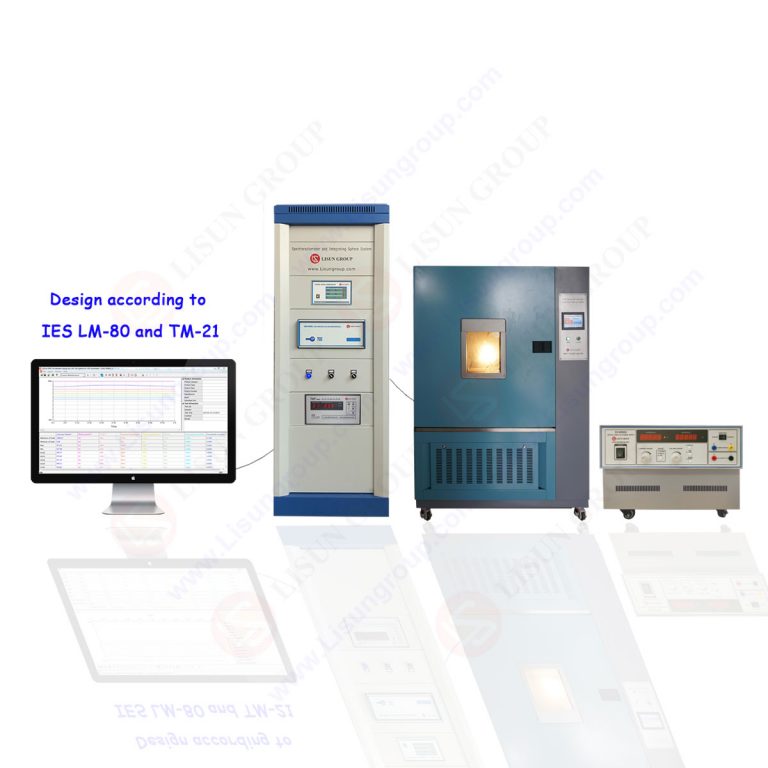
Conversely, Constant Voltage mode (usually 2-24V or 24-48V) simulates the behavior of an LED module or light engine connected to a stable, regulated power supply. This is crucial for IEC 62368-1 compliance because it tests the entire “optical sub-assembly.” In CV mode, as the LED heats up and its resistance drops, the system measures the resulting current increase, which directly impacts thermal runaway risk. This mode is indispensable for validating the failure modes of an integrated LED lamp or a self-ballasted LED module.
5.1 Multi-Chamber and Multi-Channel Support
The system supports a modular configuration with up to 3 independent temperature chambers (e.g., T1, T2, T3). A typical set-up for a test includes:
- Chamber 1 (T1): 55°C – Used for standard life projection.
- Chamber 2 (T2): 85°C – Used for accelerated aging and Arrhenius calculation.
- Chamber 3 (T3): 105°C – Used for worst-case stress testing (if applicable).
Each chamber can house multiple sample boards (up to 20 positions per chamber), allowing for high-throughput testing.
5.2 Integrated Power Analyzer and Temperature Monitoring
The hardware includes a precision power analyzer that measures voltage, current, power factor (PF), and total harmonic distortion (THD) for each channel at user-defined intervals. Additionally, k-type thermocouples are attached to the LED’s thermal pad (Tcase) to monitor junction temperature (Tj) indirectly. The system logs this data in real-time, allowing engineers to correlate a sudden increase in THD with the end of useful life (EOL). This hardware fidelity ensures that the LISUN LED Optical Aging Test Instruments for IEC 62368-1 Compliance data is accepted by global certification bodies (e.g., UL, TUV, CSA).
6.1 IES LM-79-19: Total Flux Measurement
While the aging test is the primary function, the integrating sphere used in our instruments is designed to comply with IES LM-79-19 for electrical and photometric measurements. Before initiating the 6000-hour aging test, a “T0” measurement according to LM-79-19 is mandatory. This captures the initial efficacy (lm/W) and SPD. The LISUN LED Optical Aging Test Instruments for IEC 62368-1 Compliance uses a 2-meter sphere for high-power luminaires to minimize self-absorption errors, ensuring that the baseline data is as accurate as the aging data.
6.2 CIE 084 and CIE 127 Photometry and Colorimetry
The calculation of Luminous Flux (mLF) relies on the principles of CIE 084 (The Measurement of Luminous Flux) and CIE 127 (Measurement of LEDs). Our application software applies the corrected cosine law for spatial distribution (per CIE 084) and the weighted spectral integration per CIE 127. These standards are essential for the system to correctly interpret the data from the spectroradiometer, converting raw counts into meaningful lumens. The instruments automatically apply these corrections during real-time data logging.
7.1 Accelerated Test Protocol (IEC 62368-1 Specific)
To comply with IEC 62368-1 Annex B.2, the test protocol is accelerated. A typical workflow using the LISUN LED Optical Aging Test Instruments for IEC 62368-1 Compliance is:
- T0 Measurement: Full photometric and colorimetric data (@25°C ± 2°C).
- Stress Phase: Test samples under specified Tcase temp (e.g., 85°C) and drive current (or voltage) for 1000-hour increments.
- T1 – Tn Measurements: Data collection at 0hr, 1000hr, 2000hr, 3000hr, 4000hr, 5000hr, and 6000hr.
- Relocation: Samples are cooled down before being moved to the integrating sphere or goniometer.
7.2 Reporting for Global Regulatory Bodies
The final output is a PDF report that includes:
- Raw data tables (Lumens, W, CCT, CRI vs. Time).
- TM-21/TM-28 extrapolation curve with confidence intervals.
- Arrhenius plot showing activation energy (Ea).
- Compliance statement against IEC 62368-1 Clause 5.4 (components) and Annex B.
This report is the final deliverable that allows a manufacturer to declare their product safe for the consumer market.
The LISUN LED Optical Aging Test Instruments for IEC 62368-1 Compliance are not merely measurement tools; they are an integrated system for predictive reliability. By combining the dual architecture of the LEDLM-80PL (for components) and LEDLM-84PL (for luminaires), and integrating the Arrhenius Model for accelerated life prediction, these instruments provide the most rigorous pathway to certification. For engineers, the ability to run tests simultaneously in CC and CV modes, across multiple temperature chambers, and directly correlate photometric degradation with electrical parameters (THD, PF) is invaluable. This allows for the early identification of failure mechanisms that could compromise safety. Adherence to standards like IES LM-80, IES LM-84, TM-21, and CIE 127 ensures global acceptance of test results. By investing in this testing infrastructure, manufacturers can drastically reduce time-to-market for new lighting products while maintaining the highest level of safety compliance. The system provides the empirical data necessary to confidently predict a 50,000-hour lifespan, a key requirement in modern power systems and consumer electronics.
Q1: What is the minimum test duration required by IEC 62368-1 for using LISUN’s LED Optical Aging Test Instrument to project an L70 value?
A: While IEC 62368-1 does not specify a test duration for lumen maintenance itself (it references the component standards), the industry standard for L70 projection is based on a minimum of 6,000 hours of actual test data. For a reliable TM-21 projection, you need data from at least 6,000 hours of aging at a given temperature (e.g., 85°C). Using the Arrhenius Model integrated into the LISUN software, you can then extrapolate to 36,000 hours (6x the test duration) to claim an L70 rating. For a 50,000-hour L70 claim, you would need approximately 8,000 hours of test data. The instrument’s ability to run three chambers simultaneously allows you to gather this data faster by testing at 3 different temperatures in parallel.
Q2: How does the Constant Voltage (CV) mode help meet safety requirements for LED lamps under abnormal operation?
A: In CV mode, the instrument simulates a typical residential or commercial power supply. If an LED lamp or module develops a thermal defect (e.g., poor solder joint causing localized heating), its forward voltage drops. In a CV system, this voltage drop causes the driver to push more current through the defective LED. This current surge can increase local temperature beyond acceptable limits, potentially causing burnout or fire. The LISUN LEDLM-84PL in CV mode monitors this current increase in real-time. If the current exceeds a safe threshold (set by the software or the power analyzer), it logs a “Test Failure” event, providing clear evidence of a hazardous condition per IEC 62368-1, Clause 5.4.2.
Q3: Can I use the same LISUN LED Optical Aging Test Instrument to test LED strips and individual high-power LEDs?
A: Yes. The system is modular. For high-power LEDs (e.g., 3W or 5W components), you would use the LEDLM-80PL system with its Constant Current mode (up to 2A) and mount the components on a thermal test board (MCPCB) inside the temperature chamber. For LED strips (typically 12V or 24V modules), you would use the LEDLM-84PL system in Constant Voltage mode. The hardware configuration is adaptable with different sample holders and current/voltage ranges. The software allows you to set up a “Test Plan” that specifies the mode, channel, and chamber for each sample type, allowing mixed testing in a single 6000-hour run.