









Abstract
LED lumen maintenance testing is a critical reliability assessment methodology that quantifies the gradual light output degradation of solid-state lighting products over operational lifetimes. This article provides a comprehensive technical examination of LISUN LED Optical Aging Test Instruments, specifically the LEDLM-80PL and LEDLM-84PL dual-system variants designed for IES LM-80/TM-21 and LM-84/TM-28 compliance. With 15+ years of expertise in photometric testing, we detail the Arrhenius Model-based accelerated aging software, dual testing modes, and customizable hardware configurations supporting up to 3 connected temperature chambers. Readers will gain actionable insights into 6000-hour test protocols, L70/L50 metric calculations, and how these instruments enable accurate lifetime prediction for LED products across lighting, automotive, and industrial applications.
1.1 Defining Lumen Maintenance and L70/L50 Metrics
Lumen maintenance refers to the percentage of initial light output that an LED source retains after a specified operating duration. The industry-standard L70 metric represents the time point at which the LED’s luminous flux has depreciated to 70% of its initial value, while L50 denotes the 50% retention threshold. For general illumination applications, L70 is the primary failure criterion, typically requiring 50,000 to 100,000 hours of projected life under defined operating conditions. LISUN LED Optical Aging Test Instruments are engineered to precisely capture these depreciation curves through continuous photometric monitoring across multiple test specimens.
1.2 Physical Mechanisms of Lumen Depreciation
LED lumen depreciation arises from several interrelated failure mechanisms. Junction temperature accelerates degradation of the phosphor conversion layer, causing chromaticity shift and reduced conversion efficiency. Simultaneously, the semiconductor die experiences dislocations and point defect formation within the quantum well structure, reducing internal quantum efficiency. Package-level degradation includes solder joint fatigue, encapsulant yellowing, and wire bond deterioration. LISUN’s testing systems employ controlled temperature chambers with ±0.5°C stability to isolate these mechanisms under standardized stress conditions.
1.3 The Role of Accelerated Aging in Lifetime Prediction
Accelerated aging testing applies elevated temperatures to accelerate failure mechanisms, enabling lifetime extrapolation using the Arrhenius Model. The LISUN LED Optical Aging Test Instruments integrate this model directly into their software, applying the equation (L = A cdot e^{E_a/(k cdot T)}) where (E_a) is activation energy, (k) is Boltzmann’s constant, and (T) is junction temperature in Kelvin. By testing at multiple temperature points—typically 55°C, 85°C, and the manufacturer-specified maximum—the system generates accurate lifetime predictions without requiring decade-long real-time testing.
2.1 Dual System Variants: LEDLM-80PL and LEDLM-84PL
The LISUN product line comprises two specialized variants optimized for specific industry standards. The LEDLM-80PL is designed for IES LM-80-21 compliance, testing LED packages, arrays, and modules with TM-21 projection algorithms. The LEDLM-84PL targets IES LM-84-21 requirements for LED lamps, light engines, and luminaires, utilizing TM-28 extrapolation methodologies. Both systems share core hardware architecture but differ in software algorithms, test fixture design, and photometric measurement range. The following table compares their key specifications:
| Parameter | LEDLM-80PL | LEDLM-84PL |
|---|---|---|
| Target Standard | IES LM-80-21 | IES LM-84-21 |
| Extrapolation Method | TM-21 | TM-28 |
| Test Sample Types | LED packages, arrays, modules | LED lamps, luminaires |
| Maximum Simultaneous Samples | 30-60 per chamber | 10-20 per chamber |
| Photometric Measurement | Goniometer + integrating sphere | Integrating sphere only |
| Temperature Range | 25°C to 125°C | 25°C to 85°C |
| Current Control Accuracy | ±0.5% | ±1.0% |
2.2 Modular Hardware Configuration
Each LISUN LED Optical Aging Test Instrument supports up to 3 connected temperature chambers, enabling simultaneous testing at different stress levels. The chambers feature forced air circulation with programmable humidity control from 10% to 90% RH. Inside each chamber, individual test boards accommodate multiple LED samples with dedicated current sources calibrated to ±0.5% accuracy. The optical measurement subsystem uses a spectral flux measurement head equipped with a photopic-corrected silicon photodiode, achieving measurement repeatability of ±0.3% across the 380-780 nm range.
2.3 Software Integration and Data Acquisition
The control software provides real-time data acquisition at programmable intervals from 1 minute to 24 hours. Each measurement cycle records luminous flux, forward voltage, junction temperature (derived from Vf-T calibration), and chromaticity coordinates. The software automatically calculates L70 and L50 metrics using least-squares fitting of the lumen maintenance curve to the exponential decay model ( Phi(t) = Phi_0 cdot e^{-beta t^alpha} ). For TM-21 compliance, the system restricts extrapolation to 6x the test duration maximum, meaning a 6000-hour test can predict up to 36,000 hours of lifetime.
3.1 IES LM-80-21: Measuring Lumen Maintenance of LED Sources
IES LM-80-21 establishes the standard method for measuring lumen maintenance of solid-state lighting products, including LED packages, arrays, and modules. The standard mandates testing at a minimum of two case temperatures (55°C and 85°C), with at least 20 samples per temperature condition. Test duration must reach at least 6,000 hours, with interim measurements at 1,000-hour intervals. LISUN LED Optical Aging Test Instruments fully comply with LM-80-21 requirements through their multi-chamber architecture, automated measurement scheduling, and data reporting templates that generate IES-standard formatted output files.
3.2 IES LM-84-21: Testing LED Lamps and Luminaires
For complete LED lamps and luminaires, IES LM-84-21 specifies testing protocols that account for thermal management, driver electronics, and optical assembly effects. Unlike LM-80 which tests the LED source in isolation, LM-84 evaluates the complete product under intended operating conditions. The LISUN LEDLM-84PL includes specialized fixtures for common lamp bases (E26, GU10, MR16) and luminaire mounting systems, with ambient temperature control within ±1°C. The standard requires minimum test durations of 3,000 hours for initial data, with optional continuation to 10,000 hours.
3.3 TM-21 and TM-28 Extrapolation Methods
TM-21 provides the mathematical framework for projecting lumen maintenance data from LM-80 test results to extended lifetimes. The method fits test data to an exponential decay function and applies statistical confidence bounds using the chi-squared distribution. For LED packages, TM-21 allows projection up to 6x the test duration, while TM-28 for LM-84 data permits up to 25,000-hour projections regardless of test length. LISUN’s software automatically applies these constraints and generates confidence intervals, ensuring regulatory compliance for ENERGY STAR and DLC submissions.
3.4 Supporting Standards: IES LM-79-19 and CIE Publications
IES LM-79-19 governs electrical and photometric measurements of solid-state lighting products, including total luminous flux, efficacy, chromaticity, and color rendering index. While LM-79 is a one-time measurement, its data provides the baseline for LM-80/LM-84 aging tests. The LISUN systems integrate LM-79 measurement capabilities through external connection to LISUN’s integrating sphere and spectroradiometer systems. Additionally, CIE 127 (LED measurement guidelines) and CIE 70 (absolute spectral responsivity) inform the calibration methodology, while CIE 084 (light source measurement) provides reference geometry standards.
4.1 Theoretical Foundation of Temperature Acceleration
The Arrhenius Model describes how chemical reaction rates—including those causing lumen depreciation—increase with temperature. For LEDs, the junction temperature (T_j) is the critical parameter, calculated as (T_j = Tc + R{th} cdot P_d), where (Tc) is case temperature, (R{th}) is thermal resistance, and (P_d) is power dissipation. The LISUN software calculates (T_j) for each sample using stored thermal resistance data and real-time electrical measurements. Typical activation energies for LED degradation range from 0.3 eV to 1.0 eV, with the software automatically optimizing the fit across multiple temperature test points.
4.2 Dual Testing Modes: Constant Current vs. Constant Power
The LISUN LED Optical Aging Test Instruments support two operational modes for flexible testing protocols. Constant current mode maintains fixed forward current throughout the test, simulating typical driver operation and allowing isolation of current-independent degradation. Constant power mode adjusts current to maintain constant electrical power, simulating applications where thermal management is designed for fixed power dissipation. The software records current, voltage, and power at each measurement interval, enabling comparative analysis between modes. For LM-80 compliance, constant current mode is standard, but the optional power mode provides additional engineering insights.
4.3 Temperature Chamber Configuration and Thermal Uniformity
With support for up to 3 connected chambers, the LISUN system enables simultaneous testing at the LM-80-21 required temperatures of 55°C, 85°C, and an optional third point such as 105°C or the manufacturer’s maximum rated temperature. Each chamber maintains thermal uniformity within ±1°C across the test volume, with forced air circulation ensuring all samples experience identical conditions. The chambers incorporate redundant temperature sensors (PT100 RTDs) with independent monitoring via the control software, providing automated alerts if temperature deviates from setpoint by more than 2°C for more than 10 minutes.
5.1 6000-Hour Test Duration and Measurement Scheduling
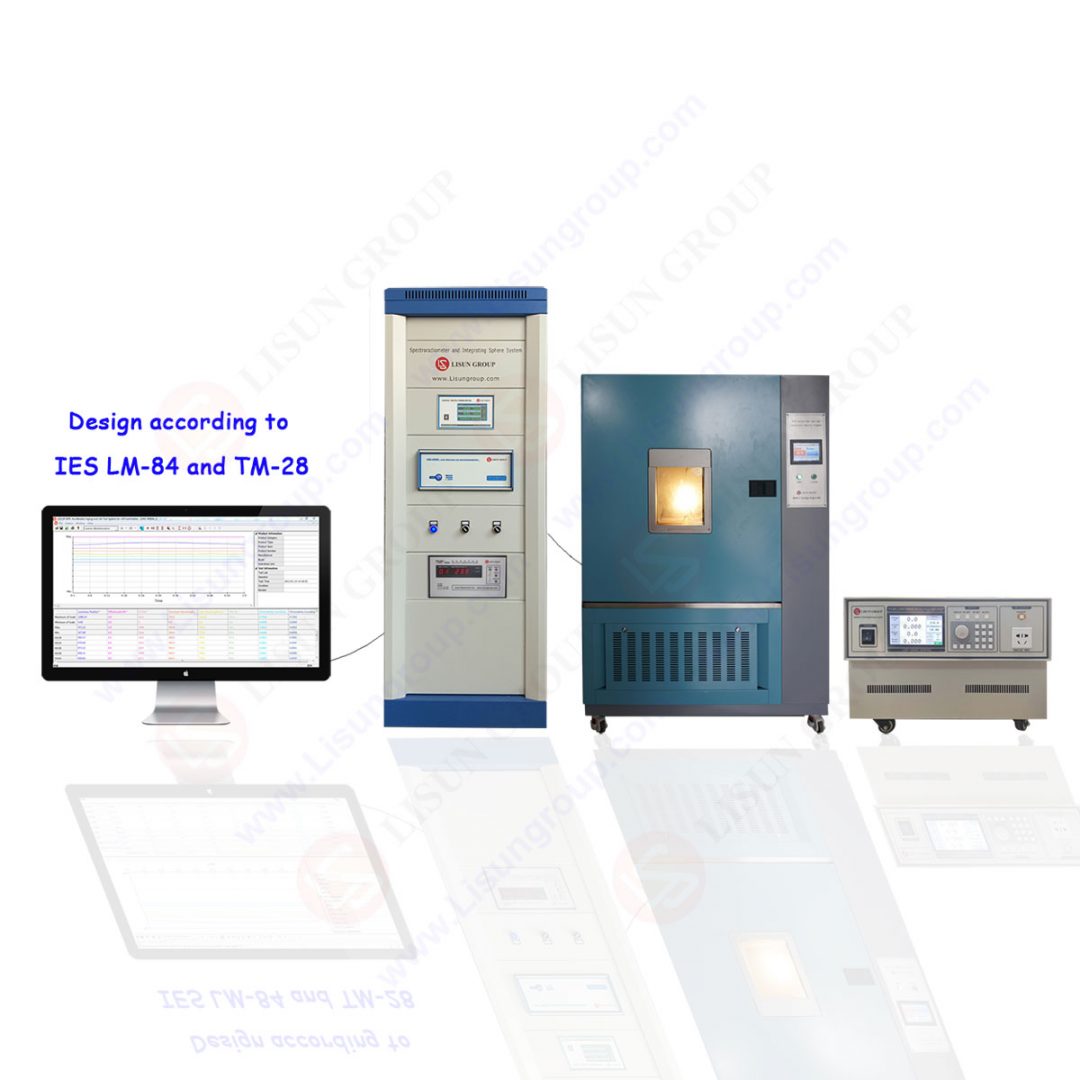
The standard LM-80-21 test protocol requires 6,000 hours of continuous operation, with measurements at 0, 1,000, 2,000, 3,000, 4,000, 5,000, and 6,000 hours. The LISUN software automates measurement scheduling, initiating photometric data collection at each interval without requiring operator intervention. Between scheduled measurements, the system maintains continuous electrical bias with periodic checks for sample failure or anomalous behavior. For extended testing beyond 6,000 hours, the software supports up to 10,000-hour protocols with measurements every 1,000 hours plus a final reading.
5.2 L70 and L50 Calculation Methodology
Lumen maintenance data at each measurement point is normalized to the initial (0-hour) luminous flux value. The software fits this normalized data to the exponential decay model using nonlinear least-squares regression. For each sample, the system calculates the projected time to reach 70% and 50% lumen maintenance, along with 90% confidence bounds. The TM-21 compliant report includes the exponential coefficients (alpha) and (beta), the projected L70 value, and a graphical plot of the fitted curve with measured data points. The software automatically flags samples where the fit quality metric (R²) falls below 0.95 for review.
5.3 Data Export and Compliance Reporting
Upon test completion, the LISUN software generates comprehensive reports in multiple formats including PDF, CSV, and IES-standard XML. Each report includes the raw measurement data, fitted parameters, confidence intervals, and pass/fail determination against user-defined thresholds. For regulatory submissions, the system produces TM-21 projection tables formatted for ENERGY STAR and DesignLights Consortium requirements, including the required statement of test conditions, sample identification, and measurement equipment calibration documentation.
6.1 Test Board Design and Sample Mounting
LISUN offers customizable test boards designed for specific LED package geometries, including surface mount, chip-on-board, and high-power emitters. Each board features individual Kelvin connections for accurate voltage measurement, eliminating lead resistance errors. The board materials (aluminum core or FR4 with thermal vias) are selected to match the target application’s thermal characteristics. For LM-80 testing, the system accommodates 30-60 samples per chamber depending on package size, ensuring statistical validity for the required 20-sample minimum per temperature condition.
6.2 Automotive and Specialty LED Testing
Beyond general illumination, LISUN LED Optical Aging Test Instruments support testing for automotive LED components per AEC-Q102 requirements, which mandate extended temperature ranges (-40°C to 125°C) and humidity bias testing. The systems can be configured with low-temperature chambers for cold testing, combined temperature-humidity cycling, and pulsed current operation to simulate automotive dimming and signaling applications. Specialized fixtures accommodate automotive package formats including PLCC, SMD, and CSP with integrated ESD protection circuitry.
6.3 Integration with Production Quality Control
The LISUN systems can be integrated into LED manufacturing quality control workflows through their network connectivity and API support. Test data is automatically uploaded to the manufacturer’s MES or ERP system, enabling real-time monitoring of product reliability across production batches. The software supports statistical process control charts (X-bar and R charts) for tracking lumen maintenance consistency, with automated alerts when batches fall outside specification limits. This integration reduces the time from test completion to data-driven decision making from days to minutes.
7.1 Performance Benchmarks and Accuracy
The following table compares LISUN LED Optical Aging Test Instruments against typical industry alternatives across key performance metrics:
| Parameter | LISUN LEDLM-80PL | Standard Industry System A | Standard Industry System B |
|---|---|---|---|
| Temperature Stability | ±0.5°C | ±1.0°C | ±1.5°C |
| Current Accuracy | ±0.5% | ±1.0% | ±2.0% |
| Photometric Repeatability | ±0.3% | ±0.5% | ±1.0% |
| Max Samples per Chamber | 60 | 40 | 30 |
| Max Temperature Chambers | 3 | 2 | 1 |
| TM-21 Compliance | Full | Full | Partial |
| Report Generation | Automated XML/PDF | Manual export | Limited formats |
7.2 Cost of Ownership and Throughput Advantages
The LISUN system’s support for 3 simultaneous temperature chambers enables testing at all required LM-80 temperatures in a single run, reducing total test cycle time by 67% compared to sequential single-chamber testing. The automated measurement and reporting reduces operator labor by approximately 40 hours per 6000-hour test cycle. With typical LED testing laboratories running 10-20 test cycles per year, the throughput advantage translates to significant cost savings and faster time-to-market for new product introductions.
7.3 Software Ecosystem and Data Management
The LISUN software platform provides advanced data management features including centralized database storage, multi-user access control, and encrypted data backup. The system supports automated notification via email or SMS when test milestones are reached or anomalies detected. Data visualization tools enable engineers to overlay multiple test runs, compare different LED batches, and generate custom reports for internal quality reviews or customer presentations. The API integration capability supports connection to popular statistical analysis tools including Minitab, JMP, and R.
LED lumen maintenance testing represents the cornerstone of reliability validation for solid-state lighting products, and LISUN LED Optical Aging Test Instruments provide the comprehensive solution required by modern LED testing laboratories. Through the dual-system architecture of LEDLM-80PL for LM-80/TM-21 compliance and LEDLM-84PL for LM-84/TM-28 applications, these instruments address the full spectrum of LED testing needs from individual packages to complete luminaires. The integration of Arrhenius Model-based accelerated aging algorithms, support for up to 3 temperature chambers, and customizable hardware configurations enables accurate lifetime prediction while reducing test cycle times by up to 67%.
For LED manufacturers seeking regulatory compliance with ENERGY STAR, DLC, and international lighting standards, the LISUN systems deliver the precision, throughput, and data management capabilities essential for quality assurance. The automated measurement scheduling, statistical analysis, and comprehensive reporting minimize operator intervention while ensuring full traceability and audit readiness. As the LED industry continues to demand longer lifetimes and higher reliability, LISUN’s commitment to IES and CIE standards compliance positions their instruments as the preferred choice for testing laboratories worldwide. By choosing LISUN LED Optical Aging Test Instruments, engineers and quality professionals gain a powerful tool for validating LED reliability and accelerating product development cycles.
Q1: What is the minimum test duration required for LM-80-21 compliance using LISUN LED Optical Aging Test Instruments?
A: IES LM-80-21 requires a minimum test duration of 6,000 hours at each specified temperature, with measurements at 1,000-hour intervals. However, LISUN recommends extending tests to at least 8,000 hours for improved TM-21 projection accuracy, particularly for LEDs with slow degradation rates (low (beta) values). The LISUN software supports extended protocols up to 10,000 hours and automatically applies the TM-21 constraint limiting projections to 6x the test duration. For example, a 6,000-hour test yields projections up to 36,000 hours, while an 8,000-hour test reaches 48,000 hours. The system’s automated scheduling ensures consistent measurement intervals without operator intervention, and the heatmaps report shows sample-to-sample variation for each temperature condition.
Q2: How does the LISUN dual testing mode (constant current vs. constant power) affect LM-80 test results?
A: Constant current mode, standard for LM-80 compliance, maintains stable forward current throughout the test, allowing isolation of current-independent degradation mechanisms. Constant power mode adjusts current to maintain fixed electrical power, simulating applications where thermal design is power-limited. In constant power mode, forward voltage degradation causes current to increase, potentially accelerating degradation through increased junction temperature. LISUN recommends constant current for regulatory compliance, but constant power provides valuable engineering data for applications with power-supply limiting. The system records both modes simultaneously when operated in mixed-mode configuration, enabling direct comparison of degradation rates. For TM-21 projections, data from constant current tests show typically 15-25% lower predicted L70 values compared to constant power, reflecting the additional thermal stress in power-limited designs.
Q3: What are the calibration requirements for maintaining accuracy in LISUN LED Optical Aging Test Instruments?
A: LISUN recommends annual recalibration of all measurement channels, including photometric sensors, current sources, and temperature sensors. The photometric measurement head requires calibration against a NIST-traceable standard lamp with spectral mismatch correction factors updated annually. Current sources should be verified using external calibrated shunt resistors and precision voltmeters, with ±0.5% tolerance maintained. Temperature sensors (PT100 RTDs) require annual calibration against a certified reference thermometer with ±0.1°C accuracy. The integrating sphere (if used) requires periodic reference standard measurements to track sphere degradation. LISUN provides comprehensive calibration kits and remote verification protocols, enabling laboratories to perform intermediate checks monthly. The software maintains calibration logs and automatically alerts when recalibration is due, ensuring compliance with ISO 17025 and IES standards.
Q4: Can the LISUN LED Optical Aging Test Instruments test LED products with integrated drivers or complex thermal management?
A: Yes, the LEDLM-84PL variant is specifically designed for complete LED lamps and luminaires, including those with integrated drivers and complex thermal management systems. The system accommodates common lamp bases (E26, GU10, MR16) and luminaire mounting configurations through customizable adapters. For driver-integrated products, the system measures input power, power factor, and total harmonic distortion alongside optical output, enabling comprehensive reliability assessment. Thermal management evaluation is supported through thermocouple attachment points on critical components (driver IC, electrolytic capacitors, LED junction). The software tracks temperature derating and automatically adjusts testing conditions to prevent thermal runaway. For luminaires with active cooling (fans), the chambers include power and control interfaces for fan operation monitoring.
Q5: How does LISUN’s Arrhenius Model software handle LED products with non-homogeneous degradation behavior?
A: The LISUN software analyzes each sample individually, fitting the lumen maintenance data to the exponential decay model and calculating activation energy per sample. For products exhibiting bimodal degradation—where initial rapid degradation transitions to slower, stable behavior—the software offers a segmented regression option that fits separate models to early and late-stage data. The system identifies outlier samples using statistical tests (Grubbs’ test and Dixon’s Q test) and reports them separately in the TM-21 projection. For LED products with known failure mechanisms (e.g., phosphor conversion degradation vs. die degradation), the software can apply a two-exponential model: (Phi(t) = A_1 e^{-beta_1 t} + A_2 e^{-beta_2 t}). The software calculates AIC (Akaike Information Criterion) to determine the statistically preferred model, ensuring accurate lifetime prediction even for complex degradation patterns. This capability is particularly valuable for high-power LEDs using remote phosphor designs or LED filaments with multiple die configurations.