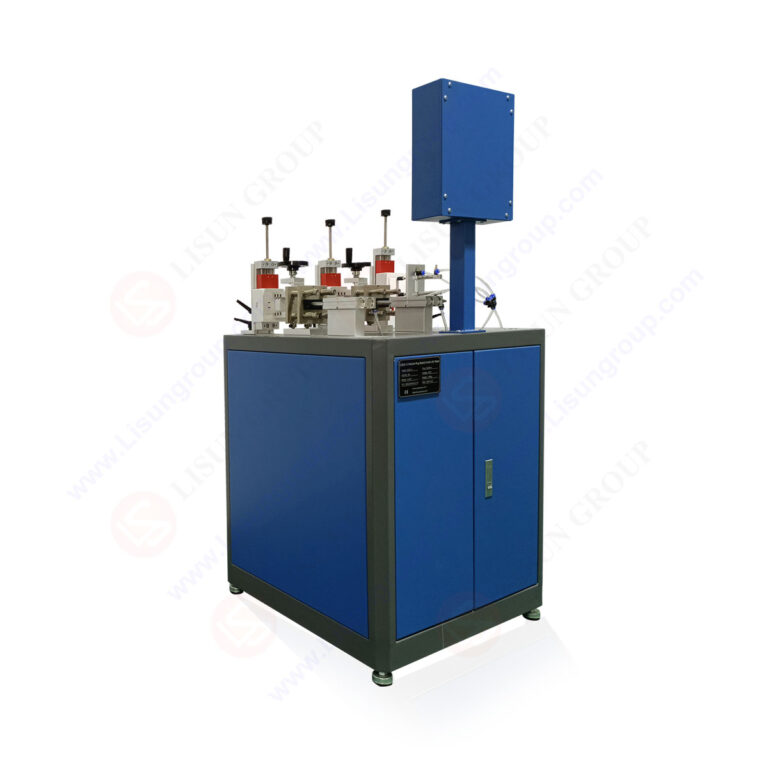
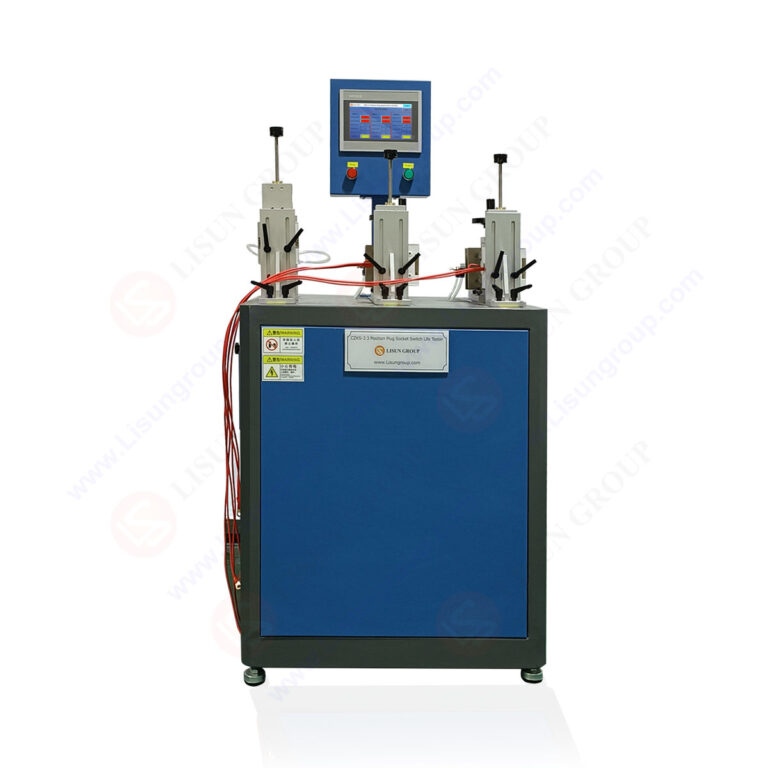
This article provides a comprehensive technical analysis of the LISUN Multi-Station Plug Socket Tester series, focusing on its compliance with IEC 60884-1 for plug and socket durability testing. The LISUN Multi-Station Plug Socket Tester is engineered to perform automated electrical durability verification, breaking capacity assessment, and mechanical endurance testing across multiple test stations simultaneously. Designed for quality control engineers and safety testing laboratories, this system integrates pneumatic actuation, PLC-based control logic, and real-time data acquisition to replicate real-world wear patterns on plugs, sockets, switches, and automotive connectors. The article examines the CZKS-3 series variants (CZKS-3, CZKS-3P, CZKS-3S, CZKS-3A), their respective test parameter ranges, and their alignment with international standards including IEC 60884-1, IEC 60669-1, IEC 61058-1, and GB/T 2099.1. Application scenarios cover household appliance components, industrial electrical interfaces, and automotive electronics, with technical comparisons and standard citations supporting each evaluation.
1.1 Modular Platform Configuration
The LISUN Multi-Station Plug Socket Tester employs a modular platform architecture that accommodates multiple test specimens in parallel. Each station operates independently under centralized PLC coordination, enabling simultaneous testing of different product types or identical samples under varied load conditions. The CZKS-3 series base model supports up to four test stations, while the CZKS-3P variant extends this capacity to six stations for high-throughput production environments. The mechanical frame utilizes extruded aluminum profiles with vibration-dampening mounts, ensuring positional accuracy within ±0.1 mm during repeated insertion and withdrawal cycles.
1.2 Pneumatic Actuation and Force Control
Cylinder-driven actuation forms the core of the mechanical motion system, with each station equipped with a dedicated double-acting pneumatic cylinder. The system regulates insertion force between 10 N and 150 N, adjustable in 1 N increments, and withdrawal force between 5 N and 100 N. Force sensors mounted on each actuator provide closed-loop feedback to the PLC, allowing real-time correction if deviation exceeds 2% of the setpoint. The CZKS-3S variant incorporates servo-driven linear actuators with encoder feedback, achieving velocity control from 5 mm/s to 200 mm/s for precise breaking capacity tests.
1.3 Control System and Data Acquisition
The PLC-based control system executes preprogrammed test sequences stored in non-volatile memory, supporting up to 50 distinct test profiles per station. Each profile defines parameters including insertion depth, dwell time, cycle count, load current, and voltage application windows. The data acquisition module samples contact resistance at 1 kHz, insulation resistance at 500 V DC, and dielectric withstand voltage at up to 4 kV AC. Results are logged to an internal SD card and can be exported via USB or Ethernet to laboratory information management systems. The CZKS-3A variant adds analog input channels for external temperature and humidity sensors, enabling environmental condition monitoring during extended durability tests.
2.1 Mechanical Endurance Requirements
IEC 60884-1 Clause 20 specifies mechanical endurance testing for plugs and socket-outlets, requiring 10,000 insertion and withdrawal cycles at a rate of 30 cycles per minute for household devices. The LISUN Multi-Station Plug Socket Tester achieves this with programmable cycle rates from 5 to 60 cycles per minute. The CZKS-3 model simultaneously tests four specimens, each undergoing identical mechanical stress profiles. The system records cumulative cycle counts and automatically halts any station that exceeds predefined contact resistance thresholds, preventing damage to the test fixture or power supply.
2.2 Electrical Breaking Capacity Verification
Clause 21 of IEC 60884-1 addresses breaking capacity, requiring the device to make and break rated current under specified voltage conditions. The LISUN Multi-Station Plug Socket Tester integrates a programmable AC/DC power supply capable of delivering 0–300 V AC and 0–400 V DC at currents up to 32 A. During breaking capacity tests, the system applies rated voltage across the plug-socket interface while the actuator withdraws the plug at a controlled speed. The PLC monitors arc duration, current waveform at 10 MHz sampling, and contact temperature via thermocouple inputs. Any station that exhibits arc duration exceeding 10 ms or contact temperature rise beyond 65 K triggers an immediate fault condition and test termination.
2.3 Contact Resistance and Temperature Rise Monitoring
Clause 22 of IEC 60884-1 mandates contact resistance measurements before, during, and after endurance testing, with maximum permissible resistance of 0.1 Ω for rated currents up to 16 A. The data acquisition system performs four-wire Kelvin measurements on each test station, achieving resolution of 0.1 mΩ. Temperature rise is monitored using type-K thermocouples embedded in the socket contacts, with readings logged every 100 cycles. The CZKS-3S variant includes a thermal imaging camera interface for contactless temperature mapping across multiple test points simultaneously, enabling detection of localized overheating in substandard specimens.
3.1 Mechanical Life Cycle Verification
IEC 60669-1 Clause 18 specifies mechanical endurance for switches, requiring 40,000 operating cycles for switches rated up to 10 A and 20,000 cycles for higher current ratings. The LISUN Multi-Station Plug Socket Tester adapts its actuation stroke and force profile for switch testing, with adjustable angular displacement from 0° to 90° and linear displacement up to 15 mm. The CZKS-3P variant includes a rotational actuator module for rocker and toggle switches, applying torque between 0.1 N·m and 2.0 N·m. Each station logs actuation force versus displacement curves, identifying mechanical wear patterns such as spring fatigue, detent degradation, and contact bounce.
3.2 Electrical Endurance and Contact Adhesion Testing
Clause 19 of IEC 60669-1 requires electrical endurance testing with resistive and inductive loads. The LISUN Multi-Station Plug Socket Tester controls load banks with power factor adjustment from 0.4 to 1.0, simulating real-world operating conditions. Contact adhesion is evaluated by measuring the force required to separate welded contacts after prolonged current flow. The PLC initiates a forced separation sequence if contact resistance drops below 1 mΩ during the closed state, indicating potential cold welding. The system records the separation force and applies a 10 ms high-current pulse to break any microwelds, then continues the test sequence with updated parameter limits.
3.3 Dielectric Strength and Insulation Resistance
IEC 60669-1 Clause 20 mandates dielectric tests at 2 kV AC for 1 minute between live parts and between live parts and enclosure. The LISUN Multi-Station Plug Socket Tester includes an integrated high-voltage test module generating 0–5 kV AC/DC with leakage current measurement from 0.1 mA to 100 mA. Insulation resistance is measured at 500 V DC with minimum acceptable values of 5 MΩ for functional insulation and 10 MΩ for reinforced insulation. The CZKS-3A variant supports automated hipot testing between test cycles, inserting a 60-second dielectric withstand test every 1,000 mechanical cycles to monitor insulation degradation over the product lifespan.
4.1 Actuation Force and Stroke Characterization
IEC 61058-1 Clause 15 requires characterization of actuation forces and stroke for switches used in household appliances. The LISUN Multi-Station Plug Socket Tester measures force profiles at 1 kHz sampling rate, capturing peak force, breakaway force, and full travel distance. The CZKS-3S variant with servo actuation provides constant velocity profiles while recording instantaneous force values with ±0.05 N accuracy. Tests are conducted at ambient temperatures ranging from −10°C to 85°C using an optional environmental chamber interface, ensuring compliance with Clause 15.3 regarding temperature-dependent actuation characteristics.
4.2 Making and Breaking Capacity Under Inductive Loads
Clause 16 of IEC 61058-1 specifies making and breaking capacity tests with inductive loads having a time constant of 6–15 ms. The LISUN Multi-Station Plug Socket Tester controls programmable inductive load banks with inductance values from 0.1 mH to 100 mH, adjustable in 0.01 mH increments. During making capacity tests, the system closes the switch contacts at a controlled speed of 50 mm/s while applying rated voltage. Current inrush waveforms are captured at 100 MHz sampling rate, and arc energy is calculated by integrating voltage and current during the arcing period. Breaking capacity tests follow immediately, with the system opening the contacts under full load and verifying arc extinction within the specified time limit of 10 ms for AC circuits.
4.3 Thermal Stability and Overload Testing
IEC 61058-1 Clause 17 requires thermal stability verification under overload conditions of 1.5 times rated current for 1 hour. The LISUN Multi-Station Plug Socket Tester programs the load bank to deliver constant current with ±0.5% accuracy while monitoring contact temperature via embedded thermocouples. The system performs continuous thermal imaging at 30-second intervals using the optional camera interface, generating temperature gradient maps across the switch housing. Any temperature rise exceeding 85 K above ambient triggers automatic load reduction and test termination, with full data logging for failure analysis documentation.
5.1 Connector Durability for Vehicle Electrical Systems
Automotive connectors require endurance testing per ISO 8092 and manufacturer-specific protocols, typically involving 10,000 to 50,000 insertion cycles with controlled forces of 20–150 N. The LISUN Multi-Station Plug Socket Tester accommodates automotive-style connectors using interchangeable fixture jaws designed for rectangular, circular, and blade-type contacts. The CZKS-3P variant includes a micro-force sensor module for low-force testing of signal connectors, achieving force resolution of 0.01 N. Each station records insertion and withdrawal force profiles, identifying wear indicators such as force degradation exceeding 20% from initial measurements or contact resistance rising above 5 mΩ for power contacts.
5.2 Vibration and Mechanical Shock Simulation
Automotive standards require combined mechanical and electrical testing under vibration profiles defined in ISO 16750-3. The LISUN Multi-Station Plug Socket Tester integrates with external vibration shakers via analog control interface, synchronizing insertion cycles with vibration waveforms from 5 Hz to 2 kHz. The data acquisition system captures contact continuity during vibration at 10 kHz sampling, detecting momentary interruptions exceeding 1 μs. The CZKS-3A variant includes an accelerometer input channel for direct vibration measurement on the test specimen, enabling closed-loop control of shaker output to maintain specified vibration levels throughout the durability test sequence.
5.3 Environmental Chamber Integration for Thermal Cycling
Temperature cycling from −40°C to 125°C is a critical requirement for automotive connectors per USCAR-2 and LV 214 standards. The LISUN Multi-Station Plug Socket Tester connects to environmental chambers via RS-485 communication, coordinating test execution with temperature ramps. During thermal cycling, the system performs contact resistance measurements at temperature plateaus every 10°C, creating resistance-versus-temperature profiles for each connector specimen. The PLC logs the number of thermal cycles and correlates mechanical wear with thermal stress, identifying failure modes such as connector shell cracking, contact relaxation, and housing deformation that occur under combined thermal-mechanical loading.
6.1 Parameter Range and Configuration Options
The following table provides a technical comparison of the four CZKS-3 series variants, highlighting their respective test parameter ranges and configuration options.
| Parameter | CZKS-3 | CZKS-3P | CZKS-3S | CZKS-3A |
|---|---|---|---|---|
| Number of test stations | 4 | 6 | 4 | 4 |
| Insertion force range (N) | 10–150 | 10–150 | 5–200 | 10–150 |
| Withdrawal force range (N) | 5–100 | 5–100 | 3–150 | 5–100 |
| Actuation velocity range (mm/s) | 10–100 | 10–100 | 5–200 | 10–100 |
| Force measurement accuracy (±N) | 0.5 | 0.5 | 0.05 | 0.5 |
| Servo control capability | No | No | Yes | No |
| Environmental sensor inputs | 0 | 0 | 0 | 4 |
| Thermal camera interface | No | No | Yes | Yes |
| High-voltage test integration | Optional | Optional | Standard | Standard |
| Rotational actuator module | Optional | Standard | Optional | Optional |
6.2 Application-Specific Configuration Selection
The CZKS-3 base model is suitable for routine compliance testing of household plugs and sockets per IEC 60884-1, offering sufficient force and cycle count capabilities for standard durability verification. The CZKS-3P variant with six stations is optimized for high-volume production quality control, enabling simultaneous testing of multiple switch types per IEC 60669-1. The CZKS-3S with servo actuation is required for breaking capacity tests requiring precise velocity control per IEC 61058-1, achieving the 5 mm/s minimum for making capacity verification at rated currents above 16 A. The CZKS-3A variant with environmental inputs is designed for automotive connector testing per ISO 8092 and USCAR-2, supporting temperature and humidity monitoring during extended thermal cycling protocols.
7.1 Household Appliance Component Verification
Testing laboratories verify compliance of plugs, sockets, and switches used in household appliances against IEC 60884-1, IEC 60669-1, and national standards such as GB/T 2099.1. The LISUN Multi-Station Plug Socket Tester streamlines this workflow by executing sequential test protocols without operator intervention between phases. A typical sequence begins with insulation resistance measurement at 500 V DC, followed by dielectric withstand test at 2 kV AC, then 10,000 mechanical endurance cycles with electrical load at rated current, and concludes with post-test contact resistance verification. The system automatically generates a compliance report citing the specific standard clauses tested, measured values, and pass/fail status for each specimen.
7.2 Automotive Connector Qualification
Automotive OEMs and tier-one suppliers use the CZKS-3S and CZKS-3A variants for connector qualification testing per customer-specific standards based on USCAR-2 and LV 214. The workflow integrates mechanical insertion cycles, contact resistance measurement at defined intervals, thermal cycling in environmental chambers, and vibration testing on separate shaker tables. The LISUN Multi-Station Plug Socket Tester provides synchronized timing signals to coordinate these test phases, ensuring consistent mechanical wear accumulation across all test conditions. The data acquisition system correlates electrical performance degradation with mechanical wear metrics, identifying early warning indicators such as increasing insertion force variance or intermittent contact resistance spikes.
7.3 Third-Party Certification Laboratory Operations
Certification bodies such as TÜV, UL, and SGS require test equipment that provides traceable calibration and audit-ready data logs. The LISUN Multi-Station Plug Socket Tester supports calibration verification using external force and resistance standards, with calibration certificates stored in the PLC memory for each parameter channel. The system logs all test parameters, measured values, and timestamps in an encrypted format that prevents post-test data manipulation. The CZKS-3P variant with six stations enables parallel testing of multiple product families, reducing certification lead times while maintaining compliance with ISO 17025 laboratory quality management requirements.
The LISUN Multi-Station Plug Socket Tester series, encompassing the CZKS-3, CZKS-3P, CZKS-3S, and CZKS-3A variants, delivers comprehensive electrical durability testing capabilities aligned with IEC 60884-1, IEC 60669-1, IEC 61058-1, and GB/T 2099.1 standards. The system’s modular architecture supports simultaneous testing of multiple specimens, each under independently controlled mechanical and electrical parameters, enabling efficient compliance verification for household, industrial, and automotive applications. The PLC-based control system provides precise force and velocity regulation, real-time data acquisition at high sampling rates, and automated fault detection for contact adhesion, excessive temperature rise, or insulation breakdown. Technical comparison across the four variants reveals distinct advantages for specific use cases: the CZKS-3 for standard plug and socket testing, the CZKS-3P for high-throughput switch durability, the CZKS-3S for precise breaking capacity tests, and the CZKS-3A for environmental chamber integration. Laboratories and manufacturers seeking reliable, standards-compliant durability testing solutions will find the LISUN Multi-Station Plug Socket Tester series to be a technically robust investment for product quality assurance and certification processes.
Q1: What is the maximum number of test cycles the LISUN Multi-Station Plug Socket Tester can execute for a single specimen?
A: The PLC-based control system supports up to 999,999 cycles per test profile, with automatic termination upon reaching the programmed target. For IEC 60884-1 compliance testing requiring 10,000 cycles, the system completes the sequence at 30 cycles per minute in approximately 5.6 hours per station. The CZKS-3P variant with six stations can simultaneously test six specimens to full cycle counts within the same timeframe, significantly reducing overall test duration. Data storage capacity on the internal SD card exceeds 16 GB, accommodating test logs for more than 50,000 individual test sequences without data overwrite.
Q2: How does the CZKS-3S variant achieve improved force measurement accuracy compared to other models?
A: The CZKS-3S variant incorporates a servo-driven linear actuator with integrated encoder feedback achieving position resolution of ±0.01 mm, combined with a high-precision load cell rated at 200 N with nonlinearity of ±0.02% full scale. The servo motor maintains constant velocity within ±0.1% of setpoint, eliminating the force variations inherent in pneumatic cylinder actuation due to compressed air compressibility and valve response times. This configuration achieves force measurement accuracy of ±0.05 N, which is ten times better than the ±0.5 N accuracy of pneumatically actuated variants, making the CZKS-3S suitable for low-force signal connector testing per automotive standards.
Q3: Can the LISUN Multi-Station Plug Socket Tester be integrated with existing environmental chamber equipment?
A: Yes, the CZKS-3A variant includes four analog input channels accepting 0–10 V or 4–20 mA signals from external temperature, humidity, and vibration sensors, plus an RS-485 communication port for commanding environmental chamber temperature setpoints. The PLC coordinates test execution with chamber temperature ramps, pausing mechanical cycling during temperature transitions and resuming upon stabilization at the target temperature. The system logs chamber temperature and humidity data alongside electrical test measurements, creating a unified test record that correlates mechanical wear with environmental stress conditions per ISO 16750-3 requirements.
Q4: What data export formats does the system support for laboratory information management system integration?
A: The LISUN Multi-Station Plug Socket Tester exports test data in CSV, XML, and PDF formats via Ethernet connection using Modbus TCP protocol for real-time data streaming. The CSV export includes timestamp, station ID, cycle count, force, contact resistance, temperature, and pass/fail status for each measurement point. XML exports follow a schema compatible with major LIMS platforms including LabVantage and STARLIMS. PDF reports are generated automatically upon test completion, including a summary table of test parameters, measured values with tolerance limits, and individual specimen pass/fail determinations. The system also supports SQL database direct writing via ODBC interface for centralized data storage in enterprise environments.
Q5: How does the system handle contact adhesion failures during switch durability testing?
A: The system detects contact adhesion when measured contact resistance remains below 1 mΩ for more than 100 consecutive cycles, indicating potential cold welding or microwelding of switch contacts. Upon detection, the PLC initiates a forced separation sequence using the actuation cylinder at maximum force (150 N for CZKS-3, 200 N for CZKS-3S). If separation is successful, the system applies a 10 ms high-current pulse at twice rated current to break any residual microwelds, then resumes the normal test sequence. If forced separation fails, the station is halted, and a fault condition is logged with full waveform data from the current and voltage sensors during the attempted separation. This approach ensures continued testing of adjacent stations without interference from the failed specimen.