









Here is the comprehensive technical article on the LISUN DFX Series Externally Ballasted Fluorescent Lamp Test Load Cabinet, generated according to your specifications.
Abstract
This article provides a detailed technical analysis of the LISUN DFX series Externally Ballasted Fluorescent Lamp Test Load Cabinet, a critical solution for electrical safety compliance testing. Designed for manufacturers and third-party labs, this load test cabinet simulates the complex electrical characteristics of inductive and resistive loads required by international standards. The article explores the product’s core capabilities in power factor adjustment, current control, and cyclic endurance testing. It validates the DFX series against key clauses from IEC 60669-1, IEC 60884-1, IEC 61058-1, and GB 16915.1. We will examine model specifications, integration with complementary LISUN equipment for complete test benches, and the technical advantages of this externally ballasted design over conventional test loads, providing engineers with the data needed for informed procurement decisions.
1.1 The Role of Load Cabinets in Compliance Verification
Electrical accessories such as switches, plugs, and connectors must withstand realistic electrical stress during their operational life. Standards like IEC 60884-1 define specific load conditions for endurance tests. A standard resistive load bank is insufficient because real-world loads, particularly fluorescent lighting and inductive motors, exhibit a phase shift between voltage and current. The electrical accessory load tester must replicate these inductive characteristics with precise power factor (PF) control. The LISUN DFX series fulfills this role by providing an externally ballasted configuration using high-inductance chokes and adjustable resistive elements. This ensures that the test voltage and current are out of phase, generating the arc energy required to validate contact durability and insulation integrity.
1.2 Externally Ballasted vs. Solid-State Load Simulation
Traditional solid-state load simulators struggle with high inrush currents and heat dissipation during prolonged cyclic tests. The LISUN DFX series employs an externally ballasted design, using physical inductive coils (chokes) and wire-wound resistors. This approach offers superior thermal management and current stability over thousands of test cycles. The external ballast principle directly mirrors the load structure found in legacy lighting systems, making it the most authentic method for testing switches rated for fluorescent lamp control. This design inherently meets the failure mode requirements of standards such as IEC 60669-1 Annex B, which mandates specific load types for heating and endurance tests.
2.1 Comprehensive Model Comparison
The DFX series is available in five primary models, each optimized for different test configurations and current requirements. The following table provides a direct comparison of core specifications:
| Model | Current Output Range (Adjustable) | Number of Channels | Input Voltage / Power | Applicable Standard (Typical) | Physical Form Factor |
|---|---|---|---|---|---|
| DFX-20 | 0.1A – 20A | Single Channel | AC 220V / 500VA | IEC 60884-1 | Benchtop |
| DFX-20-3CH | 0.1A – 20A (per ch.) | Three Independent | AC 220V / 1500VA | GB 16915.1 | Benchtop |
| DFX-40 | 0.2A – 40A | Single Channel | AC 220V / 1000VA | IEC 60669-1 (Higher current) | Floor-standing |
| DFX-60 | 0.2A – 60A | Single Channel | AC 220V / 1800VA | IEC 61058-1 | Floor-standing |
| DFX-80 | 0.5A – 80A | Single Channel | AC 220V / 2400VA | Custom Industrial | Floor-standing |
All models provide a Power Factor (PF) adjustment range from 0.3 (inductive) to 1.0 (resistive), with a resolution of 0.01. Load capacitance for arc suppression is specified at <10pF (channel to ground), ensuring minimal parasitic interference during high-frequency switching tests.
2.2 Power Factor and Current Resolution
The precision of the ballasted lamp load simulator is defined by its ability to maintain a stable PF across the entire current range. The DFX series achieves a PF accuracy of ±0.05 when operating above 10% of the full-scale current. For the DFX-40, this means a test at 10A with a target PF of 0.6 will read within 0.55-0.65 on the integrated power analyzer. The current resolution is 0.1A for models up to 40A and 0.2A for the DFX-60 and DFX-80. This fine granularity is essential for calibrating test parameters to the exact specification of IEC 60669-1 Clause 19.2, which requires testing at rated current and rated voltage with a specific load type.
3.1 Rigor for Switch Testing (IEC 60669-1 & IEC 61058-1)
The primary application for the DFX series is the endurance testing of switches for household and similar fixed electrical installations. IEC 60669-1 Clause 19.2 (Heating Test) requires a resistive-inductive load with a power factor of 0.6 ±0.05 for rated currents above 10A. The DFX series can be preset to this exact PF value and locked to prevent drift during the 10,000-cycle endurance test (Clause 19.1). Similarly, IEC 61058-1 for appliance switches mandates specific load curves. The DFX-60 model can replicate the motor load profile required by Clause 15.2, which demands a locked-rotor current condition followed by a running current at a specified PF.
3.2 Plug and Socket Testing (IEC 60884-1)
For plugs and socket-outlets, IEC 60884-1 Clause 20 and Clause 21 define the normal operation and endurance test sequences. These tests require the sample to make and break a specified current at an inductive power factor of 0.6 ±0.05 for AC circuits. The DFX-20-3CH is particularly valuable here, as it allows simultaneous testing of three different product types (e.g., a 10A socket, a 16A plug, and a 2.5A connector) to different load profiles, accelerating the compliance process. The internal overload protection of the LISUN unit ensures that the test load remains within the standard’s tolerance window, preventing false failures due to load instability.
4.1 Pairing with the CZKS Series Life Testers
The DFX series is designed for seamless integration with the LISUN CZKS series switch and socket-outlet life testers. The CZKS system provides the mechanical actuation (steady-state force, angular velocity) for sample operation, while the DFX cabinet provides the electrical load. A single control signal from the CZKS unit initiates the connection and disconnection cycle on the DFX. This integration ensures that the mechanical operation and electrical load are synchronized per standard requirements. For example, when testing a rocker switch under IEC 60669-1, the CZKS tester actuates the switch at a rate of 7.5 operations per minute, while the DFX-20 provides the 15A, 0.6 PF load on each cycle.
4.2 Supporting Bending and Mechanical Tests
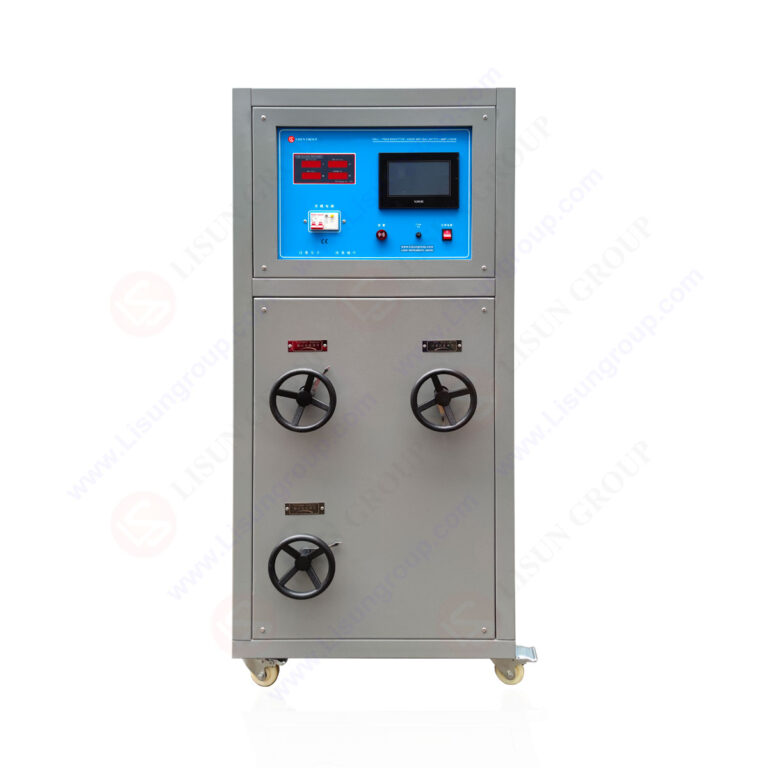
The electrical accessory load tester also supports the SW-6 series cord bending testers. For flexible cord anchors and inlets, standards require a bending test under electrical load. The DFX series, when set to a resistive load (PF = 1.0) at rated current, provides the current flow through the cord during the bending motion. The high current stability of the external ballast ensures that the load does not fluctuate during the 10,000 bending cycles, accurately simulating the thermal and mechanical stress on the connection. This holistic approach allows a laboratory to build a complete, standard-compliant test bench using LISUN equipment.
5.1 Digital Control and Measurement
The DFX series features a digital control interface with a high-definition LCD display that shows real-time voltage, current, power factor, and active power (Watts). Operators can set the test load using a simple numeric keypad. The unit includes a cycling counter that can be preset to the required number of operations (e.g., 10,000 cycles for normal operation tests). This eliminates the need for manual counting and reduces operator error. The measurement accuracy for voltage and current is ±(0.5% reading + 0.1% range), meeting the requirements of IEC 60947-2 for test equipment.
5.2 Comprehensive Overload and Thermal Management
Given the thermal energy dissipated by the inductive chokes and resistors, thermal management is critical. The DFX series incorporates a forced-air cooling system with a thermostat-controlled fan. If internal temperature exceeds a safe threshold (55°C), the system automatically disconnects the load to prevent damage to the internal inductors. Short-circuit protection is provided by a magnetic circuit breaker, and a residual current device (RCD) is integrated for operator safety. These features ensure the unit can run unattended for the multi-day duration of a full certification test sequence.
The table below compares the DFX-20’s capabilities against the minimum requirements of a key standard:
| Parameter | Minimum Requirement (IEC 60884-1 Clause 20) | LISUN DFX-20 Capability | Compliance Status |
|---|---|---|---|
| Test Current | 1.25x rated current (e.g., 15A for 10A socket) | 0.1A – 20A (adjustable) | Exceeds (Range) |
| Power Factor (Inductive) | 0.6 ±0.05 | 0.3 – 1.0 (adj.) ±0.05 | Meets |
| Voltage at Load | Rated voltage (e.g., 250V AC) | AC 220V (adjustable via variac) | Meets (With external variac) |
| Number of Cycles | 5000 (Normal op.) | Programmable to 999,999 | Exceeds |
| Load Type | Resistive + Inductive (External) | Externally Ballasted (Inductive + Resistor) | Meets (Type) |
6.1 Production Line QC and Batch Testing
For manufacturers of switches and sockets, the DFX series serves as a final quality check tool. During production, a sample from each batch can be subjected to a 200-cycle rapid endurance test using the LISUN cabinet. This is quicker than a full certification test (2 hours vs. 5 hours) but provides high confidence in contact reliability. The three-channel DFX-20-3CH is particularly useful for this, allowing a QC engineer to test three different product variants simultaneously, directly comparing their electrical performance under identical load conditions.
6.2 Third-Party Certification Laboratory Efficiency
Third-party test houses require equipment that can be calibrated and proven. The DFX series provides a known, stable impedance. The ability to log test parameters via an RS-232 interface (optional) allows for automated data acquisition, which is critical for creating test reports for CB schemes or CCC certification. The external ballast design also simplifies the calibration process, as the resistance and inductance values can be verified with a standard LCR meter, unlike complex electronic loads which require proprietary calibration software.
7.1 Achieving Precise Phase Angle Control
The core of the DFX series is its ganged adjustment of inductance and resistance. The operator turns a single control to change the inductive reactance (XL) while simultaneously adjusting the resistance (R) to maintain the set current. This prevents the operator from needing to calculate complex impedance values manually. The relationship Z = √(R² + XL²) is managed by the internal circuitry. For a test requiring 10A at 250V and PF 0.6, the system automatically finds the correct R and L combination to produce a phase angle (φ) where cos φ = 0.6.
7.2 Impact of Test Lead and Contact Resistance
A known source of error in load testing is the resistance of test leads and contact junctions. The DFX series uses a four-wire (Kelvin) sensing connection for its internal current path, ensuring that the voltage measurement for the load calculation is taken directly at the output terminals, not at the source. This eliminates the voltage drop across the test leads from the measurement, ensuring the sample sees the precise voltage and current required by the standard. The load cabinets are fitted with heavy-duty output terminals rated for 100A continuous duty to minimize contact heating.
The LISUN DFX series Externally Ballasted Fluorescent Lamp Test Load Cabinet provides a technically superior solution for electrical safety compliance testing. Its core strength lies in the accurate, stable simulation of resistive and inductive loads, directly aligning with the demands of IEC 60669-1, IEC 60884-1, and related standards. The five-model lineup offers scalability from single-channel benchtop units (DFX-20) to high-current floor-standing systems (DFX-80), accommodating a wide range of product test requirements. The externally ballasted design ensures superior thermal stability and authentic waveform generation compared to electronic alternatives. For engineers, the practical value is clear: achieving verifiable compliance through precise power factor control, seamless integration with LISUN life testers and bending testers, and robust digital monitoring. This equipment reduces testing uncertainty, accelerates certification cycles, and provides the repeatable conditions necessary for rigorous quality assurance in electrical accessory manufacturing.
Q1: What is the primary difference between a standard resistive load bank and the LISUN DFX series load test cabinet for switch testing?
A: A standard resistive load bank only provides a load where voltage and current are in phase (PF = 1.0). This is insufficient for testing inductive loads like motors or fluorescent lamps, which cause a current lag (PF < 1.0). The LISUN DFX series load test cabinet is specifically designed to generate an inductive load using external ballasts (chokes) and adjustable resistors, allowing it to simulate the exact phase shift required by standards like IEC 60669-1. This phase shift creates the correct arc energy during contact separation, which is critical for validating the endurance and safety of switches intended for real-world inductive circuits. Without this inductive component, test results would not be representative and could lead to premature field failures.
Q2: Can the LISUN DFX-20 be used for automated endurance testing without a separate life tester?
A: While the DFX-20 provides the electrical load, it does not provide mechanical actuation. For a complete endurance test (e.g., 10,000 cycles of making and breaking), you must pair it with a LISUN CZKS series life tester. The CZKS unit is the mechanical manipulator that opens and closes the switch or socket sample. The DFX-20 accepts control signals from the CZKS to synchronize the application of voltage and load with the mechanical operation. You could theoretically use the DFX-20 manually, but this is impractical for certification testing. For automated, standard-compliant tests, integration with the CZKS is the standard practice.
Q3: How do I calibrate the power factor setting on the DFX-40 to match a specific test requirement (e.g., 16A at 0.6 PF)?
A: The DFX-40 features digital controls for setting the target current and power factor. First, ensure the test sample (or a dummy short) is connected and the system is energized. Use the current selector switch to set the target (e.g., 16A). Then, use the power factor adjustment control to set the target PF (e.g., 0.6). The internal system automatically adjusts the inductance and resistance banks. Verify the final value on the integrated digital power meter, which displays real-time V, A, W, and PF. The system’s accuracy is ±0.05 for PF. For high-precision calibration, the unit’s output can be measured with an external calibrated power analyzer, and the digital setting can be fine-tuned to match.
Q4: What is the advantage of the three-channel DFX-20-3CH model over the single-channel version?
A: The DFX-20-3CH provides three independent load channels, each capable of delivering 0.1A to 20A with its own PF adjustment. The primary advantage is test throughput. In a third-party lab or high-volume QC environment, you can test three different product samples simultaneously under three different load conditions (e.g., 10A resistive on Channel 1, 16A inductive on Channel 2, and 6A inductive on Channel 3). This is particularly useful for complying with standards that require testing of different nominal current ratings within a single family of products. It effectively triples the testing capacity compared to a single-channel unit, significantly reducing the time to certification.
Q5: Does the DFX series require a special input power supply, or can it run on standard mains?
A: The DFX series is designed to operate on a standard single-phase AC power supply. The DFX-20 and DFX-20-3CH operate on AC 220V, 50/60Hz and draw less than 2000VA during maximum load. The higher current models (DFX-60, DFX-80) also run on AC 220V but require a higher input VA rating (1800VA and 2400VA, respectively). It is critical that the input supply is stable and has a low impedance to avoid voltage drops during load switching. A dedicated, high-current circuit breaker (e.g., 16A for DFX-60) is recommended. No special high-voltage or three-phase input is required, making them suitable for standard laboratory environments.