









Precision Harmonic Analysis with LISUN AC/DC Digital Power Meters: A Technical Guide for Compliance Testing and Power Quality Measurement
Abstract
LISUN precision harmonic analysis digital power meters represent a critical advancement in electrical testing for industries requiring accurate power measurement and harmonic compliance verification. These AC/DC energy analyzers integrate digital sampling waveform analysis, automatic range switching, and comprehensive harmonic analysis capabilities up to the 50th order. The LS2050B, LS2050C, and LS2050C-IEC models serve diverse applications from LED manufacturing quality control to automotive electronics validation. This article examines the technical architecture, measurement principles, and compliance applications of LISUN precision harmonic analysis instrumentation. Electrical testing engineers, quality control managers, and EMC testing laboratory professionals will gain practical insights into selecting and applying these power meters for EN/IEC61000-3-2 harmonic compliance, LM-79 photometric testing, and general power quality assessment across 0.5Hz to 100kHz frequency ranges.
1. Technical Architecture of LISUN Precision Harmonic Analysis Power Meters
1.1 Digital Sampling Waveform Analysis Technology
LISUN precision harmonic analysis power meters employ high-speed digital sampling technology to capture voltage and current waveforms with exceptional fidelity. The internal analog-to-digital conversion system samples at rates sufficient to reconstruct complex waveforms containing harmonic content up to the 50th order, as defined by IEC and CSA methodologies. This digital approach eliminates many limitations of analog measurement systems, including drift, temperature sensitivity, and limited frequency response. The sampled waveform data undergoes Fast Fourier Transform (FFT) processing to decompose the composite signal into fundamental and harmonic components, enabling accurate calculation of individual harmonic magnitudes, phase angles, and total harmonic distortion (THD) values. For electrical testing engineers validating power supplies or LED drivers, this capability provides granular insight into waveform quality that directly impacts product compliance with harmonic emission standards.
1.2 Automatic Range Switching Mechanism
The automatic range switching system in LISUN power meters represents a significant operational advantage for quality control managers overseeing diverse testing protocols. This technology continuously monitors input signals and adjusts measurement ranges in real-time, maintaining optimal resolution without manual intervention. The LS2050 series handles instantaneous maximum voltages of 1600V and peak currents of 50A, providing substantial overload capacity for transient events common in power electronics testing. Automatic range switching ensures that measurements remain within the linear operating region of the sensing circuitry, preserving accuracy specifications across widely varying test conditions. From low-power LED driver validation to high-current automotive component testing, the range switching mechanism eliminates the need for multiple instruments or external attenuators, streamlining test setups and reducing potential connection errors.
1.3 Wide Frequency Range and AC/DC Compatibility
LISUN precision harmonic analysis instruments accommodate both AC and DC measurements across a frequency span of 0.5Hz to 100kHz, making them suitable for applications ranging from traditional 50/60Hz power systems to modern switching power supplies operating at hundreds of kilohertz. This wide bandwidth capability derives from the broadband input amplifiers and high-speed sampling electronics designed into the measurement front-end. AC/DC compatibility allows single-instrument testing of products containing both AC mains-powered sections and DC output stages, such as LED drivers, battery chargers, and DC-DC converters. For R&D professionals developing mixed-signal power systems, this eliminates the measurement discontinuity that occurs when switching between separate AC and DC instruments, providing consistent data across the entire power conversion chain.
2. Harmonic Analysis Capabilities and Measurement Methodology
2.1 Harmonic Analysis Up to the 50th Order
LISUN precision harmonic analysis power meters perform comprehensive spectral decomposition of electrical waveforms, calculating individual harmonic components from the fundamental frequency through the 50th order. This analysis follows both IEC and CSA calculation methods, which differ slightly in their treatment of interharmonics and grouping conventions. The total harmonic distortion (THD) calculation encompasses both voltage and current harmonics, expressed as a percentage of the fundamental component. For compliance testing against EN/IEC61000-3-2, which limits harmonic currents for equipment with input current up to 16A per phase, the 50th-order analysis covers all required measurement points. The table below summarizes the harmonic analysis capabilities across LISUN power meter models.
| Parameter | LS2050B | LS2050C | LS2050C-IEC |
|---|---|---|---|
| Harmonic Order Range | 0-50th | 0-50th | 0-50th |
| Voltage Accuracy (45-65Hz) | ±0.2% of reading + 0.1% of range | ±0.1% of reading + 0.05% of range | ±0.1% of reading + 0.05% of range |
| Current Accuracy (45-65Hz) | ±0.2% of reading + 0.1% of range | ±0.1% of reading + 0.05% of range | ±0.1% of reading + 0.05% of range |
| Power Accuracy (45-65Hz) | ±0.5% of reading + 0.2% of range | ±0.2% of reading + 0.1% of range | ±0.2% of reading + 0.1% of range |
| Frequency Range | 0.5Hz-100kHz | 0.5Hz-100kHz | 0.5Hz-100kHz |
| Harmonic Compliance Standard | General purpose | General purpose | EN/IEC61000-3-2 |
| Communication Ports | RS232, RS485 | RS232, RS485 | RS232, RS485 |
2.2 Power Factor and Displacement Factor Measurement
Beyond total harmonic analysis, LISUN power meters provide separate measurement of power factor (PF) and displacement factor (DPF), two parameters often conflated but technically distinct in non-sinusoidal systems. Power factor represents the ratio of real power to apparent power, encompassing both phase displacement and harmonic distortion effects. Displacement factor isolates the cosine of the phase angle between fundamental voltage and current components, excluding harmonic contributions. This distinction proves essential when troubleshooting power quality issues in facilities with nonlinear loads, where a low power factor may result from either poor displacement factor, high harmonic content, or both. Quality control managers evaluating LED lighting products benefit from this dual measurement, as LED drivers typically exhibit low power factor due to harmonic currents rather than fundamental phase displacement.
3. Compliance Testing with LISUN Precision Harmonic Analysis Instruments
3.1 EN/IEC61000-3-2 Harmonic Current Compliance
The LS2050C-IEC model specifically addresses the requirements of EN/IEC61000-3-2, the international standard governing harmonic current emissions for equipment connected to public low-voltage distribution systems. This standard classifies equipment into four categories (Class A through D) with different harmonic current limits applicable to each class. The LS2050C-IEC incorporates pre-programmed test sequences and limit lines corresponding to each equipment classification, enabling automated pass/fail determination. For EMC testing laboratory technicians, this feature reduces test time and minimizes interpretation errors. The instrument measures harmonic currents under steady-state conditions as specified by the standard, averaging results over appropriate observation periods to account for normal equipment operating variations. R&D teams developing products for European market entry can integrate the LS2050C-IEC into pre-compliance testing workflows, identifying harmonic issues before formal certification testing.
3.2 LM-79 Photometric Testing Integration
Solid-state lighting testing per LM-79 (IESNA Approved Method for Electrical and Photometric Measurements of Solid-State Lighting Products) requires precise electrical measurements as input for photometric calculations. LISUN precision harmonic analysis power meters support LM-79 requirements by providing accurate AC power measurements under controlled conditions. The standard dictates that electrical measurements must be performed with true RMS instruments capable of handling the non-sinusoidal waveforms typical of LED drivers. LISUN instruments meet this requirement through their digital sampling architecture, which captures true RMS values regardless of waveform distortion. For LED manufacturing testing lines, integrating the power meter with photometric measurement systems enables simultaneous electrical and optical characterization, streamlining quality control processes and ensuring lighting products meet published performance specifications.
3.3 IEC 61010 and UL 1989 Safety Compliance
LISUN precision harmonic analysis power meters undergo certification to IEC 61010 (Safety Requirements for Electrical Equipment for Measurement, Control, and Laboratory Use) and UL 1989 (Standard for Safety for Power Meters), ensuring operator safety during high-voltage measurements. IEC 61010 specifies creepage distances, clearance requirements, and protection against electric shock for measurement equipment connected to hazardous live circuits. UL 1989 provides additional safety requirements specific to power metering instruments. These certifications assure quality control managers that LISUN instruments meet international safety standards, reducing liability concerns when deploying test equipment on production floors. The high overload capacity of 1600V instantaneous maximum voltage and 50A instantaneous maximum current, combined with built-in protection circuitry, provides robust protection against accidental overvoltage conditions during testing.
4. Application-Specific Testing Configurations
4.1 LED Manufacturing Quality Control Testing
LED manufacturing facilities require consistent, repeatable electrical measurements across production batches to maintain product quality and regulatory compliance. LISUN precision harmonic analysis power meters support these requirements through their stable measurement architecture and automatic range switching capabilities. In a typical LED driver production test, the power meter measures input AC parameters (voltage, current, power, power factor, and harmonic content) while simultaneously monitoring DC output characteristics. The 0.5Hz to 100kHz frequency range accommodates both standard mains frequencies and the high-frequency ripple components present in switching power supplies. Quality control managers can configure test limits for each measured parameter, with the instrument providing immediate pass/fail indication and data logging for statistical process control. The RS232 and RS485 communication ports facilitate integration with automated test systems and manufacturing execution systems.
4.2 Automotive Electronics Validation Testing
Automotive electronics testing presents unique challenges due to the wide voltage variations (typically 9V to 16V for 12V systems, with transients exceeding 100V) and the prevalence of noisy electrical environments within vehicles. LISUN power meters accommodate these conditions through their broad measurement range and robust overload protection. Testing of automotive LED lighting modules, infotainment systems, and electronic control units requires measurement capabilities extending to DC and low-frequency AC systems, all within the instrument’s specified range. The harmonic analysis function proves valuable when evaluating power quality in electric vehicle charging systems, where harmonic currents can cause overheating of transformers and distribution equipment. Automotive R&D teams use LISUN instruments to characterize power consumption profiles across operating conditions, supporting both design validation and energy efficiency optimization.
5. Data Acquisition and System Integration
5.1 Communication Ports and Remote Control
LISUN precision harmonic analysis power meters include both RS232 and RS485 communication interfaces, enabling integration into automated test systems and data acquisition networks. RS232 provides point-to-point communication suitable for bench-top laboratory setups, while RS485 supports multi-drop configurations for production lines with multiple test stations. The instruments respond to standard command sets for reading measurement values, configuring measurement parameters, and controlling test sequences. Software libraries and LabVIEW drivers facilitate integration with existing test platforms, reducing development time for R&D teams building automated characterization systems. For EMC testing laboratories running compliance sequences, remote control capability allows the power meter to be integrated into comprehensive test automation systems controlling environmental chambers, programmable power sources, and data logging systems.
5.2 Data Logging and Reporting
Comprehensive data logging capabilities in LISUN power meters support both real-time monitoring and post-test analysis. The instruments can log measurement data at user-defined intervals, storing parameters including voltage, current, power, power factor, displacement factor, frequency, and individual harmonic magnitudes. For quality control applications, logged data enables trend analysis to identify process drift before products exceed specification limits. The reporting features generate formatted output compatible with laboratory quality management systems and certification documentation requirements. Electrical testing engineers analyzing power quality phenomena can capture transient events and harmonic spectra over extended periods, building comprehensive datasets for root cause analysis of power quality issues in manufacturing facilities or during product validation testing.
6. Comparison of LISUN Power Meter Models for Precision Harmonic Analysis
6.1 LS2050B Standard Accuracy Configuration
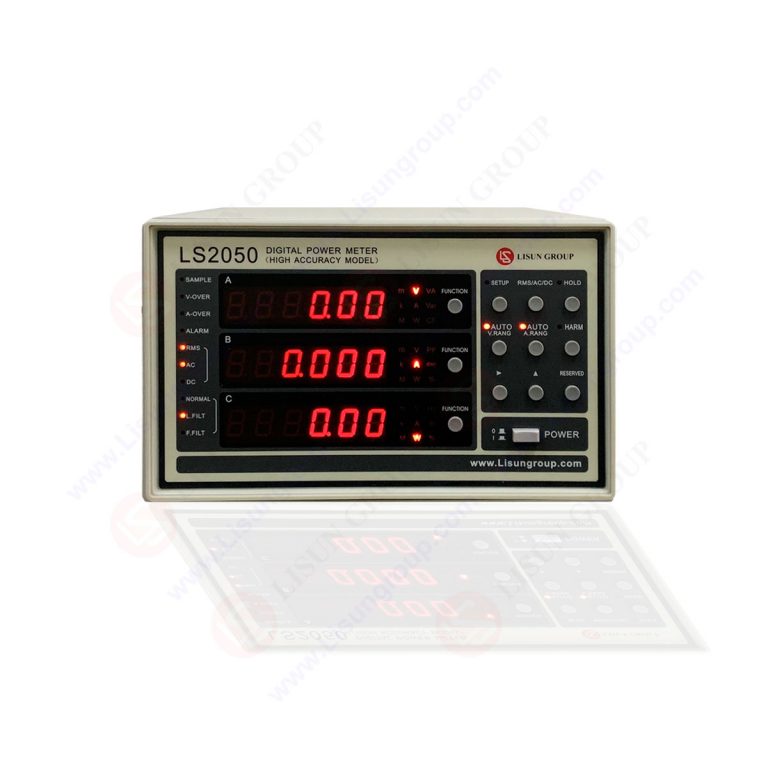
The LS2050B serves as the entry-level precision harmonic analysis instrument in the LISUN power meter family, offering robust measurement capabilities for general laboratory and production testing applications. With voltage and current accuracy of ±0.2% of reading plus 0.1% of range, the LS2050B meets requirements for most quality control and R&D testing scenarios where cost optimization is a consideration. This model supports the full 0-50th order harmonic analysis suite and the complete frequency range of 0.5Hz to 100kHz. For manufacturing teams testing products against internal specifications rather than regulatory harmonic limits, the LS2050B provides a cost-effective solution without sacrificing the core digital sampling technology that ensures measurement integrity. The automatic range switching and overload protection features are identical across all models, ensuring operational safety and convenience regardless of the selected accuracy tier.
6.2 LS2050C High Accuracy Configuration
The LS2050C doubles the measurement accuracy of the standard model, achieving voltage and current accuracy of ±0.1% of reading plus 0.05% of range, with power accuracy of ±0.2% of reading plus 0.1% of range. This enhanced precision is achieved through higher-grade components in the analog front-end, improved temperature compensation, and tighter calibration tolerances. For R&D professionals performing characterization of high-efficiency power converters where small measurement errors can significantly impact efficiency calculations, the LS2050C provides the necessary measurement fidelity. Quality control managers in industries with stringent tolerance requirements, such as medical device manufacturing or aerospace electronics, benefit from the reduced measurement uncertainty inherent in the higher accuracy class. The LS2050C retains all connectivity and analysis features of the standard model, providing a straightforward upgrade path for facilities requiring enhanced measurement capability.
6.3 LS2050C-IEC EMC Harmonic Compliance Configuration
The LS2050C-IEC builds upon the LS2050C high-accuracy platform by incorporating pre-programmed compliance testing sequences for EN/IEC61000-3-2. This model includes built-in limit line profiles for Class A, B, C, and D equipment classifications, automated pass/fail determination based on measured harmonic currents, and reporting templates formatted for inclusion in compliance documentation. For EMC testing laboratories performing certification testing, the LS2050C-IEC streamlines the testing workflow and reduces the potential for operator error in limit line interpretation. The instrument automatically applies appropriate averaging times and measurement intervals as specified by the standard, ensuring test results meet regulatory requirements for repeatability and reproducibility. Manufacturing teams developing products for markets requiring EN/IEC61000-3-2 compliance can use the LS2050C-IEC for pre-certification testing, reducing the risk of failure during formal compliance assessment.
7. Best Practices for Precision Harmonic Analysis Measurements
7.1 Measurement Setup and Calibration
Achieving optimal measurement accuracy with LISUN precision harmonic analysis power meters requires proper setup and adherence to calibration best practices. The instruments should be warmed up for at least 30 minutes before critical measurements to allow internal temperature stabilization. Connecting the power meter in the correct configuration for the measurement application is essential; for most power measurements, the instrument should be wired for direct connection with voltage sensed at the load and current in series with the power source. Regular calibration verification using traceable standards ensures measurement integrity over time. LISUN recommends annual recalibration with adjustment to maintain specified accuracy. Quality control managers should establish calibration schedules based on usage frequency and criticality of measurements, maintaining documentation of calibration status for audit purposes. The RS232 and RS485 communication ports can be used to automate calibration verification procedures.
7.2 Harmonic Measurement Interpretation
Interpreting harmonic analysis results requires understanding of the measurement context and the specific analysis methods employed. The IEC and CSA calculation methods differ in how they handle interharmonic components and signal windowing, which can produce slightly different results for the same measured signal. Electrical testing engineers should verify which method is selected in the instrument setup and apply consistent methodology throughout a testing campaign. When evaluating harmonic compliance per EN/IEC61000-3-2, attention must be paid to the equipment classification, as limit values vary significantly between Class A and Class D equipment. The displacement factor measurement provides additional insight into the reactive power characteristics of the load, helping distinguish between fundamental power factor issues and harmonic distortion problems. R&D teams analyzing power quality problems should examine both individual harmonic magnitudes and the phase relationships between harmonics, as these determine the cumulative effect on system performance.
8. Conclusion
LISUN precision harmonic analysis AC/DC digital power meters provide electrical testing engineers, quality control managers, and EMC testing laboratory professionals with comprehensive measurement capabilities for power quality assessment and compliance verification. The LS2050B, LS2050C, and LS2050C-IEC models offer graduated accuracy levels and compliance-specific features while maintaining consistent core technologies including digital sampling waveform analysis, automatic range switching, and harmonic analysis through the 50th order. The instruments support testing across diverse industry standards including EN/IEC61000-3-2 for harmonic current compliance, LM-79 for solid-state lighting electrical measurements, and IEC 61010 and UL 1989 for operator safety assurance. The wide frequency range of 0.5Hz to 100kHz, AC/DC measurement compatibility, and communication interfaces enable integration into automated test systems across LED manufacturing, automotive electronics, and general power quality analysis applications. By providing separate power factor and displacement factor measurements, comprehensive harmonic spectral data, and model-specific features for compliance testing, LISUN precision harmonic analysis instruments enable informed decision-making in product development, quality assurance, and regulatory compliance activities.
FAQ
Q1: What is the difference between power factor and displacement factor in LISUN power meter measurements?
A: Power factor (PF) represents the ratio of real power (watts) to apparent power (volt-amperes) in an electrical system, accounting for both phase displacement between voltage and current and harmonic distortion effects. Displacement factor (DPF) isolates the cosine of the phase angle between the fundamental voltage and current components only, excluding harmonic contributions. In non-sinusoidal systems typical of modern power electronics, PF and DPF can differ significantly. For example, an LED driver with a high crest factor may exhibit PF of 0.65 while DPF remains near 0.95. LISUN precision harmonic analysis power meters provide both values independently, enabling engineers to diagnose whether power quality issues originate from fundamental phase shift or harmonic distortion, facilitating targeted corrective actions such as power factor correction capacitors (for poor DPF) or harmonic filters (for high THD).
Q2: How does the LS2050C-IEC model support EN/IEC61000-3-2 compliance testing?
A: The LS2050C-IEC integrates pre-programmed test sequences aligned with EN/IEC61000-3-2 requirements for harmonic current emissions from equipment connected to public low-voltage distribution systems. This model includes built-in limit line profiles for all four equipment classifications outlined in the standard: Class A (balanced three-phase equipment, household appliances), Class B (portable tools), Class C (lighting equipment), and Class D (equipment with input current less than 600W and specific waveform characteristics). The instrument automatically applies appropriate measurement bandwidths, averaging times, and observation periods as specified by the standard, producing pass/fail determinations for each harmonic order independently. For EMC testing laboratories, this automation reduces test time by approximately 40% compared to manual limit line comparison and eliminates interpretation errors. The LS2050C-IEC also generates formatted compliance reports suitable for inclusion in technical documentation required for CE marking certification.
Q3: What communication protocols are supported for integrating LISUN power meters into automated test systems?
A: LISUN precision harmonic analysis power meters feature both RS232 and RS485 serial communication interfaces. RS232 supports point-to-point connections up to 15 meters, suitable for benchtop laboratory setups where a single instrument communicates with a PC running data acquisition software. RS485 enables multi-drop configurations supporting up to 32 instruments on a single bus with cable lengths up to 1200 meters, appropriate for production line environments with multiple test stations. Both interfaces support industry-standard command sets for reading instantaneous measurement values, configuring measurement parameters (voltage range, current range, integration time), and controlling test sequences. LISUN provides LabVIEW drivers and software libraries compatible with major programming languages, enabling integration into existing National Instruments, Keysight VEE, or custom Python-based test platforms. For manufacturing execution system integration, the RS485 interface allows centralized data collection from multiple production lines, facilitating statistical process control and real-time quality monitoring.
Q4: How should LISUN power meters be calibrated to maintain specified accuracy?
A: LISUN recommends annual recalibration of precision harmonic analysis power meters to maintain specified accuracy, with more frequent calibration intervals for instruments subjected to heavy use or adverse environmental conditions. Calibration should be performed using traceable standards at a calibration laboratory accredited to ISO/IEC 17025, ensuring measurement results are traceable to national or international standards. The calibration procedure verifies accuracy at multiple points across the voltage and current ranges, at various frequencies within the 45-65Hz baseband where accuracy specifications are tightest, and for power factor conditions including unity, lagging, and leading. For harmonic analysis accuracy verification, calibration includes testing with known harmonic spectra to confirm FFT processing accuracy and harmonic magnitude measurement uncertainty. The instrument stores calibration data internally, and recalibration involves updating these constants through the communication interface. Quality control managers should maintain calibration records including as-found and as-left data, with out-of-tolerance conditions triggering investigation of measurements made since the previous calibration.