









Abstract
In the demanding fields of LED manufacturing, automotive electronics, and EMC compliance testing, the accuracy and reliability of power measurement are non-negotiable. The LS2050 High Accuracy AC and DC Power Meter: Digital Sampling & Automatic Range Switching addresses this critical need by providing laboratory-grade precision for both AC and DC power analysis. This advanced instrument leverages high-speed digital sampling and intelligent range management to deliver comprehensive measurements, including voltage, current, power, power factor, and harmonic distortion up to the 50th order. Its core value lies in enabling rigorous product validation, ensuring compliance with stringent international standards, and optimizing energy efficiency in R&D and quality control applications. For engineers and technicians, it is an indispensable tool for ensuring product performance and regulatory adherence.
1. The Imperative of Precision Power Measurement in Modern Electronics
1.1 Evolving Demands in LED and Automotive Industries
The proliferation of switch-mode power supplies, LED drivers, and automotive power electronics has fundamentally altered the electrical landscape. These devices often draw non-linear currents, generating significant harmonic distortion that can lead to inefficiency, component stress, and electromagnetic interference (EMI). For manufacturers, accurately characterizing this behavior is essential for optimizing design, ensuring longevity, and meeting global energy efficiency and electromagnetic compatibility (EMC) mandates. A precision power meter is no longer a simple volt-amp meter but a critical diagnostic tool for analyzing power quality, harmonic content, and true power consumption under real-world operating conditions.
1.2 The Role of Compliance and Standardization
Global market access is contingent upon compliance with a complex web of international standards. These standards define permissible limits for harmonic emissions, power factor, and safety. Instruments used for verification must themselves be certified and capable of performing tests according to prescribed methodologies. The LS2050 High Accuracy AC and DC Power Meter is engineered to support compliance testing against key standards, providing the traceable, accurate data required for certification reports. Its design and calibration are aligned with the rigorous requirements of testing laboratories.
2. Core Technology: Digital Sampling and Waveform Analysis
2.1 Fundamentals of Digital Sampling for Power Analysis
Unlike traditional analog meters that infer values, the LS2050 series utilizes high-speed analog-to-digital converters (ADCs) to digitally sample voltage and current waveforms simultaneously at a high sampling rate. This raw waveform data is processed in real-time using digital signal processing (DSP) algorithms. This method captures the true shape of the waveform, which is crucial for accurately calculating parameters for non-sinusoidal signals common in modern electronics. It enables the direct computation of true RMS values, instantaneous power, and complex harmonic spectra.
2.2 Comprehensive Parameter Measurement
From the digitized waveforms, the instrument derives a complete set of electrical parameters:
- True RMS Voltage and Current: Accurate for any waveform shape.
- Active Power (W), Apparent Power (VA), Reactive Power (VAR): Essential for load characterization and efficiency calculation.
- Power Factor (PF) and Displacement Factor (DPF): Critical for understanding the phase relationship and distortion components of the load.
- Frequency: With a wide measurement range from 0.5Hz to 100kHz, covering everything from sub-harmonics to high-frequency switching noise.
3. Advanced Capabilities: Harmonic Analysis and Automatic Range Switching
3.1 Harmonic Analysis for Compliance and Diagnostics
A standout feature is its ability to perform harmonic analysis up to the 50th order, following recognized methods such as those in IEC/CSA standards. This capability is directly targeted at compliance with EN/IEC 61000-3-2, which limits harmonic current emissions for equipment. By displaying individual harmonic magnitudes and total harmonic distortion (THD) for both voltage and current, engineers can identify problematic harmonics, redesign filtering circuits, and generate the necessary data for EMC test reports, supporting standards like UL 1989 for LED drivers.
3.2 Intelligent Automatic Range Switching
To maximize accuracy across vastly different signal levels—from a low-power LED module to a high-current automotive component—the LS2050 incorporates intelligent automatic range switching. The instrument continuously monitors the input signals and automatically selects the optimal measurement range. This eliminates manual range selection errors, protects the instrument from minor overloads within its robust design limits (1600V/50A instantaneous), and ensures the highest possible accuracy is maintained for every measurement, a principle aligned with the safety requirements of IEC 61010.
4. Model Variations and Technical Specifications Comparison
4.1 Tailored Solutions for Different Accuracy and Compliance Needs
The LS2050 series is offered in three primary models, each optimized for specific user requirements, from general R&D to accredited compliance testing.
4.2 Comparative Technical Data
The following table outlines the key differentiating specifications between the models:
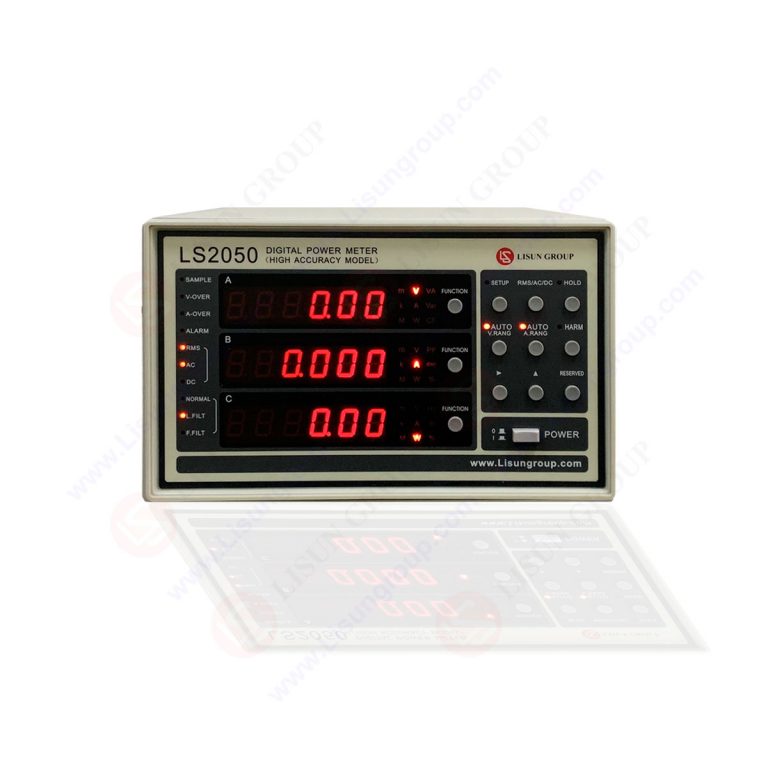
| Feature / Specification | LS2050B (Standard Accuracy) | LS2050C (High Accuracy) | LS2050C-IEC (Harmonic Compliance) |
|---|---|---|---|
| Basic Power Accuracy | ±(0.1% reading + 0.1% range) | ±(0.05% reading + 0.05% range) | ±(0.05% reading + 0.05% range) |
| Harmonic Analysis Method | Standard FFT Analysis | Standard FFT Analysis | IEC/CSA Compliant Method |
| Primary Compliance Focus | R&D, Quality Control, General Testing | High-Precision R&D, Validation | EN/IEC 61000-3-2, LM-79 (Energy Efficiency) |
| Typical Application | Factory floor QC, benchtop verification | Laboratory-grade design validation | EMC test labs, photometric testing per CIE/IEC standards |
| Communication | RS232 / RS485 Standard | RS232 / RS485 Standard | RS232 / RS485 Standard |
5. Target Applications and Industry-Specific Workflows
5.1 LED Manufacturing and Photometric Testing
In LED lighting, the relationship between electrical input and light output is paramount. The LS2050C-IEC model is particularly suited for LM-79 testing, which requires precise electrical measurements (AC input power, voltage, current, power factor) alongside photometric data to calculate luminous efficacy (lumens per watt). Its high accuracy ensures reliable efficacy ratings, while harmonic analysis helps designers meet mandatory harmonic emission limits for global markets.
5.2 Automotive Electronics Validation
Automotive components must operate reliably under extreme electrical conditions. Engineers use the LS2050 to measure the inrush current, standby power, efficiency, and harmonic characteristics of devices like DC-DC converters, infotainment systems, and LED lighting assemblies. The wide frequency range and DC measurement capability are essential for testing both 12V/24V DC systems and AC components, supporting robust design validation.
5.3 EMC Compliance Testing Labs
For labs performing conducted emissions testing per EN/IEC 61000-3-2, the LS2050C-IEC serves as a dedicated harmonic analyzer. It provides the classified measurement data (harmonic currents relative to limits) needed for formal test reports. Its certified methodology and communication ports allow for seamless integration into automated test suites, improving lab throughput and data integrity.
6. Integration and Data Management Features
6.1 Communication and Remote Control
Equipped with both RS232 and RS485 ports, the LS2050 can be integrated into automated test systems. This allows for remote control of all functions, continuous data logging, and synchronization with other test equipment (e.g., oscilloscopes, environmental chambers). This is vital for endurance testing, production line end-of-line tests, and complex multi-instrument setups in R&D.
6.2 Robustness and Safety Design
Built for professional environments, the meter features high overload capacity, protecting it from transient spikes. Its design and construction comply with the safety requirements of IEC 61010 for electrical equipment for measurement, control, and laboratory use, ensuring operator safety when connected to potentially hazardous circuits.
7. The Value Proposition for Engineering Teams
7.1 Enhancing Product Quality and Reliability
By providing deep insight into power consumption characteristics, engineering teams can identify design flaws early, optimize for efficiency, and reduce the risk of field failures. Accurate power measurement directly correlates with predicting thermal performance and component stress.
7.2 Accelerating Time-to-Market and Certification
Having a compliant, accurate instrument in-house allows for pre-compliance testing during the design phase. This identifies potential harmonic or power factor issues long before final submission to an external lab, preventing costly redesign cycles and accelerating the overall certification timeline.
8. Conclusion
The LS2050 High Accuracy AC and DC Power Meter represents a sophisticated convergence of digital measurement technology and practical application needs. Its foundation in high-speed digital sampling and waveform analysis provides the fidelity required to characterize modern, non-linear electronic loads accurately. The critical differentiation through model variations—particularly the LS2050C-IEC with its standards-compliant harmonic analysis—ensures that users from R&D engineers to compliance lab technicians have a tool precisely matched to their task. By integrating automatic range switching, robust communication capabilities, and a design aligned with international safety and performance standards, it delivers reliable, traceable data. For professionals in LED manufacturing, automotive electronics, and EMC testing, deploying the LS2050 is a strategic decision that enhances product quality, ensures regulatory compliance, and ultimately safeguards brand reputation in a competitive global marketplace.
FAQ (Frequently Asked Questions)
Q1: What is the primary difference between the LS2050C and the LS2050C-IEC model for harmonic testing?
A: The core difference lies in the harmonic analysis methodology. While both models can analyze harmonics up to the 50th order, the LS2050C uses a standard FFT (Fast Fourier Transform) analysis suitable for general design and diagnostic purposes. The LS2050C-IEC implements a specific, certified algorithm that strictly adheres to the measurement requirements outlined in standards like EN/IEC 61000-3-2. This includes specific sampling, windowing, and grouping rules mandated for formal compliance testing. For generating legally acceptable data for EMC certification reports, the LS2050C-IEC is the required instrument.
Q2: Can the LS2050 meter measure the power quality of both AC and DC inputs, and why is this important?
A: Yes, the LS2050 is specifically designed as a true AC/DC power meter. It accurately measures DC voltage, current, and power, as well as all AC parameters. This dual capability is crucial for industries like automotive electronics, where systems use both DC (battery, converters) and AC (motor drives, charging systems) power. It allows engineers to use a single instrument to validate the efficiency of a DC-DC converter, measure the input power to an AC inverter, and analyze the harmonic content on the AC mains side, streamlining the validation workflow for complex hybrid systems.
Q3: How does automatic range switching benefit us in a production line testing environment?
A: In a production line setting, speed, reliability, and elimination of operator error are paramount. Automatic range switching ensures that every unit under test (UUT), which may have slightly different operating points, is measured using the instrument’s optimal range for maximum accuracy. It removes the need for technicians to manually configure ranges, speeding up the test process. Furthermore, it protects the meter by preventing it from being left on a sensitive range when a high-current device is connected, leveraging its high overload capacity to handle unexpected transients without damage or invalid readings.