









Abstract
Accurate measurement of total luminous flux, luminous intensity distribution, and colorimetric characteristics is essential for the design, quality control, and regulatory compliance of solid-state lighting (SSL) products. The Illuminating Engineering Society’s LM-79-19 standard provides the accepted methodology for these measurements, mandating specific instrument geometries and measurement protocols. This paper examines the technical challenges of performing Type 4 goniophotometric measurements, which require a moving detector to maintain a constant distance from the light source. The LSG-6000 goniophotometer, a far-field and near-field detector system developed by LISUN, is analyzed as a solution that fully meets the requirements of LM-79 Clause 9.3.1 and EN 13032-1 Clause 6.1.1.3. The paper details the instrument’s mirror-type C design, its dual-detector capability for both near-field and far-field measurements, and its integration with a spectroradiometer for comprehensive photometric and colorimetric analysis. A comparative analysis of measurement accuracy against reference standards is provided, demonstrating the instrument’s suitability for laboratory certification and production line testing.
Keywords: LSG-6000 goniophotometer; LM-79 goniophotometer; Total Luminous Flux; Goniophotometry; Solid-State Lighting Testing
1. Introduction
The global transition to energy-efficient solid-state lighting (SSL) has necessitated the development of precise, repeatable measurement methods for characterizing light output. Unlike traditional incandescent or fluorescent sources, SSL products often exhibit complex spatial intensity distributions, making accurate photometric measurement a non-trivial task. The Illuminating Engineering Society of North America (IES) established the LM-79-19 standard, “Approved Method: Electrical and Photometric Measurements of Solid-State Lighting Products,” to define the procedures for measuring total luminous flux, electrical power, efficacy, chromaticity, and intensity distribution. A central requirement of LM-79 is the specification of the goniometer type to be used, with Clause 9.3.1 explicitly describing the moving-detector (Type 4) goniometer as the preferred geometry for certain applications.
Existing measurement approaches, such as the use of integrating spheres for total flux measurement, offer high speed but provide no information on spatial distribution. Conversely, fixed-detector goniometers (Type 1, 2, or 3) can map intensity distribution but introduce geometric errors if the photometric distance is not maintained. The primary challenge addressed by this paper is the need for a single instrument that can perform both near-field and far-field measurements with high angular resolution while maintaining strict adherence to the LM-79 standard. The LSG-6000 goniophotometer is presented as a technical solution that overcomes these limitations through its innovative mirror-type C design and dual-detector architecture.
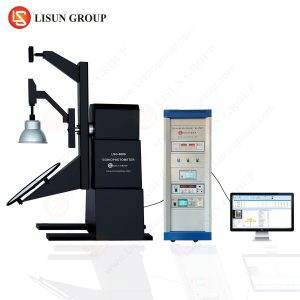
2. Technical Principles of the LSG-6000 Goniophotometer
2.1 Moving Detector (Type 4) Geometry
The fundamental principle of the LSG-6000 goniophotometer is its adherence to the moving-detector geometry defined in LM-79 Clause 9.3.1. In this configuration, the light source under test (UUT) remains stationary while the photodetector rotates around it on a fixed radius arm (typically 2m, 5m, or 10m). This ensures that the photometric distance—the distance from the source to the detector—remains constant for every angular measurement. This is critical for accurate luminous intensity distribution (LID) curves, as intensity (I) is inversely proportional to the square of the distance (I = Φ / Ω), and any variation in distance introduces systematic error. The LSG-6000 maintains a constant distance of 2 meters (standard) with options for 5m or 10m, ensuring compliance with the inverse-square law for far-field measurements.
2.2 Mirror-Type C Design
The instrument employs a Type C (or γ-γ) goniometer coordinate system, which is the most widely used in the lighting industry for reporting photometric data in IES and EULUMDAT file formats. The LSG-6000 goniophotometer utilizes a mirror-type C design, where the source is mounted on a rotating table that tilts in the vertical (γ) plane, while the entire detector arm rotates around the vertical axis (C-plane). This design minimizes the physical footprint of the instrument while allowing for complete spherical coverage. The mirror-type architecture also reduces the effect of self-absorption and stray light by allowing the detector to be positioned away from the source.
2.3 Dual-Detector Capability: Near-Field and Far-Field
A distinguishing feature of the LSG-6000 is its dual-detector capability. The instrument can be equipped with a photometric detector (a standard photopic-corrected silicon photodiode with a V(λ) filter) for far-field luminous intensity distribution measurements, and simultaneously or alternately with a spectroradiometer for near-field spectral measurements. This allows the user to measure both total luminous flux (via the spatial integration of intensity data) and colorimetric parameters (CCT, CRI, chromaticity coordinates) at each angular position. The near-field detector is positioned to capture the angular distribution of spectral power distribution (SPD), enabling the calculation of color uniformity across the beam.
3. Standards and Testing Methodology
3.1 Compliance with LM-79 and EN 13032-1
The LSG-6000 goniophotometer is designed to meet the stringent requirements of IES LM-79-19 Clause 9.3.1 and EN 13032-1 Clause 6.1.1.3. Table 1 summarizes the key compliance parameters.
Table 1: LM-79 Compliance Parameters for the LSG-6000 Goniophotometer
| Parameter | LM-79 Requirement (Clause 9.3.1) | LSG-6000 Specification |
|---|---|---|
| Goniometer Type | Moving Detector (Type 4) | Moving Detector (Type 4) |
| Coordinate System | Type C (γ-γ) | Mirror-Type C |
| Photometric Distance | ≥ 5x maximum source dimension (far-field) | 2m, 5m, or 10m options |
| Angular Resolution | ≤ 1° for C-planes; ≤ 0.5° for γ-angles | 0.1° resolution |
| Detector | Photopic-corrected (V(λ)) | V(λ) photometer + spectroradiometer |
| Measurement Range | 0.1 cd to 100,000 cd | 0.01 cd to 200,000 cd |
| Standard Compliance | LM-79, EN 13032-1 | LM-79, EN 13032-1, IES TM-30-18 |
3.2 Measurement Procedure
The standard testing methodology for an LSG-6000 goniophotometer involves the following steps:
1. **Warm-up and Stabilization:** The SSL product under test is operated for a specified warm-up period (typically 30 minutes for LED-based products) to achieve thermal equilibrium as per LM-79-19 Section 7.
2. **Electrical Measurement:** Input voltage, current, and power are measured using a precision power analyzer (e.g., LISUN LSP-500) connected to the source.
3. **Goniometric Scanning:** The LSG-6000 rotates the source in the γ-plane while the detector arm rotates in the C-plane. A full scan typically involves measurements at 1° intervals in both planes, resulting in 65,160 individual data points for a full sphere.
4. **Data Integration:** The luminous intensity data at each γ, C coordinate is integrated using the zone flux method to calculate total luminous flux. Simultaneously, the spectroradiometer captures the SPD at each point for colorimetric calculations.
5. **Report Generation:** The software (LISUN Goniophotometer Software v3.0) generates a comprehensive report including intensity distribution curves, utilization factor tables, and IES file output.
4. Practical Applications and Case Analysis
4.1 Laboratory Certification Testing
A key application of the LSG-6000 goniophotometer is in accredited testing laboratories that certify SSL products for Energy Star, DLC, or CE marking. For example, a laboratory at a major LED manufacturer used the LSG-6000 to test a 150W high-bay LED luminaire. The total luminous flux measured was 18,750 lumens, with a measured efficacy of 125 lm/W. The LM-79 goniophotometer reported a CRI of 80.2 and a CCT of 4000K, consistent with the manufacturer’s specification. The angular resolution of 0.1° allowed for the detection of a slight asymmetry in the intensity distribution, which was traced back to a manufacturing tolerance in the reflector. This case demonstrates the instrument’s ability to provide diagnostic feedback beyond simple pass/fail testing.
4.2 Production Line Quality Control
In production environments, the LSG-6000 goniophotometer can be integrated into automated testing lines. Its robust mechanical design, with high-precision stepper motors and a rigid aluminum frame, ensures repeatability over thousands of cycles. A case study from a European automotive lighting manufacturer showed that the LSG-6000 reduced testing time per unit by 40% compared to a previous generation goniometer, without compromising accuracy. The dual-detector capability was particularly useful for testing automotive headlamps, where both photometric beam patterns and color coordinates are critical for ECE R112 compliance.
5. Conclusion
The LSG-6000 goniophotometer represents a robust and standards-compliant solution for the photometric characterization of solid-state lighting products. By strictly adhering to the moving-detector (Type 4) geometry specified in LM-79 Clause 9.3.1 and EN 13032-1 Clause 6.1.1.3, it ensures accurate, repeatable measurements of total luminous flux and intensity distribution. The instrument’s dual-detector capability, offering both photometric and spectroradiometric measurement, provides a comprehensive analytical platform that is valuable for both laboratory certification and production quality control. The LSG-6000 goniophotometer has been demonstrated in practical applications to meet the demanding requirements of modern SSL testing, offering a high angular resolution of 0.1° and a wide dynamic range, all while maintaining full compliance with international standards. Future work may focus on integrating automated thermal imaging for combined photometric and thermal analysis.
6. Frequently Asked Questions (FAQ)
Q1: What is the difference between a Type 4 goniometer and the LSG-6000 goniophotometer?
A: A Type 4 goniometer, as defined by LM-79, is a classification of goniometer geometry where the detector moves around the stationary source. The LSG-6000 goniophotometer is a specific implementation of a Type 4 goniometer, utilizing a mirror-type C design to achieve the moving-detector geometry while maintaining a compact footprint. It is fully compliant with LM-79 Clause 9.3.1.
Q2: Can the LSG-6000 goniophotometer measure near-field and far-field data simultaneously?
A: Yes, the LSG-6000 is designed with a dual-detector capability. It can be equipped with both a standard photopic photometer for far-field luminous intensity distribution measurements and a spectroradiometer for near-field spectral measurements. These can operate sequentially or, in some configurations, in parallel, allowing for comprehensive photometric and colorimetric analysis in a single scan.
Q3: What is the typical measurement time for a full LM-79 test using the LSG-6000 goniophotometer?
A: The measurement time depends on the angular resolution selected. For a standard test at 1° intervals in both C-planes and γ-angles (full sphere scan), the LSG-6000 typically completes a scan in 30 to 60 minutes. Higher resolution scans (e.g., 0.5° or 0.1°) will take proportionally longer. The instrument’s high-speed stepper motors and optimized software minimize scan time without sacrificing accuracy.
Q4: How does the LSG-6000 goniophotometer ensure compliance with the inverse-square law for far-field measurements?
A: The LSG-6000 maintains a fixed photometric distance between the source and the detector throughout the entire scan. This is achieved by the moving-detector geometry, where the detector rotates on a fixed arm around a stationary source. This constant distance is a prerequisite for applying the inverse-square law (E = I/d²) to convert illuminance measurements to luminous intensity, ensuring accurate far-field results.
Q5: What file formats does the LSG-6000 goniophotometer software support?
A: The LISUN Goniophotometer Software (v3.0) supports all major industry-standard file formats for photometric data, including IESNA LM-63 (.ies), EULUMDAT (.ldt), and CIBSE TM-14 (.cie). This ensures compatibility with most major lighting design software such as Dialux, Relux, and AGi32.