









Abstract
The LISUN SW Series Power Cord Flexibility Bending Tester represents a precision-engineered solution for validating power cord reliability in compliance with IEC 60335-1 and related international standards. This PLC-controlled power cord bending tester integrates servo motor drive technology with current-based test judgment to simulate real-world cable fatigue conditions. Designed for household appliance manufacturers, hand-held tool producers, and plug/socket component suppliers, the SW Series offers single, dual, and six-station configurations. The system automates bending cycles while monitoring load current continuity, enabling objective pass/fail determination. This article examines the technical architecture, standard compliance parameters, operational workflows, and comparative performance characteristics of this cable flexibility testing equipment for technical professionals seeking robust cord reliability validation devices.
1.1 Core Control and Drive Components
The LISUN SW Series power cord bending tester employs a programmable logic controller (PLC) as its central processing unit, coordinating all test sequences with deterministic timing accuracy. The PLC interfaces directly with a servo motor drive system that provides precise angular positioning and consistent bending rates. Unlike pneumatic or mechanical cam-driven alternatives, servo motor control enables programmable bending angles ranging from 45 to 180 degrees with ±1 degree positional accuracy. The PLC architecture supports real-time data acquisition from multiple sensors, including current monitoring transducers, position encoders, and cycle counters. This integration allows the cord reliability validation device to execute complex test profiles that simulate varying usage conditions without manual intervention.
1.2 Current-Based Test Judgment Methodology
A distinguishing feature of this power cord bending tester is its continuous load current monitoring system. During each bending cycle, the tester applies a specified test current through the cord conductors while simultaneously measuring voltage drop and current continuity. The PLC compares these measurements against predefined threshold values stored in the test program. When conductor breakage, intermittent contact, or insulation degradation occurs, the system detects characteristic changes in the electrical parameters and triggers an automatic stop function. This methodology eliminates subjective visual inspection and provides quantitative data on failure modes. The current-based judgment system operates according to the principles outlined in IEC 60884-1 Clause 23, which specifies electrical continuity requirements during mechanical endurance testing.
1.3 Multi-Station Synchronization Architecture
For the SW-2 and SW-6 configurations, the PLC manages synchronized or independently programmable test stations. Each station contains its own servo motor, load circuit, and current monitoring module. The master PLC coordinates station operation through a distributed control network, allowing simultaneous testing of multiple cord samples under identical or varying test parameters. This parallel processing capability significantly reduces overall test time for production quality assurance applications. Station-to-station variation remains below 2% in bending angle and cycle rate, ensuring consistent test conditions across all samples.
2.1 Standard Requirements for Power Cord Bending Tests
IEC 60335-1, the international standard for household electrical appliance safety, specifies power cord bending tests in Clause 25.14. This clause requires that flexible cords withstand a specified number of bending cycles without conductor breakage or significant insulation damage. The test parameters include bending angle (typically 90 degrees), bending rate (10 to 30 cycles per minute), and load current (1.0 to 1.5 times rated current). The SW Series power cord bending tester fully satisfies these requirements with programmable ranges exceeding standard minimums: bending angles from 0 to 180 degrees, rates from 5 to 60 cycles per minute, and load currents up to 25 amperes. Additionally, the system complies with IEC 60884-1 Clause 23 for plug and socket-outlet cord anchorages, IEC 60745-1 Clause 24 for hand-held motor-operated tools, and GB/T 2099.1 for Chinese market compliance.
2.2 Test Parameter Configuration for Standard Compliance
Configuring the PLC-controlled bending tester for specific standard requirements involves setting parameters through the touchscreen HMI. For IEC 60335-1 compliance, operators select the predefined test profile that automatically configures 90-degree bending angle, 30 cycles per minute rate, and 1.1x rated load current. The system stores up to 100 user-defined profiles, enabling rapid switching between different product standards. Critical parameters include:
- Bending angle tolerance: ±2 degrees from setpoint
- Cycle rate stability: ±0.5 cycles per minute over 24-hour continuous operation
- Load current accuracy: ±1% of setpoint value
- Failure detection response time: less than 10 milliseconds
These specifications exceed the measurement accuracy requirements specified in IEC 60335-1 Annex A for type testing equipment.
2.3 Documentation and Traceability Features
The SW Series generates comprehensive test reports that include all configured parameters, cycle count at failure, failure type classification, and timestamp data. This documentation satisfies the traceability requirements of ISO/IEC 17025 for testing laboratories. The PLC logs each test event with millisecond resolution, providing an auditable record suitable for certification body review. Data export via USB or Ethernet interface enables integration with laboratory information management systems.
3.1 Technical Specifications Table
The following table compares the three SW Series models against relevant industry standard minimum requirements:
| Parameter | SW-1 Single Station | SW-2 Dual Station | SW-6 Six Station | IEC 60884-1 Minimum Requirement |
|---|---|---|---|---|
| Number of Test Stations | 1 | 2 | 6 | N/A (single sample per test) |
| Bending Angle Range | 0-180° | 0-180° | 0-180° | 90° ±5° |
| Bending Rate Range | 5-60 cycles/min | 5-60 cycles/min | 5-60 cycles/min | 10-30 cycles/min |
| Load Current Range | 0.5-25 A | 0.5-25 A | 0.5-25 A | 1.0-1.5x rated current |
| Maximum Bending Cycles | 999,999 | 999,999 | 999,999 | 10,000-50,000 (varies by product) |
| Servo Motor Power | 200 W | 400 W | 1.2 kW | N/A |
| Power Supply | 220 VAC 50/60 Hz | 220 VAC 50/60 Hz | 380 VAC 50/60 Hz | N/A |
| Failure Detection Method | Current monitoring | Current monitoring | Current monitoring | Visual or continuity check |
| Automatic Stop Function | Yes | Yes | Yes | Recommended but not mandatory |
3.2 Model Selection Criteria
For research and development laboratories conducting type testing on single prototypes, the SW-1 provides adequate capacity with lower capital investment. Production quality control environments benefit from the SW-2 configuration, enabling side-by-side testing of control and experimental samples under identical conditions. High-volume testing facilities, such as third-party certification laboratories, should select the SW-6 for maximum throughput. The six-station configuration can complete 30,000-cycle endurance tests on six samples simultaneously in approximately 16.7 hours at 30 cycles per minute, compared to 100 hours for sequential single-station testing.
4.1 Test Setup Procedure
The PLC-controlled power cord bending tester streamlines test setup through a five-step procedure accessible via the 7-inch color touchscreen. First, operators select the product standard from a dropdown menu, which automatically populates default parameters. Second, cord samples are clamped into the bending fixture arms with adjustable tensioning to prevent slippage without damaging insulation. Third, load current connections are established through quick-connect terminals that accommodate wire gauges from 18 AWG to 10 AWG. Fourth, the operator initiates a pre-test calibration cycle that verifies angle accuracy and current continuity. Fifth, the test program is started, and the PLC executes the complete test sequence without further human intervention.
4.2 Real-Time Monitoring and Data Logging
During operation, the HMI displays real-time data including elapsed test time, current cycle number, instantaneous load current per station, and cumulative passes or failures. The PLC records these parameters at user-selectable intervals ranging from 1 second to 60 seconds. When a station detects failure, the display highlights the affected channel, pauses that station independently, and records the failure cycle count. This partial-stop capability allows other stations to continue testing, maximizing operational efficiency. Historical test data is stored in non-volatile memory capable of retaining results from over 10,000 individual tests.
4.3 Calibration and Maintenance Workflow
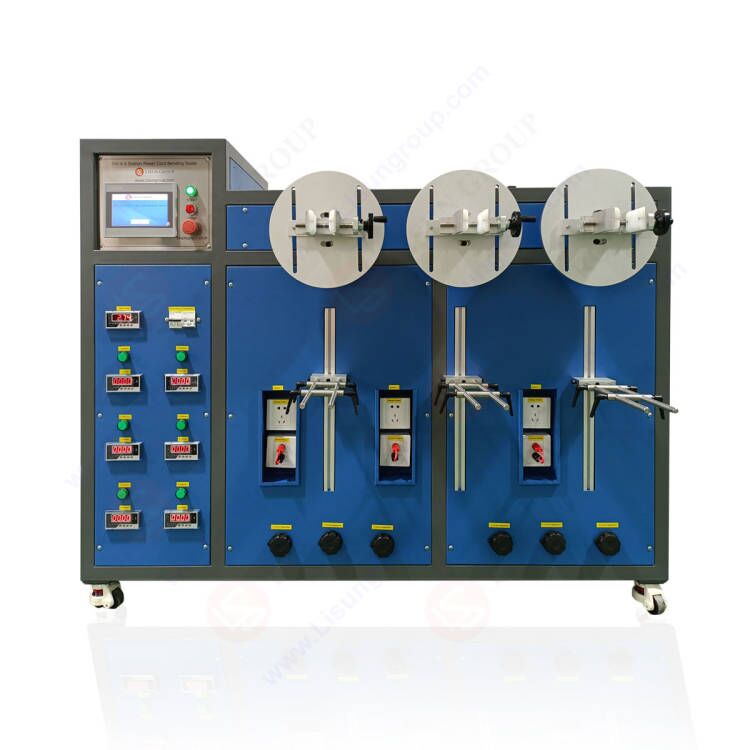
The SW Series supports field calibration using traceable reference standards. Angle calibration involves attaching a digital protractor to the bending arm and adjusting the servo motor offset in the PLC software. Current calibration uses a precision shunt resistor and multimeter to verify the current monitoring circuit. The system prompts scheduled maintenance at intervals defined by the user, typically every 500,000 cycles for mechanical lubrication and electrical contact inspection. This proactive maintenance approach extends the service life of the cord reliability validation device beyond 5 million total operating cycles.
5.1 Household Appliance Manufacturing
Refrigerator, washing machine, and vacuum cleaner manufacturers utilize the power cord bending tester to validate cord durability at the cord-entry point, a common failure location identified in field returns. The test reproduces the bending stresses that occur during normal appliance movement and cleaning. For example, a vacuum cleaner cord typically undergoes 10,000 to 20,000 bending cycles during its expected service life, and manufacturers test to 30,000 cycles with a 50% safety margin. The current-based failure detection identifies intermittent conductor breaks that might not cause immediate failure but could lead to arcing hazards over time, directly addressing IEC 60335-1 Clause 25.14 requirements.
5.2 Hand-Held Electric Tool Production
Angle grinders, drills, and circular saws experience severe cord bending near the tool body during operation. The SW Series tester simulates these conditions with adjustable bending angles up to 180 degrees to accommodate the extreme flexing that occurs during tool manipulation. Tool manufacturers configure the bending rate to match typical usage patterns, often 20-30 cycles per minute representing the frequency of cord repositioning during continuous use. The multi-station capability enables simultaneous testing of cords from different production batches or suppliers, accelerating supplier qualification processes.
5.3 Plug and Socket Component Validation
Plug manufacturers test cord anchorage performance by securing the plug body in the bending fixture and applying cyclic loads to the cord exiting the plug. This test validates the strain relief mechanism and conductor termination within the plug body. The SW-6 configuration allows testing of six different plug designs or six samples from a single production run, providing statistically significant data on manufacturing consistency. Test results inform design modifications to strain relief geometry and material selection, reducing field failure rates for power cord assemblies.
6.1 Programmable Test Profiles
The PLC control system supports conditional test profiles that change parameters based on cycle count thresholds. For example, a test might begin with 90-degree bending at 30 cycles per minute for 10,000 cycles, then automatically increase to 120-degree bending at 20 cycles per minute for an additional 5,000 cycles. This multi-phase testing simulates the progressive deterioration of cord materials and identifies failure modes that single-parameter testing might miss. The profile editor allows up to 10 sequential phases with independent angle, rate, load current, and cycle count settings.
6.2 Environmental Integration Options
For comprehensive cord reliability validation, the SW Series can interface with environmental chambers to perform combined temperature and mechanical stress testing. The PLC controls temperature setpoints and ramp rates through analog output signals, while monitoring chamber conditions through sensor inputs. This integration enables testing at elevated temperatures up to 85 degrees Celsius, simulating conditions inside enclosed appliance compartments. The system records temperature data alongside mechanical and electrical parameters, providing a complete stress profile for failure analysis.
6.3 Remote Monitoring and Control
Ethernet connectivity enables remote supervision of test operations through standard web browsers or SCADA systems. Engineers can monitor real-time test status, receive email alerts on test completion or failure events, and access historical data from any network-connected device. This capability is particularly valuable for third-party testing laboratories that manage multiple test stations across different test rooms or facilities. The remote interface mirrors the local HMI functionality, allowing parameter adjustments and test initiation as needed.
7.1 Built-In Self-Test and Diagnostics
The SW Series incorporates power-on self-test routines that verify PLC functionality, servo motor communication, current sensor calibration, and emergency stop circuit integrity. Diagnostic screens display system status for each component, enabling rapid troubleshooting when issues arise. The system logs all diagnostic events with timestamps, aiding in preventive maintenance scheduling. If a component fails self-test, the PLC prevents test initiation and displays a fault code that references the user manual troubleshooting section.
7.2 Data Security and Validation
Test results are stored with cryptographic checksums that detect any data corruption during storage or retrieval. The system prevents manual modification of test records, ensuring data integrity for audit purposes. When test data is exported via USB, the file format includes hash values that can be verified by laboratory information management systems. This security architecture satisfies the data integrity requirements of regulated industries and certification bodies.
7.3 Repeatability and Reproducibility Studies
The SW Series supports automated repeatability testing protocols that run the same test program multiple times and calculate statistical variation. Operators can configure the system to perform five repeatability runs automatically, with the PLC calculating mean, standard deviation, and coefficient of variation for key parameters. This data supports measurement system analysis as required by ISO/IEC 17025 and Six Sigma quality programs. Typical repeatability for failure cycle count across ten identical samples is within ±5%, demonstrating the consistency of this cable flexibility testing equipment.
The LISUN SW Series PLC-controlled power cord bending tester delivers comprehensive capabilities for validating power cord reliability in accordance with IEC 60335-1 and related international standards. The integration of servo motor drive technology, real-time current monitoring, and programmable logic control provides precise, repeatable test conditions essential for objective failure analysis. With three model configurations offering one, two, or six test stations, the system accommodates diverse testing volumes from research and development prototypes to production quality assurance batches. The current-based failure detection methodology eliminates subjective visual inspection and provides quantitative data that engineers can use for design optimization and supplier qualification. Standard compliance across IEC 60884-1, IEC 60745-1, and GB/T 2099.1 ensures the system serves international markets without modification. For technical professionals seeking a robust cord reliability validation device, the SW Series offers the accuracy, flexibility, and data integrity required for rigorous type testing and routine quality control. The combination of multi-station efficiency, programmable test profiles, and remote monitoring capabilities positions this cable flexibility testing equipment as a valuable asset for any organization committed to product safety and compliance.
Q1: How does the current-based failure detection differ from visual inspection methods in power cord bending testers?
A: Current-based failure detection continuously monitors electrical continuity through the cord conductors during each bending cycle. The PLC-controlled power cord bending tester applies a specified load current and measures voltage drop across the cord. When conductor fatigue produces intermittent contact or complete breaks, the current waveform changes instantaneously, and the system detects this transition within 10 milliseconds. This method captures failures that may be invisible to the naked eye, such as partial conductor fractures that still conduct current under static conditions but fail under dynamic bending. Visual inspection typically identifies only complete insulation breaks or visible conductor exposure. The quantitative approach of current monitoring provides objective pass/fail criteria aligned with IEC 60335-1 Clause 25.14 requirements, eliminating human judgment variation between operators and improving test reproducibility across different laboratories.
Q2: What are the maintenance requirements for the LISUN SW Series bending tester to ensure ongoing IEC standard compliance?
A: The cable flexibility testing equipment requires two maintenance levels. Daily maintenance involves inspecting cord clamping fixtures for wear and cleaning current contact terminals using isopropyl alcohol to ensure low-resistance connections. Weekly maintenance includes verifying bending angle accuracy using a digital protractor and recalibrating if deviation exceeds ±1 degree from setpoint. After every 500,000 bending cycles, the servo motor bearings require lubrication with specified high-temperature grease, and the linear guide rails need inspection for wear. The PLC software stores calibration dates and prompts these activities automatically. Annual calibration performed by an accredited service provider verifies all electrical and mechanical parameters against traceable standards. Maintaining this schedule ensures the power cord bending tester continues to produce results within the ±2% accuracy required for IEC compliance testing and supports ISO/IEC 17025 accreditation for laboratory operations.
Q3: Can the SW Series power cord bending tester accommodate non-standard cord geometries, such as flat cables with foil shielding?
A: Yes, the cord reliability validation device accepts various cable configurations through adjustable clamping fixtures. Flat cables require custom jaw inserts that distribute clamping force evenly across the cable width without crushing the foil shielding. The standard fixture accommodates cable diameters from 4 mm to 15 mm, but the manufacturer provides specialized inserts for flat cables up to 25 mm width. The current monitoring system automatically compensates for the lower resistance of foil-shielded conductors by adjusting the failure threshold sensitivity. For cables with integral strain relief boots, the fixture height adjusts to position the bending fulcrum at the boot exit point as specified in IEC 60884-1 Clause 23. Operators should consult the application engineering team when testing non-standard cables to ensure fixture compatibility and correct parameter configuration for accurate test results.