









Abstract
The LISUN SW Series Power Cord Flexibility Bending Tester represents a critical advancement in mechanical endurance validation for power supply cords, specifically engineered to meet UL 817 and IEC 60884-1 compliance requirements. This article provides a detailed technical examination of the SW-1, SW-2, and SW-6 models, focusing on their PLC-controlled servo drive systems, current-based failure detection mechanisms, and multi-station parallel testing capabilities. For R&D and quality control engineers in household appliance manufacturing, hand-held power tool production, and plug/socket component industries, understanding the operational parameters, calibration procedures, and standard-specific test configurations of this power cord flexibility tester is essential for achieving repeatable, certifiable results. The analysis covers technical specifications, compliance pathways, and practical implementation strategies for robust cord reliability validation.
1.1 Mechanical Endurance Principles in Cord Reliability Validation
The power cord flexibility tester operates on the fundamental principle of accelerated mechanical fatigue simulation. During normal product lifecycle, power cords undergo repeated bending, twisting, and flexing at connection points, particularly near strain reliefs and plug terminations. The bending cycle frequency, deflection angle, and applied load current are critical parameters that determine test severity. UL 817 clause 57 specifies that cord assemblies must withstand 2,500 bending cycles at a rate of 10 cycles per minute with a specified load current, while IEC 60884-1 clause 23.4 requires 10,000 cycles for detachable cord sets. These requirements establish the baseline performance envelope for the SW series equipment.
1.2 Failure Mechanisms Detected Through Flexibility Testing
The primary failure mechanisms identified through power cord bending tests include conductor strand fracture, insulation degradation, and intermittent contact resistance increases. When conductors experience repeated flexural stress, work hardening occurs at stress concentration points, leading to micro-crack initiation and propagation. The LISUN SW series employs real-time current monitoring to detect these failures—any interruption or fluctuation in the load current triggers automatic test termination and station alarm indication. This current-based judgment method provides objective, quantitative pass/fail criteria that correlate directly with field reliability performance.
2.1 PLC Control and Servo Drive Integration
The SW series power cord bending tester utilizes a Programmable Logic Controller (PLC) as the central processing unit, coordinating all test sequences, parameter management, and safety interlocks. The servo motor drive system provides precise angular positioning and consistent bending speed control, maintaining ±1° angular accuracy across the entire test duration. This closed-loop control architecture ensures that each bending cycle applies identical mechanical stress to the specimen, eliminating variability between test runs. The PLC also manages the counting system, displaying cumulative cycles on the human-machine interface while continuously comparing against preset test limits.
2.2 Multi-Station Parallel Testing Capabilities
The modular design philosophy of the SW series enables scalable testing throughput. The SW-1 configuration provides a single test station for low-volume validation or calibration purposes, while the SW-2 dual-station version doubles productivity for medium-sized quality assurance programs. The SW-6 six-station model represents the highest throughput configuration, allowing simultaneous testing of six independent specimens under potentially different test conditions. Each station features independent load current control and failure detection circuitry, preventing cross-interference between concurrently running tests. This parallel architecture significantly reduces total test time for batch certification programs.
3.1 UL 817 Mechanical Endurance Specifications
UL 817 establishes comprehensive requirements for cord sets and power supply cords, with specific mechanical endurance clauses governing flexibility testing. The standard mandates a bending angle of 90 degrees (45 degrees each side of vertical) at a bending rate specified by the cord diameter and construction. The test apparatus must apply a tensile load to the free end of the cord, typically 0.5 kg or as specified in the product standard, while maintaining the load current at rated value or 75% of rated current for cords rated above 10A. The LISUN SW series accommodates these parameters through adjustable bending angle settings (10-90°) and variable load current ranges (0.1-30A), ensuring full alignment with UL 817 requirements.
3.2 Cross-Standard Compliance for Global Market Access
Beyond UL 817, the power cord flexibility tester supports compliance with multiple international standards, enabling manufacturers to serve diverse global markets with a single validation platform. IEC 60884-1 clause 23.4 governs flexibility testing for plugs and sockets, specifying 10,000 bending cycles at 10 cycles per minute with a 90° deflection angle for cord anchorages. IEC 60745-1 clause 25.9 addresses hand-held electric tools, requiring 20,000 cycles for cords with nominal cross-sectional areas up to 1.5mm². GB/T 2099.1, the Chinese national standard harmonized with IEC 60884-1, applies to domestic appliance cords. The SW series’ programmable parameters allow seamless switching between these test protocols without hardware modifications.
4.1 Bending Angle, Speed, and Cycle Count Optimization
Precise control of mechanical test parameters directly influences test validity and repeatability. The SW series power cord bending tester offers a bending angle adjustment range of 10-90°, settable in 1° increments to accommodate various standard requirements and cord configurations. Bending speed ranges from 5-60 cycles per minute, with the servo drive ensuring constant angular velocity throughout each stroke. Cycle counting is performed through the PLC’s high-speed counter inputs, providing accuracy to ±1 cycle even during extended 100,000+ cycle test runs. These parameters are entered through the touch screen interface with password-protected access to prevent unauthorized modifications during production testing.
4.2 Load Current Monitoring and Failure Detection Thresholds
The electrical monitoring subsystem of the power cord flexibility tester evaluates specimen integrity through continuous load current analysis. Each test station includes an adjustable current source capable of delivering 0.1-30A AC at voltages up to 300V, matching the electrical ratings specified in the relevant product standard. The failure detection logic monitors for current interruption (open circuit) or significant current reduction, with response time under 10 milliseconds to prevent prolonged arcing at fracture points. When a failure occurs, the system automatically stops the affected station, records the cycle count at failure, and illuminates a visual indicator while triggering an audible alarm. This immediate detection capability provides quantitative data on specimen durability beyond simple pass/fail outcomes.
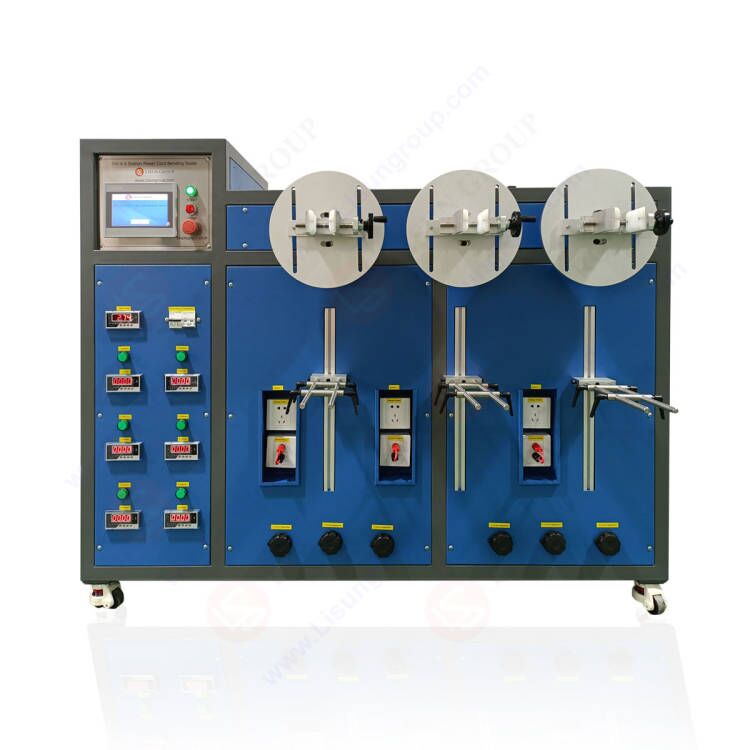
5.1 Technical Specifications and Throughput Comparison
Selecting the appropriate power cord flexibility tester configuration depends on test volume requirements and laboratory space constraints. The single-station SW-1 model suits research laboratories conducting developmental testing or certification bodies handling low-volume specialized evaluations. The dual-station SW-2 configuration provides 100% throughput improvement for routine quality control programs while maintaining instrument footprint at 650mm × 400mm bench space. The six-station SW-6 model maximizes productivity for high-volume appliance manufacturers, enabling complete production batch validation within realistic timeframes. Each station operates independently, allowing simultaneous testing of different cord types under different test parameters.
5.2 Model Selection Decision Matrix
| Parameter | SW-1 Single Station | SW-2 Dual Station | SW-6 Six Station | UL 817 Requirement |
|---|---|---|---|---|
| Test Stations | 1 | 2 | 6 | ≥1 |
| Bending Angle Range | 10-90° | 10-90° | 10-90° | 90° ± 2° |
| Bending Speed | 5-60 cycles/min | 5-60 cycles/min | 5-60 cycles/min | 10 cycles/min |
| Load Current Range | 0.1-30A | 0.1-30A | 0.1-30A | Rated current |
| Cycle Counter Accuracy | ±1 cycle | ±1 cycle | ±1 cycle | Not specified |
| Failure Response Time | <10 ms | <10 ms | <10 ms | Not specified |
| Dimensions (W×D×H) | 550×400×700mm | 650×400×700mm | 1100×500×750mm | Apparatus-dependent |
6.1 Specimen Preparation and Mounting Procedures
Proper specimen mounting is essential for obtaining valid power cord flexibility test results. The cord under test must be secured with its strain relief positioned at the pivot point of the bending arm, ensuring that flexural stress concentrates at the same location as in real-world applications. The free end of the cord connects to the tensile loading mechanism, which applies the specified gravitational force through a pulley system. For UL 817 compliance, the cord should extend vertically downward from the bending point with the specified weight attached. The load current connections must be made using appropriate terminals that do not introduce additional stress on the specimen, and the electrical continuity should be verified before initiating the test cycle.
6.2 Calibration, Maintenance, and Quality Assurance Protocols
Regular calibration of the power cord bending tester ensures long-term measurement accuracy and reproducible test results. The bending angle should be verified quarterly using a digital protractor, confirming accuracy within ±1°. The cycle counter accuracy requires validation through comparison with an independent counter over a defined test sequence. Load current accuracy is verified using a calibrated ammeter in series with the test circuit, maintaining tolerance within ±2% of the set value. Daily operational checks should include visual inspection of the bending mechanism, verification of safety interlocks, and confirmation of emergency stop functionality. These quality assurance practices align with ISO/IEC 17025 laboratory accreditation requirements when the instrument is used for certification testing.
7.1 Integration with Data Acquisition and IoT Systems
The evolution of power cord flexibility testing equipment continues toward enhanced data connectivity and analysis capabilities. Modern implementations may integrate the SW series PLC outputs with laboratory information management systems (LIMS) through RS-485 or Ethernet interfaces, enabling automatic test report generation and trend analysis across production batches. Real-time monitoring of multiple test parameters—including bending torque, temperature rise, and contact resistance—provides deeper insight into failure mechanisms beyond simple cycle count at failure. These data-driven approaches support predictive maintenance strategies for cord reliability, identifying design weaknesses before they manifest in field failures.
7.2 Adaptation to Emerging Cord Technologies and Standards
As power cord technology evolves with higher current ratings for electric vehicles and fast-charging applications, flexibility testing equipment must adapt to new requirements. The SW series’ programmable current range up to 30A accommodates most present-day applications, while the servo drive system’s precision supports the tighter angular tolerances specified in emerging standards for high-flexibility cables. Recyclable and bio-based insulation materials present new mechanical behavior characteristics that require validation through extended bending tests. The flexibility of the LISUN platform allows test laboratories and manufacturers to develop custom test protocols aligned with evolving regulatory requirements and industry best practices.
The LISUN SW Series Power Cord Flexibility Bending Tester provides essential capabilities for mechanical endurance testing of power cords according to UL 817 and related international standards. The combination of PLC-controlled servo drive precision, real-time current-based failure detection, and scalable multi-station architectures delivers reliable, repeatable validation data for quality assurance programs. For R&D engineers developing new cord designs, the instrument enables systematic evaluation of material and geometric parameters affecting flexural durability. For quality control laboratories, the SW series provides compliance-grade testing capabilities with documented traceability and operational efficiency. By understanding the technical architecture, operational parameters, and compliance pathways described in this article, testing professionals can effectively implement power cord flexibility testing programs that support product certification, manufacturing quality control, and continuous reliability improvement initiatives.
Q1: What is the fundamental difference between UL 817 and IEC 60884-1 flexibility testing requirements for power cords?
A: UL 817 focuses on complete cord sets and power supply cords for North American applications, specifying 2,500 bending cycles at 10 cycles per minute with the specimen positioned vertically and a tensile weight applied to the free end. IEC 60884-1 applies to plugs and socket-outlets globally and requires 10,000 cycles for cord anchorage testing, conducted at the same frequency but potentially with different mounting configurations and load current values. The test angle in both standards is 90 degrees total deflection, but the interpretation of the bending plane and specimen orientation may differ. The LISUN SW series accommodates both protocols through adjustable parameters, allowing laboratories to switch between standards without hardware modifications.
Q2: How does the current-based failure detection mechanism in the LISUN SW series improve upon traditional visual inspection methods?
A: Current-based failure detection provides quantitative, objective pass/fail criteria that eliminate human subjectivity in test evaluation. When a conductor strand fractures during bending, the effective cross-sectional area reduces, causing increased resistance and corresponding current reduction. The SW series monitoring circuitry detects this change within 10 milliseconds, immediately stopping the affected test station and recording the precise cycle count at failure. This approach also catches intermittent failures that might escape visual detection, such as partial strand fracture that maintains continuity but creates localized heating. Additionally, the automated detection enables unattended 24-hour operation, increasing laboratory throughput while maintaining consistent failure criteria across all tests.
Q3: What maintenance procedures are essential for maintaining accuracy in power cord flexibility test results over extended operational periods?
A: Routine maintenance focuses on mechanical precision and electrical calibration. The bending mechanism’s pivot bearings require periodic lubrication according to the manufacturer’s schedule, typically every 500 operating hours, to maintain consistent angular motion. The servo drive belt tension should be verified monthly to prevent angular position drift. Electrical calibration involves quarterly verification of load current accuracy against a calibrated ammeter and annual validation of the complete monitoring system using a test specimen with known failure characteristics. Cycle counters should be cross-checked against an independent counter during annual preventive maintenance. Documentation of all maintenance activities supports traceability requirements for ISO/IEC 17025 accredited laboratories.
Q4: Can the SW-6 six-station model test different power cord types simultaneously with different test parameters?
A: Yes, the SW-6 power cord flexibility tester provides independent parameter control for each test station. Each station has its own adjustment for bending angle (10-90°), bending speed (5-60 cycles/min), load current (0.1-30A), and cycle count limit. This independence allows testing six different cord specifications concurrently, significantly compressing the overall validation timeline for mixed production runs. The PLC maintains separate counters and failure records for each station, generating individual test outcomes that can be reported separately. This multi-parameter capability is particularly valuable for manufacturers producing diverse product lines who require batch certification testing while maintaining laboratory efficiency.
Q5: What angular accuracy and repeatability specifications should testing professionals expect from a compliance-grade power cord flexibility tester?
A: For compliance testing applications, the instrument should maintain actual bending angle within ±1° of the set value throughout the entire test duration, verified under dynamic operating conditions. The repeatability specification—the consistency of angle across consecutive cycles—should be within ±0.5° to ensure that every bending cycle applies equivalent mechanical stress to the specimen. The LISUN SW series achieves these figures through its servo motor drive and closed-loop PLC control, which continuously corrects angular position based on encoder feedback. Testing professionals should verify these specifications during instrument acceptance testing using an external digital protractor mounted at the bending pivot point, documenting the results for laboratory quality records.