









Abstract
The LISUN SW Series Power Cord Flexibility Bending Tester provides automated, compliant testing for power cord reliability under repeated mechanical stress as defined by IEC 60884-1 and related international standards. This article examines the engineering principles, operational parameters, and compliance advantages of the SW-1, SW-2, and SW-6 models for technical professionals in appliance manufacturing, power tool production, and component testing. The system employs PLC-controlled servo motor drives with current-based fail detection to simulate field failures in cord strain relief. Key capabilities include adjustable bending angles from 45° to 180°, load currents up to 25A, and automatic test termination upon conductor breakage. This power cord bending tester enables precise, repeatable validation of cord durability across single or multi-station configurations.
1.1 Mechanical Stress Simulation in Cord Reliability Validation
Power cord reliability validation devices must simulate the cumulative mechanical stress experienced by cords during actual product use. The IEC 60884-1 standard, clause 21, specifies that flexible cords and their connections to plugs or appliances must withstand repeated bending without conductor fracture or insulation degradation. The fundamental test involves oscillating the cord at a defined angle and frequency while a load current passes through the conductors. A cable flexibility testing equipment system monitors continuity throughout the test duration. When a conductor breaks, the interruption of the load current triggers an automatic stop function, recording the exact cycle count at failure. This mechanism provides quantitative data for comparing cord designs, strain relief geometries, and material selections.
1.2 The Bending Test Mechanism and Failure Analysis
The bending test subjects the cord to alternating flexural stress at the junction between the cord and the appliance inlet or plug body. The test fixture clamps the cord at a specified distance from the termination point, typically 100 mm to 300 mm, depending on the cord diameter and standard requirements. A moving arm oscillates the cord through the defined bending angle, typically ±45° from vertical, at a rate of 60 cycles per minute. The load current, ranging from 0.1 A to 25 A depending on the cord rating, flows through the conductors during the test. This current serves dual purposes: it represents real-world electrical loading, and it enables immediate detection of conductor fracture. The PLC control system continuously samples the circuit continuity at 10 ms intervals to ensure rapid failure detection.
2.1 Hardware Configuration and Station Options
The LISUN SW Series offers three primary configurations to accommodate different throughput requirements and laboratory scales. The SW-1 single-station model suits low-volume testing for R&D departments conducting iterative design validation. The SW-2 dual-station configuration allows simultaneous testing of two cord samples under identical or independent parameter sets, improving testing efficiency for quality control labs that handle moderate production volumes. The SW-6 six-station system addresses high-throughput requirements in third-party testing facilities or large-scale manufacturing environments where batch testing of multiple cord samples must occur concurrently. Each station operates independently with its own load current circuit and failure detection system, yet all stations share the common PLC controller for synchronized start and stop functions when required by test protocols.
2.2 Control System and Drive Technology
The SW Series incorporates a dedicated PLC (Programmable Logic Controller) with a human-machine interface (HMI) touchscreen for parameter input and real-time monitoring. The PLC manages the servo motor drive that controls the bending arm position, velocity, and acceleration profiles. Servo motor technology provides precise angular control within ±0.5° of the set bending angle, ensuring test repeatability across multiple samples and test sessions. The control system stores up to 50 test parameter sets, enabling quick recall of standard test protocols for different cord types. The HMI display shows real-time data including current cycle count, elapsed test time, station status, and any failure events. An RS-232 or USB interface allows data export to laboratory information management systems for comprehensive reporting.
| Parameter | SW-1 Single Station | SW-2 Dual Station | SW-6 Six Station | IEC 60884-1 Minimum Requirement |
|---|---|---|---|---|
| Test Stations | 1 | 2 | 6 | 1 |
| Bending Angle Range | 45° to 180° | 45° to 180° | 45° to 180° | ±45° (90° total) |
| Bending Frequency | 10-60 cycles/min | 10-60 cycles/min | 10-60 cycles/min | 60 cycles/min |
| Load Current Range | 0.1 A to 25 A | 0.1 A to 25 A | 0.1 A to 25 A | Rated current of cord |
| Power Supply | 220 V AC, 50/60 Hz | 220 V AC, 50/60 Hz | 220 V AC, 50/60 Hz | N/A |
| PLC Control | Yes, with HMI | Yes, with HMI | Yes, with HMI | N/A |
| Automatic Stop on Failure | Yes | Yes | Yes | Required |
3.1 IEC 60884-1 Bend Test Requirements
IEC 60884-1, as the primary standard for plugs and socket-outlets for household and similar purposes, defines the bending test methodology in clause 21. The standard specifies that cords must withstand 10,000 bending cycles without conductor breakage when tested at a bending angle of 90° (45° each side of vertical) and a frequency of 60 cycles per minute. The load current shall be the rated current of the cord under test. The SW Series exceeds these minimum requirements by supporting angles up to 180° and frequencies from 10 to 60 cycles per minute, allowing engineers to conduct accelerated aging tests or evaluate cords under more severe conditions when required by specific product specifications.
3.2 Integration with Related Standards
Beyond IEC 60884-1, the SW Series supports testing protocols defined in several other standards relevant to power cord reliability. IEC 60745-1, covering hand-held motor-operated electric tools, requires bend testing for power supply cords in clause 25.7, with parameters depending on tool weight and cord configuration. IEC 60335-1 for household electrical appliances specifies bend testing in clause 25.14, focusing on cord entry points subject to repeated flexing during normal use. The Chinese standard GB/T 2099.1, which harmonizes with IEC 60884-1, applies to products sold in the Chinese market and requires identical test protocols. The SW Series parameter flexibility allows direct programming of all these standard-specific test conditions without hardware modification.
4.1 Test Parameter Selection for Different Cord Types
The bending test parameters must reflect the actual mechanical stresses encountered by the cord in its intended application. For light-duty cords used in small kitchen appliances, a bending angle of 90° with a load current of 2.5 A typically suffices, as these cords experience moderate flexing during occasional movement. Heavy-duty cords for power tools or industrial equipment require more severe testing: bending angles up to 135° and load currents equal to the cord’s rated capacity (10 A to 25 A). The cord clamp position relative to the strain relief also influences the stress distribution: positioning the clamp closer to the termination point increases the bending radius curvature and accelerates failure in poorly designed assemblies. Engineers should document the clamp position for each test series to maintain consistency across comparative evaluations.
4.2 Failure Detection and Data Interpretation
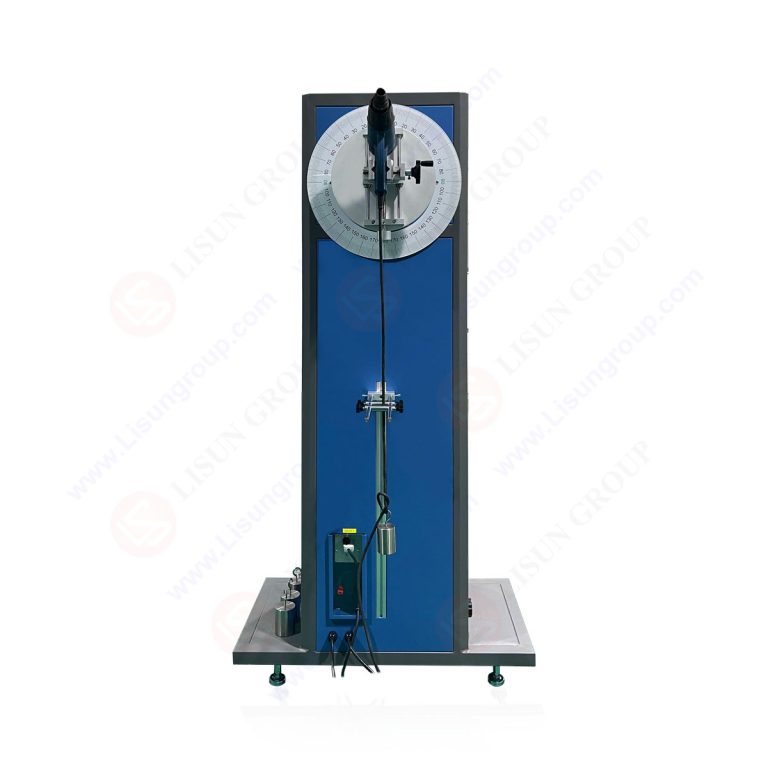
The current-based failure detection system provides unambiguous indication of conductor fracture. When a conductor breaks, the load current drops to zero, and the PLC registers the failure within 20 ms. The system records the cycle count at failure, stops the test for that station, and displays the result on the HMI. For multi-conductor cords, the test should confirm that all conductors remain intact throughout the specified number of cycles. If a sample fails before reaching the required cycle count, engineers should examine the failure location to determine root cause: conductor fracture at the strain relief indicates excessive stress concentration, whereas failure inside the cord jacket suggests inadequate conductor stranding or material fatigue resistance. The SW Series data export function enables statistical analysis of failure cycles across multiple samples, supporting reliability predictions and design improvements.
5.1 Automatic Test Termination and Safety Systems
The SW Series incorporates multiple safety and automatic termination features that protect both the test samples and the equipment. When the PLC detects conductor failure, it immediately stops the bending arm motion for that station, preventing further damage to the cord that could obscure failure analysis. The system also monitors for abnormal current conditions, such as short circuits caused by insulation breakdown during the test, and halts the test to prevent fire or electrical hazards. An emergency stop button on the HMI panel provides manual intervention capability. The automatic stop function ensures that test data reflects actual failure points without over-testing that might induce secondary failures unrelated to the bending stress.
5.2 Multi-Station Synchronization and Independent Operation
The SW-2 and SW-6 models offer flexible operation modes to accommodate different test protocols. In synchronized mode, all stations start simultaneously and apply identical test parameters, enabling batch testing of samples from the same production lot for statistical analysis. In independent mode, each station can run different test parameters, allowing simultaneous evaluation of multiple cord designs or materials under varying conditions. The independent mode proves valuable for R&D departments testing multiple prototype designs concurrently, significantly reducing total test time compared to sequential single-station testing. The PLC maintains separate failure counters and status indicators for each station, ensuring that data from each sample remains distinct and traceable.
6.1 Household Appliance Manufacturing Quality Control
Manufacturers of washing machines, vacuum cleaners, and kitchen appliances must verify that power cords meet bending endurance requirements per IEC 60335-1 clause 25.14. The SW Series enables integration of bend testing into production quality control workflows. For high-volume production lines, the SW-6 model can test six cord samples simultaneously, providing batch results within hours rather than days. Quality engineers can establish statistical process control limits based on historical failure cycle data, flagging production lots where cord samples show reduced bending endurance. This proactive approach prevents field failures that would otherwise manifest as customer complaints, warranty claims, and potential safety incidents.
6.2 Third-Party Testing Laboratory Operations
Testing laboratories require equipment that delivers traceable, reproducible results across multiple clients and test standards. The SW Series parameter programmability allows laboratories to maintain preset test protocols for IEC 60884-1, IEC 60745-1, and IEC 60335-1, switching between standards via the HMI interface without hardware reconfiguration. The data export function supports generation of test reports that include cycle counts, failure mode documentation, and test parameter verification. Laboratories can calibrate the bending angle and frequency annually against reference standards, ensuring compliance with ISO 17025 accreditation requirements for testing equipment.
7.1 Routine Maintenance Procedures
The SW Series requires minimal routine maintenance to ensure consistent performance over years of operation. Operators should inspect the bending arm bearings and pivot points monthly for wear or play that could affect bending angle accuracy. The servo motor drive belt tension should be checked quarterly and adjusted per manufacturer specifications. Electrical connections to the load current circuits should be tightened annually, as thermal cycling from repeated current flow can loosen terminals over time. The HMI touchscreen should be cleaned with a soft cloth to maintain response accuracy. Following these procedures ensures that test results remain valid and reproducible.
7.2 Calibration Verification and Traceability
Annual calibration verification should include measurement of the bending angle using a digital protractor, confirmation of the bending frequency using a stopwatch over 100 cycles, and validation of the load current using a calibrated ammeter. The PLC controller stores calibration constants that can be adjusted if verification reveals drift beyond tolerances. A calibration certificate should document all measured values against acceptance criteria, with traceability to national standards. Maintaining calibration records supports the legal defensibility of test results in product liability cases and regulatory audits.
The LISUN SW Series Power Cord Flexibility Bending Tester provides a comprehensive solution for power cord reliability testing in compliance with IEC 60884-1, IEC 60745-1, IEC 60335-1, and GB/T 2099.1 standards. The SW-1, SW-2, and SW-6 models offer scalable testing capacity from single-station R&D validation to high-throughput six-station batch testing for manufacturing quality control and third-party laboratory operations. The PLC-controlled servo motor drive ensures precise, repeatable bending angle control within ±0.5°, while the current-based failure detection system provides unambiguous conductor breakage identification with automatic test termination. Adjustable parameters including bending angle from 45° to 180°, frequency from 10 to 60 cycles per minute, and load current up to 25 A accommodate diverse cord types and application-specific test protocols. The multi-station independent operation capability enables simultaneous testing of different cord designs or materials, accelerating product development cycles. For technical professionals seeking a reliable power cord bending tester that delivers actionable data for design validation, production quality assurance, and compliance certification, the SW Series combines engineering precision with operational flexibility to meet demanding testing requirements across household appliance manufacturing, power tool production, and component supply industries.
Q1: What distinguishes the LISUN SW Series from basic mechanical bending testers?
A: Traditional mechanical testers rely on cam-driven mechanisms with fixed bending angles and frequencies, offering limited adjustability and no automated failure detection. The SW Series employs PLC-controlled servo motor drive technology that provides programmable bending angles from 45° to 180° and frequencies from 10 to 60 cycles per minute, accommodating multiple international standards without hardware changes. The integrated current-based failure detection system monitors conductor continuity throughout the test, automatically stopping the station within 20 ms of conductor fracture and recording the exact cycle count at failure. This data enables engineers to quantify durability differences between cord designs rather than merely observing pass/fail outcomes. The HMI touchscreen and data export capabilities further distinguish the SW Series by enabling test parameter storage, real-time monitoring, and integration with laboratory information management systems for comprehensive documentation.
Q2: How does the load current setting affect cord bending test results?
A: The load current serves two critical functions in bending testing: it represents the electrical loading the cord experiences during normal operation, and it enables immediate detection of conductor fracture. When the load current equals the cord’s rated current, the test simulates worst-case thermal conditions during flexing. Higher load currents increase conductor temperature through resistive heating, which can accelerate work-hardening and fatigue failure in copper strands. For IEC 60884-1 compliance testing, the load current must equal the rated current marked on the cord. However, engineers conducting comparative material evaluations may choose to test at currents above rated values to accelerate failure mechanisms and reduce test duration for screening purposes. The SW Series supports load currents from 0.1 A to 25 A, covering the full range of cord ratings for household appliance and power tool applications.
Q3: Can the SW Series test cords with different plug types and termination configurations?
A: Yes, the SW Series accepts various cord termination configurations through interchangeable clamps and adjustable mounting fixtures. The standard test fixture accommodates cord diameters from 5 mm to 20 mm with screw-type or quick-release clamps. For cords terminated with molded plugs, the fixture positions the plug body to prevent interference with the bending motion while ensuring the cord bends at the natural stress point near the plug entry. For cords with appliance connectors or bare wire ends, alternative clamping methods secure the insulation without damaging the conductor strands. The bending arm attachment point can be adjusted vertically to accommodate different cord entry positions on appliances or plugs. Users should fabricate custom adapters for non-standard termination types, maintaining the specified bending radius at the cord exit point as defined by the applicable standard.
Q4: What maintenance is required to ensure consistent bending angle accuracy?
A: Maintaining bending angle accuracy requires monthly inspection of the mechanical pivot assembly and drive belt tension. The bending arm bearings should show no detectable play when manually rocked; replacement is indicated when play exceeds 0.5 mm at the cord contact point. The servo motor encoder retains angular position calibration, but the mechanical linkage between motor and bending arm can drift over time due to belt stretch or coupling wear. Operators should verify the actual bending angle using a digital protractor at the beginning of each test series, comparing the physical angle to the programmed value. Deviation exceeding 1° requires adjustment of the mechanical linkage or recalibration of the servo motor position offset in the PLC controller. Annual professional calibration should include full verification of angle accuracy across the entire 45° to 180° range at multiple frequency settings.
Q5: How does the SW Series support testing according to multiple international standards?
A: The SW Series parameter programmability allows direct configuration for any standard that specifies bending angle, frequency, and load current parameters. The PLC stores up to 50 preset test protocols, which can be labeled by standard designation (e.g., “IEC 60884-1 Clause 21”) for quick selection. Operators need only select the appropriate protocol and connect the test sample; the system automatically configures bending angle, frequency, load current, and stop conditions. This flexibility supports testing according to IEC 60884-1 for plug and socket cord terminations, IEC 60745-1 for power tool cords, IEC 60335-1 for appliance cords, and GB/T 2099.1 for Chinese market products. Each standard may specify different cord clamp positions and test durations, which the operator must configure manually according to standard requirements, though the bending motion parameters are fully automated.