









Here is the comprehensive technical article on the LISUN DFX series, structured and written according to your specifications.
Abstract
This article provides a technical deep-dive into the LISUN DFX series Externally Ballasted Fluorescent Lamp Test Load Cabinet, a critical instrument for validating the switching performance of electrical accessories. Designed for manufacturers and third-party laboratories, the DFX series simulates the precise electrical characteristics of inductive and resistive loads—specifically T8/T12 fluorescent lamps and their external ballasts—to ensure compliance with international safety standards. By offering configurable power factors, high current accuracy, and multi-channel operation, the load test cabinet enables rigorous testing of switches, relays, and connectors. This piece explores the technical architecture, compliance pathways, and operational benefits of the DFX series, positioning it as an essential tool for achieving certification and ensuring long-term product reliability in inductive load environments.
1.1 The Physics of Ballasted Lamp Loads
Externally ballasted fluorescent lamps present a complex load profile characterized by a low, lagging power factor (typically 0.45 to 0.6). This inductive behavior causes severe arcing when contacts open, leading to accelerated contact erosion. Standard resistive loads cannot replicate this stress. A dedicated electrical accessory load tester must generate a specific ratio of resistance (R), inductance (L), and capacitance (C) to simulate the inrush current and arc extinction characteristics accurately.
1.2 Why Standard Resistor Banks Fail
Using a simple resistor bank to test switches ignores the transient overvoltage and current asymmetry created by the magnetic ballast. IEC standards mandate that test loads include an inductance to reproduce the phase angle between voltage and current. Without precise L/R ratios, the test results do not correlate with real-world failure modes, potentially allowing substandard components to pass certification.
2.1 Core Hardware Configuration
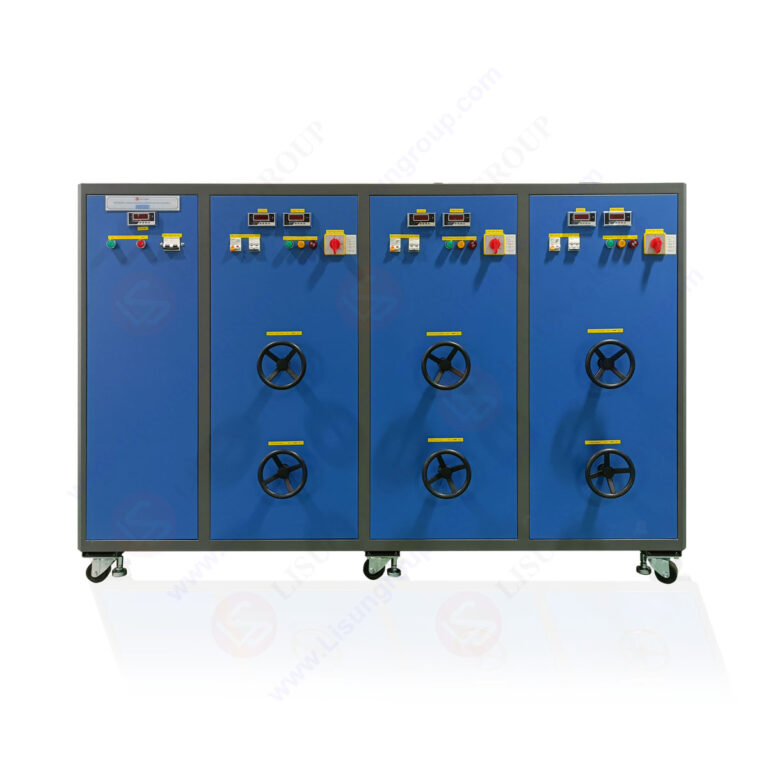
The LISUN DFX series (DFX-20, DFX-20-3CH, DFX-40, DFX-60, and DFX-80) is engineered as a dedicated ballasted lamp load simulator. It integrates high-precision discrete inductors and resistors, switched in binary steps to achieve excellent resolution. The cabinet is designed to handle the high thermal dissipation generated during endurance tests, ensuring stability over thousands of operations.
2.2 Power Factor Adjustment & Resolution
Accurate simulation requires fine adjustment of the impedance angle. The DFX series allows users to set the power factor (cos φ) within a range of 0.3 to 0.98, with a resolution surpassing 0.01. This granularity is vital for replicating specific ballast types (magnetic vs. electronic) or for conforming to different international product classifications.
Table 1: LISUN DFX Series Model Comparison
| Model | Current Range (A) | Channel Configuration | Input Voltage (VAC) | Control Method | Typical Application |
|---|---|---|---|---|---|
| DFX-20 | 0.2 – 20 | Single Phase, 1-Channel | 100-240 | Manual/PLC | Initial type testing |
| DFX-20-3CH | 0.2 – 20 | Single Phase, 3-Channel | 100-240 | Independent Control | Multi-station life tests |
| DFX-40 | 0.2 – 40 | Single Phase, 1-Channel | 100-240 | Manual/PLC | Higher current switches |
| DFX-60 | 0.2 – 60 | Single Phase, 1-Channel | 100-240 | Manual/PLC | Industrial contactors |
| DFX-80 | 0.2 – 80 | Single Phase, 1-Channel | 100-240 | Manual/PLC | Heavy-duty isolators |
3.1 Alignment with IEC 60669-1 (Switches)
For switches used in lighting circuits, the DFX series is configured to meet the stringent requirements of IEC 60669-1 Clause 19.2 (Endurance test). This clause requires the switch to operate under a load of 0.6 times the rated current for incandescent loads, but for inductive loads, the test requires a specific “cos φ” of 0.6 ± 0.05. The DFX series provides this exact impedance, ensuring the switch is tested for arcing wear rather than just thermal heating.
3.2 Verification of Socket-Outlets (IEC 60884-1)
When testing socket-outlets for use with portable lighting, IEC 60884-1 Clause 20 dictates the test load for inductive loads. The DFX series ensures that the voltage drop across the load does not exceed 5% during the test, maintaining the integrity of the test voltage. The built-in high-precision instrumentation allows operators to verify the impedance before the “make and break” sequence begins.
4.1 Measurement Precision
The DFX series does not merely provide a load; it also measures the circuit parameters. It features internal potential transformers and current transformers (CTs) with a measurement accuracy of ±0.5% (class 0.5). This allows for real-time monitoring of the voltage, current, and power factor during the cyclic test, ensuring the load remains within the tolerance band specified by the testing standard.
4.2 Load Capacitance and Resonance Control
The parasitic capacitance of the inductors can cause resonance at high frequencies, leading to invalid test results. The LISUN load test cabinet is specifically wound and shielded to minimize inter-winding capacitance. The load capacitance is maintained below 10pF at 50/60Hz, preventing unwanted oscillation when the switch contacts open, ensuring that the test results accurately reflect the switch’s capability to quench the arc.
5.1 Synchronization with LISUN CZKS Series Life Testers
The DFX series serves as the passive load center for the LISUN CZKS multi-station life testers. In this configuration, the DFX-20-3CH model is particularly useful, providing independent load circuits for up to three DUT (Devices Under Test) stations simultaneously. The CZKS machine controls the mechanical actuation and counts cycles, while the DFX provides the electrical stress, creating a fully automated durability testing platform.
5.2 Complementary Mechanical Testing
For switches that also undergo mechanical robustness checks, the load cabinet is often used in sequence with the LISUN SW-6 series bending testers. This separation ensures that the mechanical stress (bending, torsion) is not compounded with electrical arcing, isolating specific failure modes. This workflow aligns with the sequence prescribed in IEC 60669-1 Clause 20, allowing for a sequential, comprehensive qualification of the device.
6.1 Thermal Management at High Currents
Operating at currents up to 80A (DFX-80) generates significant heat. The inductors are mounted on thermally conductive bases with forced air cooling via tangential fans. The cabinet’s control logic includes a thermal overload relay that disconnects the load if the internal temperature exceeds 75°C, protecting both the test setup and the operator.
6.2 Reproducibility Across Test Labs
One of the biggest challenges in load testing is lab-to-lab reproducibility. The DFX series addresses this by allowing operators to perform a “system calibration” using an external reference meter. By adjusting the binary-coded switches, the operator can trim the impedance to exactly match the nominal value of the ballast they are emulating, This ensures that a switch tested in Shanghai yields the same results as the same switch tested in Berlin, assuming standard mains conditions.
7.1 Protection Mechanisms
The cabinet includes a dedicated emergency stop circuit, an over-current breaker, and a door-interlock switch conforming to IEC 61010-031 safety requirements. These safety circuits are rated for the full short-circuit current of the feeder line, ensuring personnel safety when servicing the high-current terminals.
7.2 Control Interface
The front panel features a color TFT display showing the set resistance, inductance, and capacitance values, alongside the live measured values. For automated testing, the cabinet includes a RS-485 Modbus interface, allowing for remote control and data acquisition by a central PLC (Programmable Logic Controller), ensuring seamless integration into existing industrial automation systems.
The LISUN DFX series Externally Ballasted Fluorescent Lamp Test Load Cabinet represents a critical investment for laboratories seeking to validate switching devices against international standards. Its ability to provide precise inductive loads with low capacitance and high power factor resolution directly addresses the failure modes associated with fluorescent lighting circuits. The integration of the electrical accessory load tester into automated life-testing systems reduces operator error and accelerates time-to-certification. By offering models from 20A to 80A and multi-channel options, the DFX series scales from R&D benchtop testing to high-volume production line endurance testing. For electrical engineers and compliance specialists, the DFX series ensures that every “make and break” cycle is a statistically valid representation of real-world inductive stress, providing confidence in the durability and safety of certified products. This is not just a load bank; it is a precision measurement instrument designed for the rigorous demands of modern compliance engineering.
Q1: What is the difference between testing with a resistive load and using the LISUN DFX series for electrical accessory testing?
A: A resistive load draws current in phase with the voltage, meaning the current crosses zero when the voltage does. This allows a switch to extinguish the arc easily. However, an externally ballasted fluorescent lamp is inductive, causing the current to lag behind the voltage. When a switch opens, the current is not at the zero-crossing point, resulting in a sustained, high-energy arc that erodes the contacts. The LISUN DFX series load test cabinet comprises specific inductors and resistors (R/L/C network) to simulate this lag phase, ensuring the switch is tested under the exact arcing conditions it would face in real-world installation. This is mandated by standards such as IEC 60669-1 to verify actual electrical endurance, not just thermal capacity.
Q2: How does the DFX-20-3CH configuration improve testing efficiency?
A: The DFX-20-3CH model features three independent load channels within a single chassis. In a production environment, this allows a single LISUN CZKS life tester to run three Devices Under Test (DUTs) simultaneously, each with its own independent current path and protection. This is particularly beneficial for testing single-pole switches or relays where three separate units can be tested in series to accelerate statistical data collection. While the total current draw is limited by the main input supply, each channel can be individually set to a specific current level (e.g., Channel 1 at 5A, Channel 2 at 10A), dramatically increasing throughput compared to single-channel sequential testing.
Q3: Can the DFX series simulate electronic ballasts (HF) as well, or only magnetic ones?
A: The primary design of the DFX series is for magnetic (electromagnetic) ballasts, which present a classic inductive load with a low power factor (0.45-0.6). Electronic ballasts (high frequency) draw a non-sinusoidal current with high harmonic content and a crest factor near 1.7. Standards like IEC 60669-2-1 require specific testing for electronic loads. While the DFX series can simulate the fundamental reactive power of a capacitive load (power factor leading) if the capacitors are engaged, it does not generate HF harmonics. For electronic ballast testing, LISUN recommends a dedicated electronic load simulator with arbitrary waveform generation to accurately match the mains current waveform distortion.
Q4: What does “Power Factor Resolution of <0.01" mean in a practical testing scenario?
A: It refers to the granularity at which you can set the lagging power factor (cos φ). For example, a device requiring a cos φ of 0.6 must be tested within a tolerance of ±0.05 per IEC standards. If your load cabinet only allowed adjustment in steps of 0.05, you might only be able to set 0.60 or 0.65, leaving you at the edge of the tolerance band or out of it. The DFX series allows you to set a value like 0.61 or 0.58. This precision is crucial for borderline pass/fail results. A switch that passes arcing tests at 0.65 might fail at 0.6 because the current lag is higher; the DFX ensures you are not leveraging an out-of-tolerance setup to claim compliance.