









Precision Power Measurement for Automotive Electronics | LISUN Digital Power Meter
Abstract
The LISUN Digital Power Meter series represents a critical advancement in high-accuracy AC/DC power measurement for automotive electronics and LED manufacturing applications. These instruments integrate digital sampling waveform analysis, automatic range switching, and comprehensive harmonic analysis up to the 50th order to deliver precise electrical parameter validation. Designed for electrical testing engineers and quality control professionals, the LS2050B, LS2050C, and LS2050C-IEC models provide reliable power factor measurement, displacement factor calculation, and wide frequency range coverage from 0.5 Hz to 100 kHz. This article examines the technical architecture, compliance capabilities, and practical applications of precision power measurement for automotive electronics using LISUN Digital Power Meter solutions, emphasizing their role in EMC compliance testing, R&D validation, and manufacturing quality assurance.
1. Core Architecture of Precision Power Measurement for Automotive Electronics
1.1 Digital Sampling and Waveform Analysis Technology
Modern automotive electronics testing demands exceptional measurement fidelity across diverse electrical loads. The LISUN Digital Power Meter employs advanced digital sampling waveform analysis that captures voltage and current waveforms at high resolution, enabling accurate calculation of true RMS values even under non-sinusoidal conditions. This technology is essential for evaluating automotive components such as DC-DC converters, battery management systems, and electric drive inverters, where harmonic distortion can significantly impact power quality.
The digital sampling approach processes multiple points per cycle, reconstructing the waveform with minimal phase error. For the LS2050C high-accuracy model, this translates to a basic power accuracy of ±0.1% of reading, enabling engineers to detect subtle efficiency variations in automotive electronic control units (ECUs). The continuous waveform capture also supports transient analysis, critical for validating power supply rejection ratios and load regulation performance.
1.2 Automatic Range Switching and Overload Protection
Precision power measurement for automotive electronics requires handling wide dynamic load ranges, from microampere standby currents to multi-ampere operational loads. The LISUN Digital Power Meter integrates automatic range switching that seamlessly adjusts voltage and current measurement scales without interrupting data acquisition. This feature eliminates manual range selection errors and ensures continuous monitoring during automotive component stress testing.
The hardware supports high instantaneous overload capacity, with maximum voltage ratings of 1600 V and current ratings of 50 A. This robust design protects the instrument during fault conditions common in automotive electrical systems, such as load dump transients or inductive kickback from solenoids. The automatic ranging algorithm prioritizes measurement resolution, maintaining full accuracy specifications across ten voltage ranges and ten current ranges.
1.3 Harmonic Analysis for Automotive EMC Compliance
Harmonic current emissions from automotive electronics must comply with international standards to prevent power quality degradation and electromagnetic interference. The LISUN Digital Power Meter performs total harmonic analysis from the 0th to the 50th order using both IEC and CSA methodologies. For the LS2050C-IEC model, this capability directly supports EN/IEC61000-3-2 compliance testing, which limits harmonic currents injected into the public mains supply.
Engineers can isolate individual harmonic components, calculate total harmonic distortion (THD), and assess power factor contributions from displacement and distortion components. This granular analysis is vital for designing input filters, power factor correction circuits, and electromagnetic compatibility solutions in automotive chargers, inverters, and auxiliary power supplies.
2. Model Comparison and Technical Specifications
2.1 Performance Metrics Across the LS2050 Series
Selecting the appropriate digital power meter depends on required accuracy, compliance scope, and application-specific measurement demands. The table below compares key specifications for the LISUN LS2050B, LS2050C, and LS2050C-IEC models, highlighting their suitability for different precision power measurement tasks in automotive electronics validation.
| Specification | LS2050B | LS2050C | LS2050C-IEC |
|---|---|---|---|
| Basic Power Accuracy | ±0.2% of reading | ±0.1% of reading | ±0.1% of reading |
| Harmonic Analysis Order | Up to 50th | Up to 50th | Up to 50th (IEC mode) |
| Frequency Range | 0.5 Hz – 100 kHz | 0.5 Hz – 100 kHz | 0.5 Hz – 100 kHz |
| Voltage Measurement | 0 – 1000 V RMS | 0 – 1000 V RMS | 0 – 1000 V RMS |
| Current Measurement | 0 – 50 A RMS | 0 – 50 A RMS | 0 – 50 A RMS |
| EN/IEC61000-3-2 Compliance | Optional | Optional | Integrated |
| Communication Interfaces | RS232, RS485 | RS232, RS485 | RS232, RS485 |
| Data Sampling Rate | 500 kS/s | 1 MS/s | 1 MS/s |
The LS2050B serves as a cost-effective solution for routine manufacturing quality checks, while the LS2050C delivers enhanced accuracy for R&D characterization and validation. The LS2050C-IEC adds pre-configured harmonic test routines aligned with EN/IEC61000-3-2 limits, streamlining EMC pre-compliance testing for automotive electronic subassemblies.
2.2 Measurement Capabilities for Automotive Electrical Parameters
Precision power measurement for automotive electronics extends beyond basic voltage and current readings. The LISUN series calculates active power, apparent power, reactive power, power factor, and displacement factor, all essential for characterizing motor drives, battery chargers, and power distribution units. The wide frequency range from 0.5 Hz to 100 kHz accommodates both fundamental power frequencies and high-frequency switching noise from modern automotive power electronics.
The displacement factor measurement, computed from the phase angle between fundamental voltage and current components, provides insight into reactive power consumption independent of harmonic distortion. This separation is particularly relevant for evaluating power factor correction effectiveness in electric vehicle traction inverters and onboard chargers.
3. Industry Standards and Compliance Validation
3.1 EN/IEC61000-3-2 Harmonic Current Emissions
Automotive electronics connected to AC mains must limit harmonic current injection to prevent distribution network degradation. The LISUN Digital Power Meter LS2050C-IEC directly supports EN/IEC61000-3-2 compliance testing, which mandates maximum allowable harmonic currents for equipment rated up to 16 A per phase. This standard covers automotive battery chargers, workshop equipment, and diagnostic systems that operate from utility power.
The instrument implements the standard’s measurement methodology, classifying harmonics into odd and even orders and applying appropriate averaging times. Engineers can generate compliance reports that document harmonic magnitudes relative to limit curves, simplifying certification processes for automotive electronic products destined for European and international markets.
3.2 LM-79 and Lighting Product Validation
For automotive lighting applications, LM-79 provides standardized procedures for measuring electrical and photometric characteristics of solid-state lighting products. The LISUN Digital Power Meter integrates seamlessly with photometric measurement systems, providing accurate electrical input parameters required for efficacy calculations. The instrument’s AC/DC compatibility ensures it can measure both AC-powered headlamps and DC-powered interior lighting modules.
The high accuracy of the LS2050C model directly supports LM-79 requirements, which demand electrical measurement uncertainty below 0.2% for power and 0.1% for voltage and current. This level of precision enables manufacturers to validate luminous efficacy claims and ensure compliance with automotive lighting regulations.
3.3 Safety and Reliability Standards (IEC 61010, UL 1989)
Electrical safety in automotive test environments requires instrumentation that withstands fault conditions without compromising operator safety. The LISUN Digital Power Meter complies with IEC 61010, the international safety standard for electrical test and measurement equipment. This certification ensures appropriate insulation, creepage distances, and protection against electric shock.
Additionally, UL 1989 addresses the safety of standby batteries and battery chargers, directly relevant to automotive battery testing applications. The instrument’s high overload capacity and protection circuitry align with these safety requirements, allowing engineers to perform worst-case scenario testing without equipment damage or personal risk.
4. Application in Automotive Electronics R&D
4.1 Power Quality Analysis for Electric Drives
Electric vehicle powertrains generate complex power waveforms due to pulse-width modulation (PWM) control strategies. Precision power measurement for automotive electronics using LISUN Digital Power Meter enables detailed analysis of inverter efficiency, motor losses, and regenerative braking performance. The instrument’s ability to measure power across fundamental and harmonic frequencies provides a complete picture of energy conversion efficiency.
Engineers can simultaneously monitor DC link voltage, AC phase currents, and total power throughput, identifying losses in power semiconductor switches and magnetic components. The harmonic analysis capability reveals distortion introduced by dead-time effects and switching transients, supporting optimization of modulation algorithms and filter designs.
4.2 Battery Management System Validation
Automotive battery management systems (BMS) require precise coulomb counting and power monitoring to estimate state of charge and state of health. The LISUN Digital Power Meter’s DC measurement capability, with accuracy down to ±0.1% for the LS2050C model, supports verification of BMS current sensors and voltage measurement circuits.
The instrument’s automatic range switching is particularly valuable during battery charge/discharge cycling, where currents can range from milliampere trickle charges to high-rate fast charging exceeding 50 A. The wide dynamic range ensures measurement continuity without requiring manual intervention, enabling automated test sequences for extended duration battery aging studies.
5. Manufacturing Test Integration
5.1 In-Line Production Testing for Automotive Modules
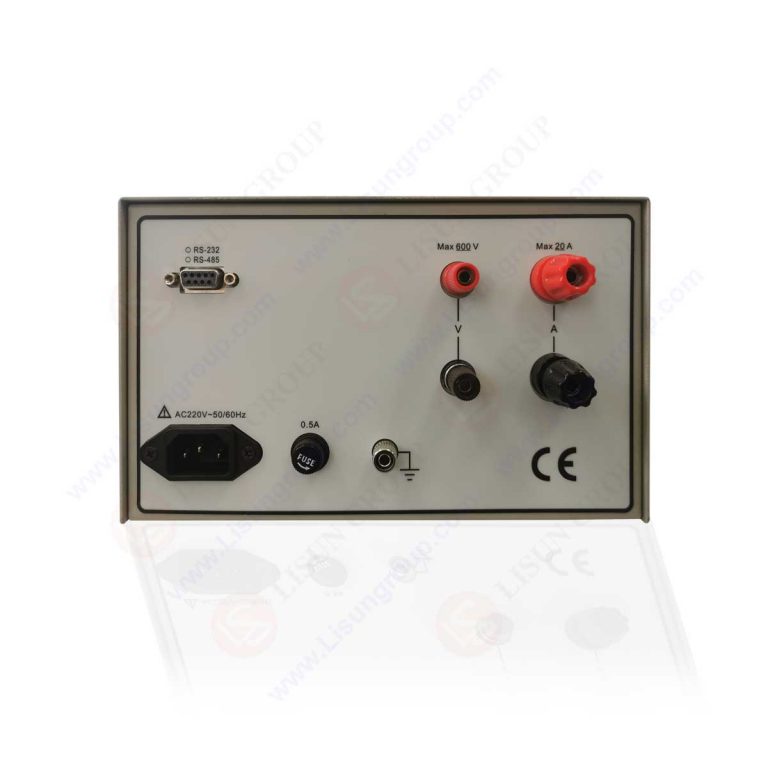
Manufacturing environments demand high-throughput testing with repeatable accuracy. Precision power measurement for automotive electronics using LISUN Digital Power Meter supports in-line production test stations through its RS232 and RS485 communication interfaces. These ports enable direct integration with programmable logic controllers (PLCs) and test automation software, allowing automated data logging and pass/fail decision-making.
The instrument’s fast sampling rate ensures minimal test cycle time while maintaining measurement fidelity. For automotive electronic control modules, the digital power meter can validate standby power consumption, active load regulation, and power factor correction effectiveness within seconds, supporting production throughput targets.
5.2 Quality Control for LED Lighting Modules
Automotive exterior and interior lighting systems increasingly utilize LED technology, requiring accurate power measurement for photometric test reports. The LISUN Digital Power Meter’s compliance with LM-79 ensures that electrical measurements align with industry-accepted photometric testing standards. Quality control engineers can verify that LED driver efficiency, power factor, and total harmonic distortion meet design specifications before module assembly.
The instrument’s ability to measure both AC and DC inputs accommodates the variety of LED driver topologies used in automotive lighting, from AC-input headlamp drivers to DC-input ambient lighting controllers. This flexibility reduces the need for multiple test instruments on the production floor.
6. EMC Pre-Compliance and Troubleshooting
6.1 Harmonic Analysis for EMI Source Identification
Electromagnetic interference in automotive electronics often originates from high-frequency switching circuits and rectifier stages. The LISUN Digital Power Meter’s harmonic analysis capability helps engineers identify the frequency components contributing to conducted emissions. By isolating harmonic orders that exceed threshold limits, designers can target specific circuit stages for EMI suppression.
For example, if harmonic analysis reveals elevated 3rd and 5th order harmonics, the engineer can investigate input rectifier designs or power factor correction stages. The instrument’s IEC and CSA analysis modes provide flexibility to compare measured harmonics against different regulatory frameworks, supporting global product development.
6.2 Power Factor and Displacement Factor Optimization
Improving power factor in automotive electronics reduces reactive power losses and supports compliance with utility company requirements. The LISUN Digital Power Meter separately reports power factor and displacement factor, allowing engineers to distinguish between phase shift effects and harmonic distortion contributions.
This separation guides corrective design actions. Low displacement factor suggests the need for capacitive or inductive compensation, while high distortion power factor indicates harmonic filtering requirements. For automotive battery chargers and inverters, these measurements directly inform control algorithm adjustments and passive component selection.
7. Communication and Data Management
7.1 Remote Monitoring and Data Logging
Modern test laboratories require centralized data collection from multiple instruments simultaneously. The LISUN Digital Power Meter’s RS232 and RS485 communication ports support daisy-chaining of multiple units, enabling synchronized measurement across several test points. This capability is valuable for automotive electronics validation, where simultaneous measurement of input power, output power, and intermediate bus voltages provides complete efficiency analysis.
The standard communication protocols allow integration with LabVIEW, Python, and commercial test automation packages. Engineers can configure automated test sequences that log measurement data at user-defined intervals, capturing transient events and long-term drift without requiring constant operator attention.
8. Conclusion
Precision power measurement for automotive electronics requires instrumentation that delivers exceptional accuracy, broad measurement range, and comprehensive harmonic analysis capabilities. The LISUN Digital Power Meter series fulfills these demands through advanced digital sampling technology, automatic range switching, and support for critical industry standards including EN/IEC61000-3-2, LM-79, IEC 61010, and UL 1989. The LS2050B, LS2050C, and LS2050C-IEC models provide scalable performance options to match specific application requirements, from manufacturing quality control to R&D validation and EMC pre-compliance testing.
For electrical testing engineers and quality control professionals, these instruments enable reliable characterization of automotive electronic modules, battery systems, and lighting products. The combination of wide frequency coverage, high overload capacity, and flexible communication interfaces ensures that the LISUN Digital Power Meter serves as a versatile tool for both laboratory and production environments. By providing precise measurement of voltage, current, power, power factor, and harmonic distortion, the series supports continuous improvement in automotive electronics efficiency, reliability, and regulatory compliance.
FAQ (Frequently Asked Questions)
Q1: What is the difference between power factor and displacement factor in automotive electronics power measurement, and why does it matter?
A: Power factor (PF) represents the ratio of active power to apparent power, accounting for both phase displacement and harmonic distortion. Displacement factor (DPF) isolates the contribution of fundamental frequency phase shift, effectively measuring the cosine of the angle between fundamental voltage and current. In automotive electronics, distinguishing these parameters is essential for designing power factor correction circuits. For example, a PWM rectifier may show low PF due to harmonic distortion even if DPF remains near unity. The LISUN Digital Power Meter reports both values independently, enabling engineers to target either harmonic filtering or reactive power compensation as needed. This separation is particularly important for electric vehicle battery chargers, where low THD requirements coexist with power factor correction mandates.
Q2: How does the LISUN Digital Power Meter LS2050C-IEC simplify EN/IEC61000-3-2 compliance testing?
A: The LS2050C-IEC model integrates pre-configured harmonic test routines aligned with EN/IEC61000-3-2 limits, which define maximum permitted harmonic currents for equipment rated up to 16 A per phase. The instrument automatically classifies odd and even harmonic orders, applies the appropriate measurement bandwidth and averaging times, and compares measured values against Class A, B, C, or D limit curves. Engineers can generate compliance reports summarizing harmonic magnitudes, limit exceedances, and pass/fail status without manual calculation. This streamlined approach reduces test setup time and minimizes the risk of procedural errors during EMC pre-compliance validation for automotive electronic subassemblies and chargers.
Q3: Can the LISUN Digital Power Meter measure both AC and DC power in automotive applications, and what accuracy can be expected?
A: Yes, the LISUN Digital Power Meter series is designed for AC/DC compatibility, making it suitable for measuring power in both AC-driven automotive components (e.g., onboard chargers, workshop equipment) and DC-powered systems (e.g., battery management systems, DC-DC converters). The LS2050C high-accuracy model achieves basic power accuracy of ±0.1% of reading for both AC and DC measurements. This performance supports precise efficiency calculations for electric vehicle powertrains and validation of BMS coulomb counting circuits. The wide voltage range (0–1000 V) and current range (0–50 A) accommodate most automotive electrical interfaces without requiring external transducers.
Q4: What communication interfaces does the LISUN Digital Power Meter support for automated test integration?
A: The instrument includes RS232 and RS485 serial communication ports as standard features, enabling integration with test automation systems, programmable logic controllers, and data logging software. The RS485 interface supports multi-drop configurations, allowing multiple LISUN Digital Power Meters to be networked for synchronized measurements across several test points. Compatibility with standard protocols facilitates connection to LabVIEW, Python scripts, and commercial manufacturing execution systems. For automotive production environments, this capability enables automated data collection, real-time pass/fail decision-making, and traceable quality records without requiring manual data transcription.