









Abstract
The Programmable Environmental Test Chamber | IEC 60068 Temperature Humidity Cycling represents a critical advancement in solid-state lighting (SSL) reliability validation, bridging the gap between accelerated stress testing and real-world lumen maintenance projections. This article provides a comprehensive technical examination of LISUN’s integrated LED optical aging test systems—the LEDLM-80PL and LEDLM-84PL—which combine programmable environmental chambers with spectroradiometric measurement capabilities. We delve into the scientific principles underpinning Arrhenius Model-based lifetime prediction, the strategic application of IEC 60068 thermal cycling profiles, and the nuanced data acquisition requirements of IES LM-80, TM-21, LM-84, and TM-28 standards. Technical professionals will gain actionable insights into multi-chamber configurations supporting up to 300+ test positions, 6000-hour validation protocols, and the critical metrics of L70/L50 lumen maintenance. The article also explores the practical implementation of dual testing modes and customizable hardware architectures to ensure compliance, repeatability, and efficiency in accelerated aging validation.
1.1 The Imperative for Environmental Stress Testing in SSL
Light-emitting diodes (LEDs) are renowned for their longevity, yet their performance degrades over time due to thermal stress, humidity ingress, and current-induced migration. The Programmable Environmental Test Chamber | IEC 60068 Temperature Humidity Cycling serves as the primary tool for simulating these accelerated aging conditions. Unlike traditional static burn-in, IEC 60068-compliant chambers create dynamic temperature and humidity profiles that induce thermo-mechanical fatigue, exposing failures in solder joints, phosphor coatings, and encapsulants that static testing would miss. For LED manufacturers targeting a 50,000-hour operational life, relying on real-time testing is impractical; a multi-year product development cycle cannot accommodate a 5+ year test. Therefore, environmental chambers that tightly control temperature, humidity, and cycling rates are non-negotiable for accelerating time-to-market without sacrificing reliability data integrity.
1.2 LISUN LEDLM Series: An Integrated Approach
LISUN’s LEDLM-80PL and LEDLM-84PL systems represent a paradigm shift from standalone thermal chambers to fully integrated optical aging workstations. The LEDLM-80PL is engineered specifically for IES LM-80-15 compliance, supporting 6000-hour tests for LED packages, arrays, and modules. Conversely, the LEDLM-84PL addresses IES LM-84-19 requirements, focusing on integral LED lamps and luminaires. Both systems share a core architecture: programmable temperature chambers (capable of 0–105°C with ±0.5°C uniformity) coupled with array spectroradiometers and integrating spheres for in-situ photometric measurement. This integration eliminates the error-prone “remove-to-test” method—where samples are physically relocated for measurement—by enabling automated, scheduled optical data capture within the environmental chamber itself.
2.1 Navigating IES LM-80 and TM-21 for Lifetime Prediction
The IES LM-80-15 standard mandates lumen maintenance data collection at two temperatures (55°C and 85°C for packages, with a third optional 105°C) over 6000 hours, with data points taken every 1000 hours. The LEDLM-80PL automates this entire protocol. The collected data feeds into TM-21-19 calculations, which employ a non-linear regression model to project L70 (hours to 70% lumen maintenance) and L50 (hours to 50% maintenance) lifetimes. The LISUN software suite automatically downsamples 6000-hour datasets to the required 1000-hour intervals and computes TM-21 projections with report-ready statistical analysis, reducing manual calculation errors and ensuring audit trail compliance.
2.2 Extending to LM-84 and TM-28 for Integral Lamps
For integral lamps, IES LM-84-19 governs photometric measurements, requiring a minimum of 6000 hours of data for TM-28-19 lifetime projection. The LEDLM-84PL system accommodates larger samples—up to 50 standard lamps—within its specialized chamber configuration. TM-28 differs from TM-21 operationally, using a different sample-size handling for the “in-situ” measurement method. LISUN’s dual-system strategy ensures that whether a manufacturer is qualifying COB arrays (LM-80) or complete A-type lamps (LM-84), the environmental cycling and photometric capture are standard-compliant. Additionally, the systems are designed 100% backward-compatible with IES LM-79-19 for initial and interim efficacy measurements, allowing a single unit to serve both EMC and photometric testing roles.
2.3 Harmonization with IEC 60068 Testing Protocols
While IES standards define measurement and extrapolation, IEC 60068-2-38 (Temperature/Humidity Cyclic) defines the environmental stress profile. The LISUN chamber controller can execute profiles including 12-hour cycles between -10°C and 65°C with relative humidity ranging from 80% to 98%, with temperature ramp rates of 1-5°C/min controlled. This harmonization is critical for automotive and industrial applications where components must withstand rapid thermal transients alongside humidity. By integrating the chamber’s programmable logic controller with LISUN’s measurement software, engineers can define test profiles that alternate between LM-80 thermal points and IEC 60068 vibration/humidity cycles, replicating stringent application environments.
3.1 Dual-Mode Testing Capabilities
The LISUN systems operate in two distinct yet complementary modes. Constant Temperature Mode (Mode 1) maintains a fixed junction temperature (e.g., 55°C, 85°C) for standard LM-80 protocols. Cyclic Mode (Mode 2) introduces temperature/humidity ramping per IEC 60068, enabling evaluation of thermal fatigue resistance. The transition between modes is software-controlled, with the ability to pause and revert to constant temperature for periodic photometric checks.
Table 1: Technical Comparison of LISUN LEDLM-80PL and LEDLM-84PL Systems
| Specification | LEDLM-80PL (LM-80 Focus) | LEDLM-84PL (LM-84 Focus) |
|---|---|---|
| Primary Standard | IES LM-80-15 / TM-21-19 | IES LM-84-19 / TM-28-19 |
| Sample Compatibility | LED packages, arrays, modules | Integral lamps, luminaires |
| Max Test Positions | 300 (typical) | 50 (typical) |
| Temperature Range | 0°C to +105°C (±0.5°C) | 0°C to +105°C (±0.5°C) |
| Humidity Range | 20% RH to 98% RH | 20% RH to 98% RH |
| Test Duration (Standard) | 6000 hours (1000h intervals) | 6000 hours (1000h intervals) |
| Photometric Integration | In-situ 2m integrating sphere | In-situ 1m integrating sphere |
| Software Model | Arrhenius Model-based regression | Arrhenius Model-based regression |
| Support for Multi-Chamber | Up to 3 connected chambers | Up to 3 connected chambers |
| Measurement Metrics | L70, L50, lumen depreciation | L70, L50, efficacy, CCT shift |
3.2 Arrhenius Model-Based Predictive Software
The proprietary LISUN software utilizes the Arrhenius equation to accelerate failure prediction from short-term data. With junction temperature (Tj) as a primary stressor, the software calculates activation energy (Ea) from two or more temperature datasets. The thermal acceleration factor (AF) is computed via AF = exp[(Ea/k) * (1/T_use – 1/T_stress)]. For LED phosphor degradation, typical Ea values range from 0.3 to 0.7 eV, depending on material chemistry. The software automatically fits the TM-21 exponential decay curve and outputs lifetime to L70/L50 with 90% lower confidence bounds, providing robust, statistically defensible projections.
3.3 Multi-Chamber Configuration for High-Throughput
Time is a critical resource in environmental testing. The LISUN systems support up to 3 connected temperature chambers operating simultaneously from a single control console. In a typical configuration, Chamber A runs a 105°C constant test, Chamber B cycles between 20°C and 85°C per IEC 60068, and Chamber C performs humidity bias at 60°C/90%RH. The multiplexed optical measurement system switches a single high-precision array spectroradiometer across the three chambers, sequentially measuring each sample group. This parallelization allows a manufacturer to complete LM-80 3-temperature matrix (55°C, 85°C, 105°C) and IEC humidity cycling concurrently, reducing total validation time by up to 60% compared to serial testing.
4.1 Precision and Uniformity in Environmental Control
The integrity of accelerated aging data hinges on environmental stability. The LISUN chamber employs air-forced circulation with PID auto-tuning controllers, achieving temperature uniformity of ±0.5°C and stability of ±0.1°C. For humidity, the system uses a steam injection generator with a platinum resistance sensor, ensuring ±3% RH accuracy. These tolerances meet the stringent requirements of IEC 60068, which mandates that average temperature gradients within the working space do not exceed 1°C per 10 minutes. Such precision prevents differential aging within a sample batch, which would otherwise skew statistical analysis of lumen depreciation.
4.2 Ramp Rate and Thermal Shock Capabilities
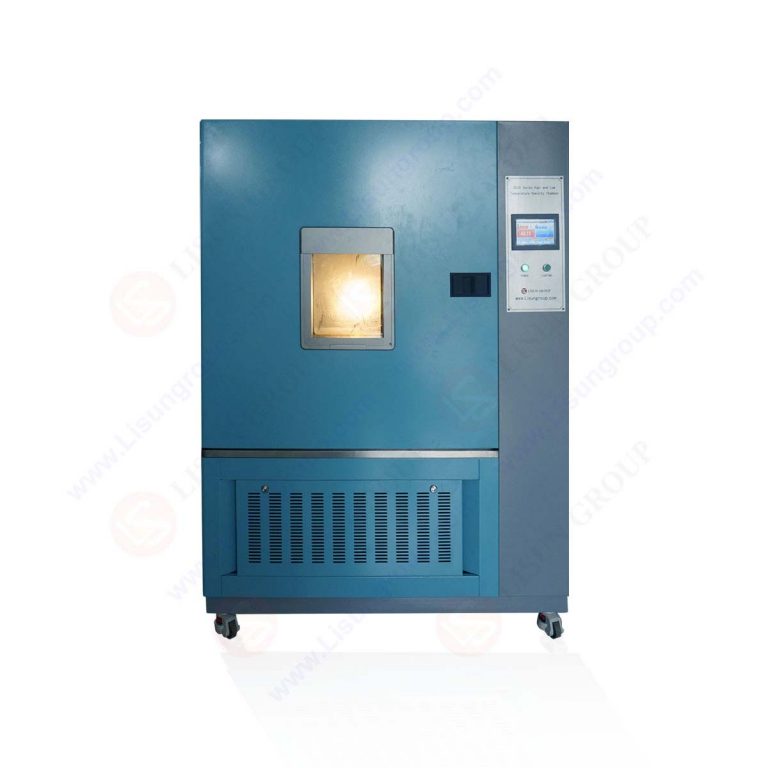
IEC 60068-2-14 specifies temperature change tests with maximum ramp rates; the LISUN chamber achieves linear ramp rates of 1 to 5°C/min controllable via the touchscreen interface. For cyclical intermittent tests, the chamber supports programmable soaks and dwell times, replicating power-on/off thermal cycling that LEDs experience in real-world fixtures. Advanced cooling systems (air-cooled compressors for 0°C) facilitate rapid recovery, ensuring that temperature overshoot does not exceed +2°C during transitions. This dynamic capability is essential for failure mechanism activation in die-attach solder fatigue, wire bonding, and substrate delamination—all accelerated by Coefficient of Thermal Expansion (CTE) mismatch.
4.3 Humidity Control in Combined Cycling Profiles
Humidity accelerates corrosion of metallic components and hydrolytic degradation of phosphors. The LISUN system integrates a programmable humidity function that coordinates relative humidity with temperature setpoints. For example, an 85°C/85%RH aging test (a common automotive qualification) demands dew point control to prevent water vapor condensation on LED optics. The dehumidification system removes excess moisture, maintaining absolute humidity at set values even when temperature transitions downward. This two-axis control is crucial for establishing accurate acceleration factors, as per the Peck Model for moisture, where AF typically triples for every 20°C rise.
5.1 Integrating Sphere and Spectroradiometer Integration
The transition from “test-then-measure” to “measure-during-test” eliminates a major source of variability: ambient temperature differences at measurement time. The LEDLM-80PL includes a 2-meter integrating sphere directly coupled to the chamber. A fiber-optic cable feeds light to a CCD-array spectroradiometer, calibrated to CIE 127 standards. This setup measures spectral power distribution without removing samples, ensuring that junction temperature remains stable during data acquisition. For luminaires with directional output, the 1-meter sphere includes a rotatable mirror to accommodate various beam angles, a requirement for LM-79-19 illuminance measurements.
5.2 Scheduled Data Acquisition Protocols
Standard LM-80 requires data at 0, 1000, 2000, 3000, 4000, 5000, and 6000 hours. The LISUN software automates these captures, prompting the chamber to temporarily pause cycling and equilibrate to a measurement temperature (e.g., 25°C ±2°C) for 30-60 minutes. This ensures all lumen readings occur under identical thermal conditions, isolating true lumen depreciation from transient thermal effects. The system logs photometric parameters—including luminous flux, CCT, CRI (Ra), and chromaticity coordinates—into a SQL database for traceability. Audit trails are automatically generated, compliant with ISO 17025 laboratory accreditation standards.
5.3 Data Handling and TM-21 Extrapolation
With 6000-hour datasets, the software applies the TM-21 exponential decay function: Φ(t) = Φ0 exp(-αt). For most LEDs, this model fits data with high correlation (R² > 0.95). The software computes the decay coefficient α and its confidence bounds, then extrapolates to L70. The Arrhenius Model is applied across multiple chamber temperatures to project lifetime at a user-defined junction temperature (e.g., 85°C). The software outputs a graphical depreciation curve, overlaying actual data points and extrapolated projection, which is directly usable in ENERGY STAR and DLC (DesignLights Consortium) application reports.
6.1 Automotive Solid-State Lighting
Automotive LEDs operate in engine bays where ambient temperatures exceed 105°C and alongside high-humidity environments. The programmable environmental test chamber is used to qualify headlight modules per IEC 60068-2-38. The cyclic mode stresses headlamp housings through rapid thermal swings, while the LM-84PL measures optical output degradation post-cycling. Automotive Tier-1 suppliers utilize the multi-chamber configuration to simultaneously test low-beam, high-beam, and DRL arrays, ensuring module-level reliability predictions meet OEM 15-year/150,000-mile requirements.
6.2 General Lighting and Architectural Applications
For indoor downlights and outdoor streetlights, lifetime claims must be substantiated by LM-80 data using the LEDLM-80PL. The integration of humidity cycling is particularly relevant for streetlights, which face condensation ingress. A standard protocol might combine 6000 hours at 85°C (LM-80) with intermittent 24-hour humidity bias cycles (IEC 60068-2-30). The LISUN system’s ability to alternate between these modes within the same chamber run—without manual intervention—delivers a comprehensive failure mode assessment in a single qualification cycle.
6.3 Horticultural and UV LED Applications
The adoption of UV-LEDs for curing and disinfection introduces unique challenges, as UV radiation accelerates organic material degradation. The LEDLM-80PL supports optional UVC irradiance probes, monitoring degradation of the optical window alongside lumen maintenance. In horticultural lighting, where specific photon flux is required, the software tracks PPF (Photosynthetic Photon Flux) decay, applying TM-28 extrapolation to predict when phytochrome-driven responses fail. The programmability of temperature and humidity cycles allows any spectral region to be studied under accelerated environmental stress.
7.1 Chamber Calibration and Periodic Verification
Annual recalibration per ISO 17025 is recommended for the temperature and humidity sensors. LISUN provides calibration certificates traceable to national standards. Common errors include thermocouple drift, which can be mitigated by routine cross-checking with a secondary platinum RTD. The Programmable Environmental Test Chamber | IEC 60068 Temperature Humidity Cycling system’s auto-calibration routine performs a 3-point temperature calibration (0°C, 50°C, 100°C) in under two hours. Maintaining calibration schedules is vital for regulatory audits of TM-21 extrapolation data.
7.2 Sample Mounting and Thermal Management
Proper sample mounting is the most significant source of test variability. The LEDLM-80PL includes standardized mounting plates ensuring a 10mm distance between PCB and plate for airflow. For accurate junction temperature (Tj) control, the chamber can be equipped with T-type thermocouples that adhere to the PCB surface. Engineers must verify that solder pads do not wick heat away, leading to a lower-than-actual Tj and an optimistic lifetime projection. The software includes a Tj calculator, which uses the measured case temperature and thermal resistance (Rth) to refine the Arrhenius acceleration factor.
7.3 Maximizing Throughput with the Multi-Chamber System
To fully utilize the 3-chamber capability, allocate one chamber to steady-state LM-80 (85°C), one to IEC 60068 temperature cycling, and the third to a customer-specific program. The multiplexed photometric switching prevents interference, but engineers should stagger measurement schedules so that while Chamber A is under test, Chambers B and C are operational. This staggered approach ensures continuous chamber utilization, preventing idle time in the spectroradiometer. For high-volume production qualification, this setup can reduce overall test program duration from 3 months to 5 weeks per batch.
The Programmable Environmental Test Chamber | IEC 60068 Temperature Humidity Cycling systems from LISUN, specifically the LEDLM-80PL and LEDLM-84PL, provide the comprehensive infrastructure required for modern, data-driven LED qualification. By integrating tight environmental control with in-situ optical metrology and Arrhenius Model-based statistical prediction, these systems enable manufacturers to accelerate their reliability assessment without sacrificing fidelity to IES and IEC standards. The capability to connect up to three chambers diversifies testing strategies—concurrently running LM-80 constant temperature, LM-84 cyclic humidity, and custom IEC 60068 profiles—dramatically shortening product release cycles. The advanced software not only automates TM-21/TM-28 extrapolation but also ensures full data traceability, which is essential for third-party certification bodies and regulatory audits. For quality control engineers seeking to balance rigorous failure mode analysis with throughput, the LISUN LEDLM series provides a scalable, precise, and standards-aligned solution. The validation data produced will reliably predict L70/L50 lifetimes, giving manufacturers the confidence to issue robust warranties and meet the demanding scrutiny of the global lighting market.
Q1: What is the primary difference between IES LM-80 and IES LM-84 testing, and how do the LISUN LEDLM-80PL and LEDLM-84PL address these differences?
A: IES LM-80 applies to LED packages, arrays, and modules, focusing on component-level lumen depreciation data over 6000 hours at specified drive currents and case temperatures. IES LM-84 applies to integral LED lamps and luminaires, considering the entire system’s photometric and chromaticity changes. The LEDLM-80PL is optimized with a 2-meter integrating sphere and mounting stations for small PCBs, ensuring accurate measurement of light emission patterns. The LEDLM-84PL uses a larger 1-meter sphere and accommodates full lamps, allowing measurement of total luminous flux, efficacy, and CCT drift. Both systems share the same accuracy for temperature control and data logging, ensuring compliance with the respective standards.
Q2: How does LISUN’s software apply the Arrhenius Model to extrapolate L70 lifetime data from 6000-hour test results?
A: The software requires lumen maintenance data from at least two temperature levels (e.g., 55°C and 85°C). It first applies a least-squares exponential fit to each dataset to determine the decay rate (α) for each temperature. It then utilizes the Arrhenius relationship to correlate these decay rates with absolute case temperature, solving for activation energy (Ea) using the slope of ln(α) versus 1/T. With Ea known, the code calculates a thermal acceleration factor (AF) that translates the high-stress test temperature to the application’s junction temperature. The software then extrapolates the 6000-hour decay curve to the predicted L70 time (where flux reaches 70% of initial). The output includes the extrapolated curve’s 90% lower confidence bound (LCL), a mandatory parameter for reporting per TM-21.
Q3: Can the same LISUN chamber run the temperature/humidity cycling specified by IEC 60068, or is this function separate from LM-80 testing?
A: The LISUN systems are inherently dual-mode. In “Cyclic Mode” (Mode 2), the controller can execute IEC 60068-2-38 profiles, which involve alternating between high temperatures (e.g., 65°C) and low temperatures (e.g., -10°C) while maintaining relative humidity thresholds. The humdity generator and refrigeration systems are synced to produce the test profile. Critically, the software allows the user to schedule optical measurements without interrupting the cyclic protocol. The system will wait for the end of a high-temperature dwell phase, quietly drop to a standard measurement temperature (25°C), capture lumens, and then resume cycling. This allows for testing that complies with both IES LM-80 (via thermal points) and IEC 60068 (via cyclical stress) within a single, continuous operation.