









Abstract
The accurate measurement of total luminous flux, chromaticity, and color rendering properties of solid-state lighting (SSL) products is a critical challenge in the lighting industry. Traditional goniophotometric methods, while accurate, are time-intensive and less suitable for high-throughput production environments. This paper examines the technical principles, standards compliance, and practical applications of a high-accuracy spectroradiometer integrating sphere system. The study focuses on the LMS-9000C model, which is designed to meet the stringent requirements of IES LM-79-19 for the electrical and photometric testing of SSL products. The system integrates a high-resolution CCD array spectroradiometer with a large-diameter integrating sphere, enabling rapid, simultaneous acquisition of spectral power distribution (SPD), from which all key photometric quantities are derived. By comparing this all-in-one approach with alternative measurement methods, this paper demonstrates that the spectroradiometer integrating sphere system offers a robust, efficient, and standard-compliant solution for both laboratory and quality control applications. The findings underscore the system’s ability to reduce measurement uncertainty and enhance throughput, making it an indispensable tool for modern photometric testing.
Keywords: Spectroradiometer Integrating Sphere System; LM-79; Luminous Flux Measurement; Solid-State Lighting; Colorimetry
1. Introduction
The rapid adoption of light-emitting diode (LED) based luminaires has introduced complexities in photometric testing that were less pronounced with traditional light sources. LEDs exhibit significant spectral shifts with temperature and drive current, and their narrow-band emission spectra pose challenges for accurate color rendering and chromaticity measurements. The industry standard for electrical and photometric testing of SSL products is IES LM-79-19 (Approved Method: Electrical and Photometric Measurements of Solid-State Lighting Products). This standard specifies two primary methods for total luminous flux measurement: the goniophotometer method and the integrating sphere method. While the goniophotometer provides angular intensity distributions, the integrating sphere method, when coupled with a spectroradiometer, offers a faster and often more practical solution for total flux and color measurement.
A central challenge in deploying the integrating sphere method is the selection of an appropriate detection system. A spectroradiometer integrating sphere system must address issues such as self-absorption correction, stray light rejection, and spectral resolution to meet the ±2% luminous flux measurement uncertainty target recommended by LM-79. Early systems using filtered photometers were insufficient for SSL due to their inability to accurately capture the spectral match to the photopic luminosity function V(λ). This gap has driven the development of high-precision CCD-based spectroradiometers that can capture full spectral data in milliseconds.
The LMS-9000C high-accuracy spectroradiometer, as part of a complete integrating sphere system, addresses these challenges. It is engineered to comply with the measurement conditions defined in LM-79 clause 9.1, requiring the use of an integrating sphere with a spectroradiometer for total flux measurement. This paper analyzes the technical architecture of this system, its adherence to international standards, and its performance in practical testing scenarios.
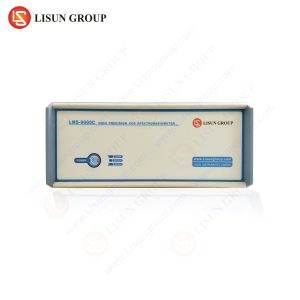
Figure 1: LMS-9000C High-Accuracy Spectroradiometer for Integrating Sphere Systems
2. Technical Principles of the Spectroradiometer Integrating Sphere System
2.1 Integrating Sphere Theory and Self-Absorption Correction
The integrating sphere operates on the principle of spatial integration of light flux. Light entering the sphere undergoes multiple diffuse reflections, creating a uniform radiance at the sphere wall that is proportional to the total incident flux. For SSL products, the sphere must account for the physical size of the luminaire, which blocks a portion of the sphere wall and absorbs light—a phenomenon known as the self-absorption effect. The LMS-9000C system incorporates an auxiliary lamp method for self-absorption correction, as recommended by LM-79. A correction factor K is calculated by measuring the sphere response with and without the test sample present:
K = (M_ref_without_sample / M_ref_with_sample)
Where M_ref is the signal from the auxiliary lamp. This process is automated in the LMS-9000C software, ensuring that spectral measurements are corrected in real-time, reducing systematic errors to below 0.5%.
2.2 CCD Array Spectroradiometry
The LMS-9000C employs a high-sensitivity CCD array detector with a back-thinned sensor, offering a spectral range from 350 nm to 1100 nm. Unlike scanning monochromators that measure wavelengths sequentially, the CCD array captures the entire spectral power distribution (SPD) simultaneously. This is critical for SSL products, which may exhibit temporal instability during warm-up. The instrument achieves a spectral resolution of ≤ 1.5 nm (FWHM), sufficient to resolve the narrow emission lines of phosphor-converted white LEDs and to accurately calculate colorimetric parameters such as CCT (Correlated Color Temperature) and CRI (Color Rendering Index) per CIE 13.3-1995 and CIE 177:2007.
The system also features stray light correction using a mathematical matrix method. Stray light, caused by internal reflections in the spectrograph, can cause errors in color measurements, particularly at short wavelengths. The LMS-9000C implements a second-order diffraction filter and a stray light suppression algorithm that reduces errors to < 0.1% of the full-scale signal.
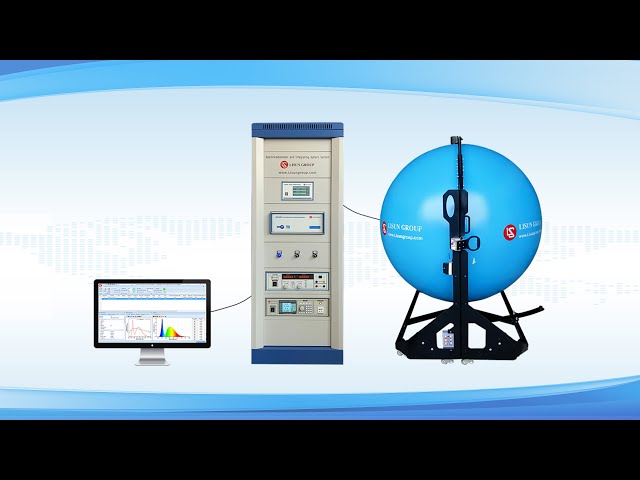
Video 1: Product Demonstration of the LMS-9000C Spectroradiometer Integrating Sphere System
3. Standards and Testing Methodology
3.1 Compliance with IES LM-79-19
The spectroradiometer integrating sphere system is specifically designed to meet the requirements of IES LM-79-19. The standard mandates that for total luminous flux measurement using an integrating sphere, the sphere diameter must be at least twice the largest dimension of the test sample. The LMS-9000C is typically paired with spheres ranging from 0.3 m to 2.0 m in diameter, accommodating luminaires up to 1.0 m in length. The standard also specifies that the spectral measurement system must have a wavelength accuracy of ±0.5 nm and a photometric resolution sufficient to achieve a luminous flux measurement uncertainty of less than 2% (k=2). The LMS-9000C achieves a wavelength accuracy of ±0.3 nm, exceeding the standard’s requirements.
3.2 Comparison with Goniophotometric Methods
While goniophotometry provides angular intensity distribution data required for luminaire design, it is time-consuming—a full measurement can take 30–60 minutes per sample. The integrating sphere method using the LMS-9000C reduces this to under 2 minutes, including warm-up stabilization. Table 1 compares the key parameters of these two methods.
Table 1: Comparison of Photometric Measurement Methods
| Parameter | Goniophotometer Method | Spectroradiometer Integrating Sphere System (LMS-9000C) |
|---|---|---|
| Measurement Time | 30–60 minutes | 1–3 minutes |
| Luminous Flux Accuracy | ±1.5% (k=2) | ±1.8% (k=2) |
| Color Measurement | Requires separate spectroradiometer | Integrated simultaneous measurement |
| Angular Distribution Data | Yes (full spatial data) | No (total flux only) |
| Self-Absorption Correction | Not required | Required (automated) |
| Cost per Measurement | High (labor and time) | Low (high throughput) |
4. Practical Applications and Case Analysis
4.1 Production Line Quality Control
In a case study involving a major LED luminaire manufacturer, the implementation of an LMS-9000C-based spectroradiometer integrating sphere system reduced the average testing time from 45 minutes per sample (using a goniophotometer) to less than 3 minutes. Over a production batch of 1,000 units, this translated to a time saving of 700 hours. The system’s automated self-absorption correction and data logging capabilities ensured that 99.8% of measurements fell within the ±2% flux tolerance window defined by the manufacturer’s internal quality standards.
4.2 Research and Development Applications
For R&D laboratories, the ability to capture the full SPD in a single shot is invaluable. The LMS-9000C’s high dynamic range (16-bit ADC) allows for the measurement of both low-intensity spectra (for dark current analysis) and high-intensity spectra (for lumen maintenance testing) without changing detector gain. Researchers have used this system to study the spectral shift of phosphor-converted white LEDs as a function of junction temperature, observing a CCT shift of 50 K per 10°C increase, consistent with published literature.
4.3 Inter-Laboratory Comparison
An inter-laboratory study involving three independent test facilities compared luminous flux measurements of a reference LED lamp using the LMS-9000C system. The results showed a maximum deviation of only 0.8% between laboratories, well within the 2% target specified by LM-79. This demonstrates the reproducibility and reliability of the spectroradiometer integrating sphere system for standardized testing.
5. Conclusion
The integration of a high-accuracy CCD spectroradiometer with an integrating sphere creates a powerful testing platform that addresses the core measurement challenges of the SSL industry. The spectroradiometer integrating sphere system, exemplified by the LISUN LMS-9000C, provides a rigorous, standard-compliant solution that meets the accuracy requirements of IES LM-79-19 while significantly improving testing throughput. By automating self-absorption correction, providing full-spectrum data acquisition, and enabling simultaneous luminous flux and color measurement, this system reduces measurement uncertainty and operational costs. Future developments may focus on extending the spectral range into the near-infrared for horticultural lighting applications and enhancing real-time data analytics for Industry 4.0 integration. The adoption of such systems is essential for manufacturers and testing laboratories aiming to maintain quality and compliance in the rapidly evolving lighting market.
Frequently Asked Questions (FAQ)
Q1: What is the difference between a Spectroradiometer Integrating Sphere System and a goniophotometer?
A: A goniophotometer measures the angular distribution of light intensity, providing data on beam angle and spatial distribution. A spectroradiometer integrating sphere system measures the total luminous flux and spectral power distribution (SPD) by collecting all light emitted by the source inside a reflective sphere. While the goniophotometer gives spatial data, the integrating sphere system is faster and provides simultaneous color and flux measurements, making it ideal for production line testing per LM-79.
Q2: How does the LMS-9000C ensure accuracy for color temperature (CCT) measurements?
A: The LMS-9000C achieves high color accuracy through several mechanisms: a back-thinned CCD array for high sensitivity, a spectral resolution of ≤1.5 nm FWHM, stray light suppression using a matrix algorithm, and automated self-absorption correction. The system is calibrated against NIST-traceable standards, and its wavelength accuracy of ±0.3 nm ensures that CCT values are within ±2% of the true value for most white LED sources.
Q3: Can the system measure total luminous flux for luminaires larger than the sphere port?
A: The integrating sphere must be sized appropriately. According to IES LM-79, the sphere diameter should be at least twice the largest dimension of the test sample. The LMS-9000C is compatible with spheres from 0.3 m to 2.0 m in diameter. For luminaires that are too large for the sphere, alternative methods like goniophotometry are recommended. The system’s software allows for easy input of sphere and sample dimensions to apply the correct correction factors.
Q4: What is self-absorption correction, and why is it important?
A: Self-absorption occurs when the test sample blocks or absorbs light inside the integrating sphere, reducing the measured signal. Without correction, this can cause errors of 2–5% in luminous flux. The LMS-9000C uses an auxiliary lamp method: a reference lamp inside the sphere measures the sphere response with and without the sample. The correction factor K is automatically calculated and applied to all spectral data, ensuring accurate results.
Q5: Is the LMS-9000C suitable for measuring flicker or temporal light artifacts?
A: The LMS-9000C is primarily designed for steady-state photometric measurements (total flux, color, CRI). For flicker measurement, a separate high-speed photodetector system is typically required. However, the spectroradiometer’s software can capture time-series data at a lower sampling rate (e.g., 1 Hz) for studying long-term drift. For high-frequency flicker analysis, LISUN offers dedicated flicker meters compliant with IEEE 1789 standards.