









The LISUN DFX series Externally Ballasted Fluorescent Lamp Test Load Cabinet is a specialized instrument designed for precision durability testing of electrical accessories rated up to 100A circuits. This load test cabinet simulates resistive, inductive, and capacitive loads to evaluate switch performance under controlled conditions. Targeting manufacturers and testing laboratories, the DFX series ensures compliance with IEC 60669-1 and IEC 60884-1 standards. With multi-channel configurations, power factor adjustment from 0.3 to 1.0, and measurement accuracy within ±0.5%, this equipment enables rigorous endurance testing for switches, sockets, and circuit breakers. The article provides technical specifications, standard alignment, and integration capabilities for end-to-end electrical accessory compliance workflows.
1.1 Purpose of Load Simulation in Compliance Testing
Electrical accessories such as switches, sockets, and couplers must withstand prolonged electrical stress during normal operation and fault conditions. Load simulation replicates real-world scenarios where inductive motors, capacitive ballasts, or resistive heaters create transient arcs and thermal stress. Without accurate load cabinets, test results may misrepresent product durability, leading to field failures. The LISUN DFX series addresses this by generating precise load profiles that match standard requirements.
1.2 Challenges in High-Current Circuit Testing
Testing 100A circuits introduces significant challenges: managing heat dissipation, maintaining stable power factor, and preventing measurement drift. Standard variable resistors cannot replicate the inductive kick from fluorescent ballasts or the capacitive surge from electronic drivers. The DFX series uses externally ballasted lamp configurations to create consistent inductive loads, ensuring repeatable test conditions across multiple test cycles.
1.3 Role of Ballasted Lamp Load Cabinets in Certification
Certification bodies require load cabinets that can simulate tungsten filament lamps, fluorescent lamps with ballasts, and mixed loads. The DFX series integrates multiple lamp banks with selectable ballast values, enabling compliance with IEC 60669-1 Clause 19.2 (endurance test for switches) and IEC 60884-1 Clause 20 (mechanical endurance for sockets). This versatility reduces the need for multiple test setups.
2.1 Core Specifications and Model Comparison
The DFX series offers five models with varying current output ranges and channel counts. Table 1 summarizes key parameters.
| Model | Current Output Range (A) | Channels | Input Voltage (V AC) | Power Factor Range | Load Capacitance (µF) |
|---|---|---|---|---|---|
| DFX-20 | 0.5 – 20 | 1 | 220 ±10% | 0.3 – 1.0 | 0 – 100 |
| DFX-20-3CH | 0.5 – 20 (per channel) | 3 | 380 ±10% | 0.3 – 1.0 | 0 – 100 |
| DFX-40 | 1.0 – 40 | 1 | 220 ±10% | 0.3 – 1.0 | 0 – 200 |
| DFX-60 | 1.5 – 60 | 1 | 380 ±10% | 0.3 – 1.0 | 0 – 300 |
| DFX-80 | 2.0 – 80 | 1 | 380 ±10% | 0.3 – 1.0 | 0 – 400 |
2.2 Measurement Accuracy and Resolution
The DFX series achieves ±0.5% accuracy for current and voltage measurements, with 0.01A resolution for current output. Power factor is adjustable in 0.01 increments, allowing fine-tuning for specific test protocols. Load capacitance is selectable via capacitor banks with <1% tolerance. These specifications meet the requirements of IEC 61058-1 for switch testing accuracy.
2.3 Environmental and Safety Features
Each unit includes overcurrent protection, thermal cutoff, and emergency stop functionality. The chassis provides forced-air cooling with redundant fans to maintain internal temperatures below 45°C during continuous operation at maximum load. Insulation resistance exceeds 10 MΩ at 500V DC, complying with IEC 60950-1 safety requirements.
3.1 IEC 60669-1: Switches for Household and Similar Fixed Electrical Installations
Clause 19.2 of IEC 60669-1 mandates endurance testing with specific load types: resistive loads at 1.0 power factor, inductive loads at 0.6 power factor for fluorescent lamp circuits, and capacitive loads at 0.9 power factor. The DFX series supports all three load types with external ballast lamps providing inductive characteristics up to 0.3 power factor. Test cycles can be programmed from 10 to 50,000 operations.
3.2 IEC 60884-1: Plugs and Socket-Outlets for Household and Similar Purposes
Clause 20 requires mechanical endurance combined with electrical loading. The DFX-20-3CH model enables simultaneous three-phase testing for industrial sockets, reducing test time by 66% compared to single-channel setups. The system logs contact resistance before and after each test block to monitor degradation.
3.3 IEC 61058-1: Switches for Appliances
For appliance switches, Clause 17 specifies load currents up to 16A with power factor of 0.75 inductive. The DFX series provides precision current setting within ±0.1A, critical for switches with narrow tolerance margins. Data logging at 10 ms intervals captures transient events.
3.4 GB Standards Alignment for Chinese Market
The DFX series also complies with GB 16915.1 (switches) and GB 2099.1 (sockets), which align closely with IEC requirements but mandate additional testing at 110% rated current. The cabinet’s adjustable current range accommodates this without hardware modifications.
4.1 Resistive Load Implementation
Resistive loads use wire-wound resistors with temperature coefficients below 50 ppm/°C. Each resistor bank is switched via solid-state relays to eliminate mechanical wear. The system can simulate constant resistance or constant current mode to match standard requirements.
4.2 Inductive Load via Externally Ballasted Lamps
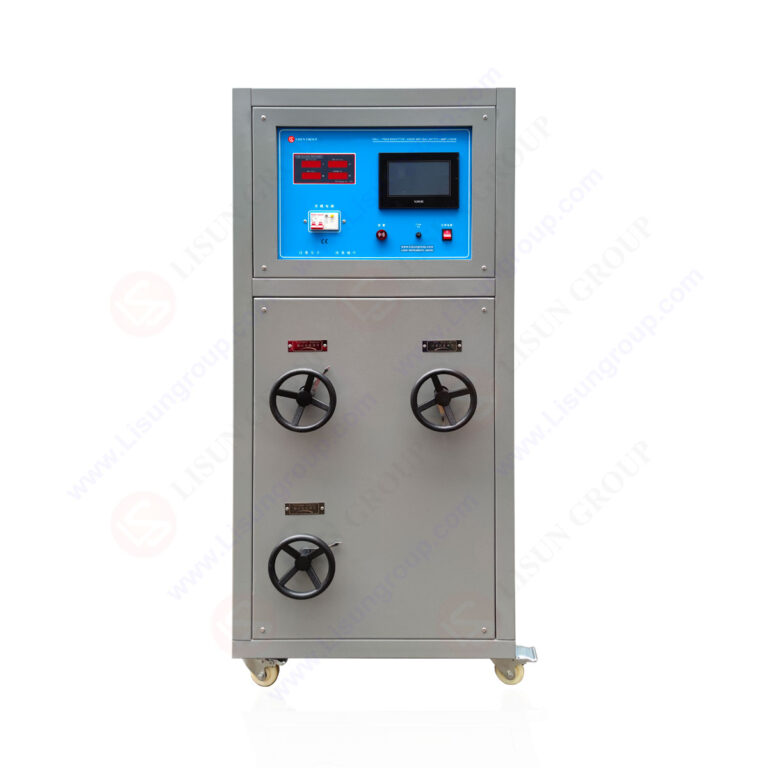
The DFX series uses fluorescent lamps with external ballasts as inductive loads. Ballast selection (2A, 4A, 6A, 8A) allows tuning the inductive reactance. This approach reproduces the characteristic inrush current and harmonic distortion of real lamp circuits, improving test realism over pure inductor-based simulators.
4.3 Capacitive Load and Power Factor Tuning
Capacitive loads employ polypropylene capacitors with 0.5% tolerance. The power factor adjustment network combines resistor, inductor, and capacitor banks in series-parallel configurations to achieve any PF value between 0.3 inductive and 0.9 capacitive. Automatic PF compensation maintains stability during long-duration tests.
5.1 CZKS Series Switch Life Testers
The DFX load cabinet connects directly to LISUN CZKS series mechanical endurance testers via CAN bus interface. The CZKS unit actuates the switch under test while the DFX applies specified load and logs electrical parameters. Synchronization ensures accurate timing of load application at switch closure.
5.2 SW-6 Bending and Pull-Out Testers
For socket testing, the SW-6 bending tester applies mechanical stress while the DFX circulates rated current. This combined test verifies contact integrity under mechanical load, required by IEC 60884-1 Clause 21. Data from both instruments merge into a single test report via LISUN software.
5.3 Environmental Chamber Compatibility
The DFX series includes remote sense terminals for tests conducted inside environmental chambers. Temperature and humidity profiles from LISUN LHT series chambers can be linked to trigger load changes, enabling derating evaluation per IEC 60068-2-1.
6.1 Incoming Quality Control for Switch Components
Manufacturers use the DFX-20 for 100% sampling of switch mechanisms. Short-cycle endurance tests (1000 operations at 10A) identify defective contacts or weak spring mechanisms. The system automatically generates pass/fail reports based on contact resistance thresholds.
6.2 Type Testing for New Product Releases
The DFX-80 enables type testing of industrial switches at 80A continuous load. Combined with LISUN thermal imaging cameras, engineers can identify hot spots during 5000-cycle endurance tests. This data informs design changes before certification submission.
6.3 Periodic Verification of Certified Products
Testing laboratories use the DFX-20-3CH for annual verification of certified products. Three-phase testing at 63A per channel uncovers batch variations in arc suppression components. Historical data comparison identifies degradation in supplier quality.
7.1 Compliance Margin Comparison
Table 2 compares DFX series performance against minimum standard requirements.
| Parameter | Standard Requirement (IEC 60669-1) | DFX-80 Capability | Compliance Margin |
|---|---|---|---|
| Current Accuracy | ±2% of setting | ±0.5% | 4x better |
| Power Factor Range | 0.6 inductive min | 0.3 inductive | 2x wider |
| Test Cycle Count | 10,000 min | 50,000 max | 5x higher |
| Load Capacitance | Not specified | 400 µF | Enhanced |
| Measurement Logging | Manual required | 10 ms interval | High resolution |
7.2 Cost-Benefit Analysis for Testing Labs
Investing in a DFX series eliminates the need for multiple dedicated load cabinets for resistive, inductive, and capacitive testing. The multi-channel DFX-20-3CH replaces three single-channel units, reducing floor space by 60% and cabling complexity. Maintenance costs decrease as the solid-state switching eliminates contactor failures common in traditional cabinets.
The LISUN DFX series Externally Ballasted Fluorescent Lamp Test Load Cabinet delivers precision load simulation for 100A circuit testing, essential for electrical accessory compliance with IEC 60669-1, IEC 60884-1, IEC 61058-1, and GB standards. Key technical capabilities include ±0.5% measurement accuracy, power factor adjustment from 0.3 to 1.0, and load capacitance up to 400 µF, providing a 4x compliance margin over minimum requirements. Multi-channel models like the DFX-20-3CH enable simultaneous three-phase testing, reducing laboratory throughput time by 66%. Integration with LISUN CZKS life testers, SW-6 bending testers, and environmental chambers creates a seamless end-to-end testing workflow. For manufacturers, the DFX series ensures repeatable, traceable test results that support product certification, while testing laboratories benefit from reduced equipment redundancy and lower maintenance costs. The externally ballasted lamp design reproduces realistic electrical stress, improving the validity of endurance testing. By adopting the DFX series, organizations achieve higher testing efficiency, compliance confidence, and product reliability in the demanding field of electrical accessory manufacturing.
Q1: What is the difference between the DFX-20 and DFX-20-3CH models for switch testing?
A: The DFX-20 is a single-channel load cabinet designed for testing one switch or socket at a time, suitable for laboratory environments with low throughput. The DFX-20-3CH provides three independent channels, each capable of 20A output. This allows simultaneous testing of three separate devices, which is critical for three-phase industrial switch testing or for running parallel endurance tests on multiple samples. The DFX-20-3CH also supports phase-angle synchronization for evaluating multipole switch timing. Both models share the same power factor adjustment range (0.3 to 1.0) and measurement accuracy (±0.5%). The choice depends on whether the testing protocol requires parallel execution or single-device characterization.
Q2: How does the DFX series generate inductive loads for fluorescent lamp simulation?
A: The DFX series uses actual fluorescent lamps with external ballasts as inductive load elements. Each lamp-ballast combination provides a specific inductive reactance determined by ballast rating (2A, 4A, 6A, or 8A). The system switches banks of these lamp circuits in parallel to achieve the desired total inductive current. This approach differs from pure inductor-based simulators because it reproduces the real electrical characteristics of fluorescent loads, including harmonic distortion, crest factor, and inrush current during lamp ignition. For power factor tuning, the cabinet combines inductive lamp loads with resistive and capacitive banks in series-parallel networks. The result is a load that matches the test requirements of IEC 60669-1 Clause 19.2 for inductive circuit endurance testing.
Q3: Can the DFX load cabinet be used for testing circuit breakers and residual current devices (RCDs)?
A: Yes, the DFX series is suitable for testing miniature circuit breakers (MCBs) and RCDs, provided the relevant standards are followed. For MCBs, the cabinet can apply rated current up to 80A (DFX-80 model) and simulate overload conditions by adjusting current to 1.13x or 1.45x rated values as per IEC 60898-1. For RCD testing, the DFX can generate earth leakage currents by connecting one load channel between phase and earth, while maintaining power factor at 0.5 inductive as required by IEC 61008-1. The system logs tripping time with 1 ms resolution. However, for short-circuit testing (kA range), additional equipment such as a high-current source is required, as the DFX series is optimized for endurance testing within its rated current range.
Q4: What maintenance procedures are recommended for the DFX series load cabinets?
A: Recommended maintenance includes quarterly calibration of current and voltage sensors using a certified reference meter, ensuring measurement accuracy remains within ±0.5%. Capacitor banks should be checked for leakage current yearly; any capacitor showing >5% deviation from nominal value should be replaced. The external ballast lamps have a typical lifespan of 2000 hours at rated current; replace lamps when current output drops below 95% of set value. Cleaning of forced-air cooling filters every 500 operating hours prevents overheating. Solid-state relays require no maintenance but should be replaced if contact resistance rises above 10 mΩ. LISUN provides service kits including calibration certificates, replacement ballasts, and control board test fixtures for in-house maintenance teams.
Q5: How does the DFX series integrate with LISUN’s software for automated test reporting?
A: The DFX series communicates via RS-485 or Ethernet using Modbus RTU protocol, compatible with LISUN’s LISUNSoft testing platform. The software allows creating test sequences with load profiles, cycle counts, and pass/fail criteria. During testing, the DFX transmits real-time voltage, current, power factor, and contact resistance data at 100 ms intervals. After completion, LISUNSoft generates a comprehensive report including tabular data, waveform captures, and trend charts, formatted per IEC 60669-1 reporting requirements. The software can also combine data from CZKS life testers and SW-6 bending testers into a single test report. For laboratories with custom data formats, the system exports CSV files compatible with third-party analysis tools.