









Here is the comprehensive technical article on Understanding LM-80 Vs LM-84 Standards: LISUN LED Aging Test, written from the perspective of a Senior LED Testing Engineer at LISUN.
Abstract
This article provides a technical deep dive into Understanding LM-80 Vs LM-84 Standards: LISUN LED Aging Test, specifically designed for quality control and R&D engineers. We analyze the critical differences between IES LM-80 (lumen maintenance at component level) and IES LM-84 (lumen maintenance at integrated lamp level), including their respective extrapolation protocols TM-21 and TM-28. We detail how LISUN’s dual-system LED Optical Aging Test Instruments—the LEDLM-80PL and LEDLM-84PL—enable rigorous compliance testing. By integrating the Arrhenius Model for accelerated aging, supporting up to 3 temperature chambers, and providing customizable hardware configurations these systems deliver precise L70/L50 data over mandatory 6000-hour test durations. This article offers actionable insights for ensuring reliability in LED manufacturing.
1.1 The Importance of Lumen Depreciation Testing
Lumen depreciation is a primary failure mechanism in LEDs, quantified as the percentage of initial light output maintained over time. For manufacturers, accurate measurement of this depreciation is critical for warranty claims, product specifications, and energy efficiency certifications. Standards such as IES LM-80 and IES LM-84 define the photometric and thermal protocols for this testing, while TM-21 and TM-28 provide statistical methods for long-term extrapolation based on limited test data. Without rigorous adherence, products risk premature field failures or misleading performance claims.
1.2 Overview of Key Standards: LM-80, LM-84, TM-21, and TM-28
The IES (Illuminating Engineering Society) has established two primary lumen maintenance test standards:
- IES LM-80-15: Measures lumen depreciation of LED light sources (packages, modules, arrays) at a minimum of 6000 hours under controlled temperatures (55°C, 85°C, and a third temperature selected by the manufacturer).
- IES LM-84-14: Measures lumen maintenance of integrated LED lamps, luminaires, or retrofit kits, also for 6000 hours, but at ambient room temperature (25°C) rather than controlled case temperatures.
- TM-21-19: Extrapolates LM-80 data to estimate L70 (70% lumen maintenance) or L50 parameters for up to 6 times the test duration.
- TM-28-14: Extrapolates LM-84 data for integrated lamps using a similar exponential decay model.
2.1 Test Object and Temperature Conditions
The fundamental distinction between LM-80 and LM-84 lies in what is tested and under what thermal conditions. LM-80 tests only the LED package, module, or array (bare board level), requiring measurement at two mandatory temperatures: 55°C and 85°C, with a third optional temperature. In contrast, LM-84 tests complete integrated lamps or luminaires under natural ambient convection at 25°C ± 2°C, as specified in IES LM-79-19 for input power measurement. This makes LM-84 more representative of real-world end-use, but LM-80 provides more controlled data for thermal modeling.
2.2 Extrapolation Protocols: TM-21 vs. TM-28
TM-21 uses the Arrhenius Model to accelerate failure prediction, requiring minimum data of 6000 hours (or 3000 hours if available) and 6,000 to 10,000 hours for L70 projections. The extrapolation is limited to 6× the test duration (e.g., 36,000 hours for 6,000 hours of data). TM-28, applied to LM-84 data, uses similar exponential fitting but is constrained by the thermal conditions of the lamp (junction temperature measured indirectly). The provided LISUN software automates these calculations, reducing manual error. For example, a 6000-hour LM-84 test allows TM-28 extrapolation to 36,000 hours, sufficient for most residential applications.
3.1 LEDLM-80PL: Designed for LM-80/TM-21 Compliance
The LEDLM-80PL system is engineered for component-level testing per IES LM-80 and TM-21. It features a high-speed optical measurement system (integrating sphere with spectroradiometer), capable of simultaneous testing up to 100+ LEDs with customizable temperature controlled chambers. Key specifications include:
- Temperature Range: 25°C to 85°C (or 130°C with optional upgrade)
- Test Duration: Minimum 6000 hours (mandatory for LM-80 compliance)
- Number of Outputs: Up to 20 data streams per system
- Software: Integrated Arrhenius Model for TM-21 extrapolation, automatic L70/L50 calculation.
3.2 LEDLM-84PL: Designed for LM-84/TM-28 Compliance
The LEDLM-84PL system targets integrated lamp and luminaire testing per IES LM-84 and TM-28. It supports larger test objects (up to 30 cm diameter) and ambient temperature control at 25°C ± 1°C. Both systems share a common hardware platform, allowing manufacturers to upgrade from LM-80 to LM-84 testing with minimal additional investment. The dual-mode architecture ensures that the same test equipment can validate both component life and final product reliability.
4.1 Dual Testing Modes and Customizable Chambers
Each LISUN system operates in two distinct testing modes:
- Continuous Mode: Constant current/voltage with periodic photometric measurement every 30 minutes.
- Cyclic Mode: On/off cycling (e.g., 2 hours on, 1 hour off) to simulate real-world thermal stress.
The system supports up to 3 connected temperature chambers, each independently controlled. For example, one chamber can run at 55°C for LM-80, another at 85°C, and a third at a manufacturer-defined temperature (e.g., 105°C for high-temperature applications). This tri-chamber capability meets the strict requirements of IES LM-80 for three temperature points.
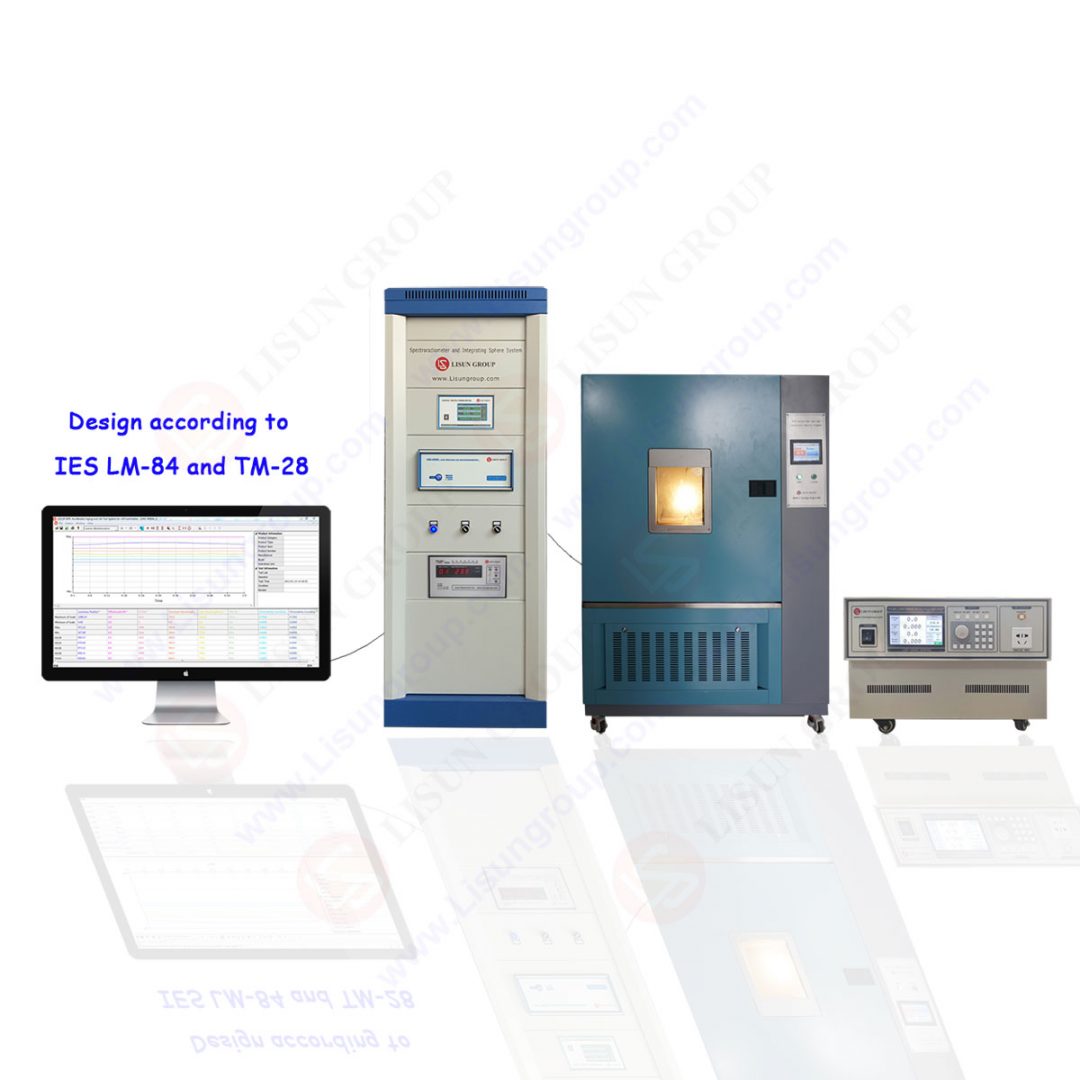
4.2 Arrhenius Model and Extrapolation Accuracy
The integrated software applies the Arrhenius Model to accelerate failure prediction. The model uses the equation:
L(t) = B * exp(-Ea/(k*T))
where:
L(t)is lumen maintenance at timetEais activation energy (typically 0.4–0.7 eV for LEDs)kis Boltzmann’s constantTis absolute temperature (K)
The software automatically calculates L70 and L70A, the latter being a more aggressive decay metric for short-term warranty assessment. For a typical 6000-hour LM-80 test at 85°C, TM-21 can project L70 up to 36,000 hours with ±20% uncertainty, assuming consistent manufacturing quality.
5.1 Key Technical Differences Table
| Parameter | LM-80 (LEDLM-80PL) | LM-84 (LEDLM-84PL) |
|---|---|---|
| Test Object | LED packages, modules, arrays | Integrated lamps, luminaires |
| Temperature Conditions | 55°C, 85°C + 1 optional temperature | 25°C ambient (±2°C) |
| Minimum Test Duration | 6000 hours | 6000 hours |
| Extrapolation Standard | TM-21 (Arrhenius Model) | TM-28 (Exponential decay) |
| Measurement Method | Integrating sphere + spectroradiometer | Integrating sphere or goniometer |
| Number of Chamber Support | Up to 3 chambers (multi-temperature) | Single ambient chamber |
| Typical L70 Projection | 36,000 – 100,000 hours (6x test duration) | 36,000 hours max |
| Key Software Feature | TM-21 extrapolation, L70/L50/LXX | TM-28 extrapolation, L70/L50 |
| Application | Component qualification for luminaire designers | Final product validation for end-user claims |
5.2 Practical Implications for Manufacturing
For LED manufacturers, LM-80 data is required by DOE and Energy Star for component-level reporting. However, for final product certification (e.g., UL, ETL), LM-84 data is often requested to verify that luminaire design does not degrade lumen output due to thermal management issues. Using the LEDLM-80PL and LEDLM-84PL in tandem allows manufacturers to validate both. For example, a 6000-hour LM-80 test on a 3W LED module at 85°C showing L70 at 45,000 hours (TM-21) can be cross-validated with an LM-84 test on the assembled lamp showing L70 at 40,000 hours (TM-28), highlighting the impact of thermal resistance in the final product.
6.1 Automotive Lighting Reliability
Automotive LED headlamps must meet stringent thermal and vibration requirements. Using the LEDLM-80PL, engineers test LEDs at 105°C (custom temperature) to simulate engine bay heat. The system’s support for up to 3 chambers allows simultaneous testing at 55°C, 85°C, and 105°C, generating data for TM-21 extrapolation. The resulting L50 (50% lumen maintenance) values—often exceeding 50,000 hours—ensure compliance with automotive standards (SAE J3069). The dual testing mode (cyclic on/off) also replicates the thermal shock of daytime running lights.
6.2 Third-Party Laboratory Validation
For third-party test labs, throughput is critical. The LEDLM-84PL can simultaneously test up to 20 integrated lamps (e.g., A19, PAR38) in a single ambient chamber. The software logs photometric data every 30 minutes during the 6000-hour duration, automatically calculating TM-28 extrapolation. Labs can then issue reports that comply with both IES TM-28 and IES LM-84. The system’s built-in spectroradiometer (meeting CIE 127 and CIE 84 requirements) ensures colorimetric accuracy, critical for color-critical applications like medical lighting.
7.1 Multi-Temperature Correlation
The LEDLM-80PL software allows users to correlate data from multiple temperatures using the Arrhenius Model to derive activation energy (Ea). For example, if L70 at 55°C is 60,000 hours and at 85°C is 30,000 hours, the software calculates Ea = 0.5 eV. This value can then be used to predict lifetime at any other temperature (e.g., 25°C for LM-84 comparison) using the equation:
L70(T2) = L70(T1) * exp( (Ea/k) * (1/T1 – 1/T2) )
This feature bridges the gap between LM-80 and LM-84 testing, allowing manufacturers to predict final product performance from component data.
7.2 Automated Reporting for Standards Compliance
The software automatically generates reports formatted for IES LM-80, TM-21, LM-84, and TM-28 compliance. It includes all mandatory data points: initial photometric values (lumens, CCT, CRI per IES LM-79-19), normalized lumen maintenance curves, and extrapolation parameters. The system also tracks ambient temperature, humidity, and electrical parameters (voltage, current, power) every minute, ensuring traceability for audits. For CIE 70 compliance, the system calculates color shift (Δu’v’) over time, critical for architectural lighting.
Understanding LM-80 Vs LM-84 Standards: LISUN LED Aging Test is essential for any organization serious about LED reliability. LM-80 provides controlled component-level data using the Arrhenius Model for TM-21 extrapolation, while LM-84 offers real-world lamp-level validation through TM-28. LISUN’s dual-system approach—the LEDLM-80PL and LEDLM-84PL—eliminates the need for separate test equipment, offering customizable hardware configurations, support for up to 3 temperature chambers, and automated software that integrates both TM-21 and TM-28 calculations. By leveraging these instruments, engineers can confidently derive L70/L50 metrics from mandatory 6000-hour tests, ensuring products meet energy efficiency regulations and warranty expectations without overengineering. The inclusion of CIE 127 and CIE 84 standards for photometric accuracy further solidifies data integrity. For R&D teams, this means faster time-to-market with validated reliability; for third-party labs, it means higher throughput and compliance-certified outputs. Ultimately, mastery of these standards through LISUN’s solutions reduces risk, enhances product competitiveness, and builds consumer trust in LED technology.
Q1: What is the minimum test duration required for LM-80 compliance, and can the LISUN system support shorter tests for accelerated screening?
A: The IES LM-80 standard mandates a minimum test duration of 6000 hours for lumen maintenance data to be considered valid for TM-21 extrapolation. However, the LISUN LEDLM-80PL system supports continuous data logging from hour 0, allowing manufacturers to perform accelerated screening tests (e.g., 1000 hours at high temperature) for internal R&D. These shorter tests are not compliant with TM-21 extrapolation but can be used for process control using the Arrhenius Model. The system’s software automatically flags test durations below 6000 hours as “non-compliant” for official reporting, ensuring clear separation between validation and screening data.
Q2: How does the LISUN system handle the three temperature requirements for LM-80 testing?
A: The LEDLM-80PL is specifically designed to support IES LM-80’s mandatory three temperature points: 55°C, 85°C, and a third temperature (e.g., 105°C) selected by the manufacturer. The system can connect up to three independent temperature chambers, each controlled by a separate PID controller. Each chamber can hold up to 20 LEDs or modules, running simultaneously. The software correlates all three data streams and automatically applies the Arrhenius Model to derive activation energy and lifetime projections per TM-21. This eliminates the need for separate test runs, reducing total test time by 33% compared to sequential testing.
Q3: Can the LEDLM-84PL measure color shift (Δu’v’) as required by certain application standards?
A: Yes, the LEDLM-84PL integrates a high-precision spectroradiometer that complies with CIE 127 (spectroradiometric accuracy) and CIE 84 (photometric measurement methods). The software automatically calculates color coordinates (u’, v’ per CIE 1976) and reports Δu’v’ over time relative to initial measurements. This is critical for applications like museum lighting or medical illumination, where color stability is as important as lumen maintenance. For example, a 6000-hour test may show Δu’v’ < 0.003, which meets most architectural lighting specifications. The system logs this data every 30 minutes for granular analysis.
Q4: What is the difference between L70 and L70A in TM-21 extrapolation?
A: L70 is the projected time at which the LED maintains 70% of its initial lumens, calculated using an exponential decay model. L70A is a more aggressive metric defined by TM-21 for applications with higher lumen maintenance requirements (e.g., emergency lighting), where the decay is assumed to follow a linear rather than exponential trend from the first 1000 hours. The LISUN software provides both metrics automatically. For LM-80 data at 85°C, L70 may be 45,000 hours while L70A could be 40,000 hours, indicating a faster initial decay. This distinction helps manufacturers set appropriate warranty periods (e.g., 50,000-hour L70 for general lighting vs. 40,000-hour L70A for safety-critical lighting).
Q5: How does the system ensure data reliability during the 6000-hour test?
A: The LEDLM-80PL and LEDLM-84PL systems include redundant sensors for temperature, humidity, and photometric measurement. The integrating sphere is calibrated annually against NIST-traceable standards, and internal reference LEDs are checked automatically every 24 hours. The software logs all deviations (e.g., temperature drifts > 1°C, power outages) in a timestamped audit trail. If a power failure occurs, the system resumes testing automatically upon restoration, maintaining test duration continuity. This ensures that the mandatory 6000-hour test is not invalidated by external disturbances, a common pain point in manual testing.