









The evolution of new energy vehicles (NEVs) demands rigorous electromagnetic compatibility (EMC) validation, particularly for transient conduction immunity. This article explores how the LISUN EMS-ISO7637 Automotive Electronics Transient Immunity EMC Testing System addresses the stringent requirements of VW 80000 Automated EMC Testing for NEV Components. As automotive electronics become increasingly complex, the need for precise, repeatable, and automated testing solutions is critical. The LISUN system provides a multi-module platform for generating standardized pulses (P1/P2a/P2b/P3/P4/P5a/P5b) across 12V/24V/36V architectures. We will analyze its technical specifications, compliance with ISO 7637-2:2021 and ISO 7637-3:2016, and its operational advantages for R&D and production environments, ultimately demonstrating why it represents a pivotal tool for ensuring the reliability of modern electric and hybrid vehicle components.
1.1 The Shift from Internal Combustion Engine (ICE) to NEV Testing Requirements
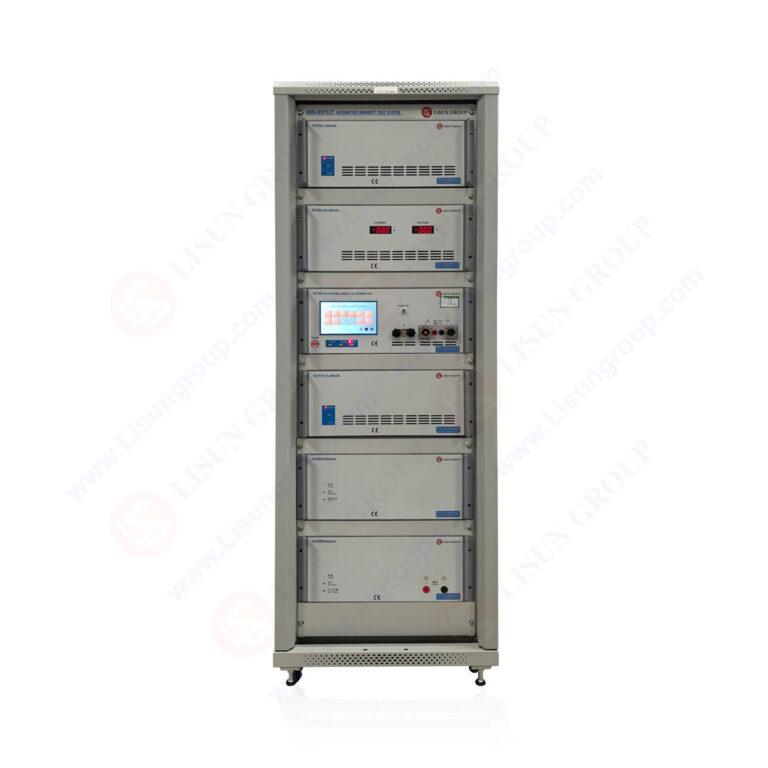
The automotive industry’s transition from internal combustion engines to new energy vehicles (NEVs) has fundamentally altered the EMC testing landscape. While ISO 7637 standards historically focused on 12V and 24V electrical systems in vehicles with conventional powertrains, the proliferation of high-voltage (up to 800V) and high-power electronics in electric vehicles (EVs) and hybrid electric vehicles (HEVs) has introduced new transient phenomena. VW 80000 Automated EMC Testing for NEV Components necessitates a comprehensive evaluation of low-voltage (12V/24V) control modules and high-voltage (36V+) power converters. The LISUN EMS-ISO7637 system is engineered to bridge this gap, providing a unified test platform that addresses both traditional and emerging power architectures. Specifically, the system’s support for 36V systems directly aligns with the trend toward 48V mild-hybrid systems, while its pulse generators are capable of simulating the stringent transient profiles defined by VW 80000, which often exceeds the baseline requirements of international standards.
1.2 Key Standards Frameworks: ISO, GB/T, and VW 80000
Understanding the interplay between different standards is non-negotiable for test engineers. The foundation is laid by ISO 7637-2:2021 (Road vehicles — Electrical disturbances from conduction and coupling — Part 2: Electrical transient conduction along supply lines only) and ISO 7637-3:2016 (Part 3: Electrical transient transmission by capacitive and inductive coupling via lines other than the supply lines) . In China, the equivalents are GB/T 21437.2-2021 and GB/T 21437.3-2021. For NEV components, VW 80000 (VW80000:2021-04, Electrical and electronic components in motor vehicles up to 3.5t – General requirements, test conditions and tests) is often the de facto industry benchmark. It mandates specific test pulses, severity levels, and test durations that are more rigorous than ISO. Additionally, ISO 16750-2:2023 (Road vehicles — Environmental conditions and testing for electrical and electronic equipment — Part 2: Electrical loads) defines the broader electrical load requirements, including DC supply voltage variations and short-circuit protection. A modern test system, like the LISUN EMS-ISO7637, must be flexible enough to program test parameters that satisfy all these standards simultaneously, ensuring that a component tested on one platform can be certified for global markets.
1.3 The Critical Role of Automated Testing in Compliance
The complexity of modern transient immunity tests, especially under VW 80000 Automated EMC Testing for NEV Components, makes manual testing impractical and error-prone. Standards dictate precise pulse parameters (e.g., rise times in nanoseconds, pulse widths in microseconds, and repetition times), requiring thousands of test cycles to ensure statistical confidence. Automation offers several key advantages: it guarantees repeatability, eliminates operator-induced variability, reduces test cycle time by sequencing multiple tests without manual intervention, and generates comprehensive, tamper-proof data reports required for audits. The LISUN EMS-ISO7637 system integrates this automation at its core, with a dual-operation interface (touchscreen and PC software) that allows for complex test plan creation, real-time monitoring, and automated report generation, all crucial for achieving VW 80000 certification in a timely manner.
2.1 Multi-Module Pulse Generation and Coverage
The core functional capability of the LISUN EMS-ISO7637 lies in its modular hardware design. Each pulse type specified in the standards is generated by a dedicated, highly stable module. For instance, the P5a and P5b modules are designed to simulate load dump transients, which are characterized by high energy content, while the P3 module addresses fast transients in the millisecond range. The system’s ability to cover the full spectrum of pulses P1, P2a, P2b, P3, P4, P5a, and P5b is essential. This multi-module architecture is not just about convenience; it ensures that each pulse shape is generated with the necessary power handling and waveform fidelity. For example, the P5a load dump module must handle high voltages and long durations, while the P2a module focuses on current consumption drops with fast rise times. This specialization allows the system to meet the precise tolerances (±10% for voltages, ±5% for timing, as per ISO 7637-2:2021) that are critical for valid test results, making it a perfect fit for VW 80000 Automated EMC Testing for NEV Components.
2.2 Voltage Class Support: 12V, 24V, and 36V Architectures
The transition to NEVs has not eliminated the 12V system; it remains the backbone for control units and infotainment. However, the emergence of 48V mild-hybrid systems (which are often tested at 36V per VW 80000 test criteria) and the high-voltage bus (typically 400V-800V, tested via specific HV-LV coupling networks) require a flexible platform. The LISUN EMS-ISO7637 system provides three selectable voltage ranges: 12V for standard passenger car electronics, 24V for commercial vehicles (trucks and buses), and 36V for newer mild-hybrid architectures. This capability is a critical differentiator. A single piece of test equipment can now validate a component destined for a global model range without needing separate test setups. Furthermore, this broader voltage range means the system can simulate the specific transient profiles that occur when a low-voltage battery is being charged from a high-voltage DC-DC converter, a scenario unique to NEVs and a focus of VW 80000 Automated EMC Testing for NEV Components.
2.3 User Interface and Operational Workflow
Ease of use is a practical necessity in a busy EMC laboratory. The system features a dual-control mechanism: a front-panel touchscreen for rapid, localized test setups, and a sophisticated PC-based software suite for creating complex, standards-based test sequences. The PC software allows engineers to pre-program full test profiles, including setting failure criteria for the DUT (Device Under Test), defining the number of test cycles, and mapping the test procedure to specific clauses of ISO 7637-2:2021 or VW 80000. The software also facilitates remote control and data logging. For instance, in an automated production line test, a PLC (Programmable Logic Controller) can trigger the EMS-ISO7637 via its Ethernet or GPIB interface to run a predefined test, receive a PASS/FAIL signal, and log the results for traceability. This level of automation is not a luxury but a requirement for mass production inspection of NEV components, aligning with the high throughput demands of modern manufacturing.
3.1 Key Performance Parameters
When evaluating a transient immunity system, specific parameters define its utility. The LISUN EMS-ISO7637 excels in several key performance indicators. The system offers pulse voltage ranges up to ±600V for the P5a/P5b modules, matching the requirements of ISO 7637-2:2021 for load dump testing. Pulse rise times are critical; for the P3 pulse, the system can achieve a rise time of less than 5 nanoseconds, as required. The internal impedance for the artificial network (AN) is selectable between 50Ω and 200Ω, allowing the system to simulate different vehicle wiring harnesses. The coupled pulse output is stable and accurate. Additionally, the system’s error rate for timing parameters such as pulse period and duration is kept below 1%, ensuring the validity of long-duration tests. These precision metrics are essential for demonstrating repeatability to accreditation bodies and for producing statistically significant data on DUT immunity over thousands of test cycles.
3.2 Comparative Table: LISUN EMS-ISO7637 vs. Industry Standards
The following table demonstrates how the LISUN system’s specifications align with, or exceed, the requirements of major international standards, including those relevant to VW 80000 Automated EMC Testing for NEV Components.
| Feature / Parameter | LISUN EMS-ISO7637 Spec | ISO 7637-2:2021 / ISO 7637-3:2016 Requirements | VW 80000 (Typical Requirement) | Advantage of LISUN System |
|---|---|---|---|---|
| Pulse Coverage | P1, P2a, P2b, P3, P4, P5a, P5b (All Modules) | All specified in standard | All specified + specific severity levels | Full standard coverage & extended OEM levels |
| Test Voltage Range | 12V / 24V / 36V (switchable) | 12V / 24V (per standard) | 12V/24V, includes 36V for mild-hybrid | Superior – Addresses 48V hybrid trend |
| P5a/P5b Load Dump Voltage | Up to ±600V (adjustable) | Test pulses 5a/5b defined (P5a max 174V per standard, P5b similar) | May require higher margins for power electronics | Superior – Higher headroom for custom tests |
| Automation & Reporting | Full PC software control, automated data logging, batch test capability | Not specified (method is manual or semi-auto) | Implicit requirement for reproducibility | Superior – Meets high-volume production demands |
| Pulse Rise Time (P3) | < 5 ns (< 2 ns typical) | 5 ns ± 1 ns (per ISO 7637-2) | Must meet ISO specs | Excellent – Tight tolerance compliance |
| Calibration Accuracy | Traceable to national standards, ±1% for voltage, ±0.5% for time base | Must be calibrated to ISO 17025 standards | Same as ISO | High – Ensures audit-readiness |
This table clearly shows that the LISUN system is not merely compliant but provides additional headroom and features, making it a future-proof investment for labs that must handle various OEM-specific requirements, like VW 80000.
4.1 R&D Verification for ECUs and Sensors
In the R&D phase, the goal is to identify design weaknesses early. For a new engine control unit (ECU), the LISUN EMS-ISO7637 system allows engineers to subject the prototype to a “stress test matrix” that includes all standard pulses under varying battery voltage conditions. For example, in testing a 12V ECU, engineers can quickly switch the system to 24V mode to simulate a jump-start scenario, as per ISO 16750-2:2023, without reconfiguring the wiring. The automated software allows for the DUT to be monitored during the test, and any glitches can be logged against the specific pulse number. This capability is invaluable for troubleshooting and design iteration. The ability to run a VW 80000 test sequence overnight without supervision accelerates the development cycle, allowing the R&D team to have completed immunity test data ready before the design review meeting.
4.2 Compliance Testing for OBC, DC-DC Converters, and BMS
For high-voltage components like On-Board Chargers (OBCs), DC-DC converters, and Battery Management Systems (BMS), the testing strategy is more complex. These components are powered by the high-voltage (HV) battery but interface with the 12V or 24V low-voltage (LV) network. The VW 80000 Automated EMC Testing for NEV Components requires that transient spikes on the LV network do not cause disturbance to the HV system, and vice versa. Using the LISUN EMS-ISO7637 system in conjunction with a high-voltage artificial network, test engineers can inject standardized transients on the LV supply pins while the DUT is operating at full load. The system’s 36V capability is particularly relevant here, as it can simulate transients on the 36V LV net of an 800V architecture. The automated pass/fail criteria, defined in the software, allow the test system to immediately flag any voltage drop on the DUT’s output, making the determination of compliance with ISO 7637-2:2021 clear and unambiguous.
5.1 Ensuring Metrological Traceability
The integrity of EMC testing relies entirely on the accuracy of the test equipment. The LISUN EMS-ISO7637 system is designed with a strong emphasis on metrology. The internal voltage and timing measurement circuits are of high precision and are recalibrated at regular intervals to national standards. The system provides built-in self-diagnostic features that warn the user if the output pulse parameters drift outside of the tolerance band specified by ISO 7637-2:2021. Furthermore, the system supports a calibration mode where the pulse waveforms can be measured externally and the results can be fed back into the system for linearization corrections. This ensures that the system consistently delivers the exact voltage, duration, and rise time required by the test standard, which is a fundamental prerequisite for obtaining ISO 17025 accreditation for the testing laboratory.
5.2 EMC and Electrical Safety of the Test System
Since the test system is used in high-energy environments, its own immunity is important. The LISUN EMS-ISO7637 system is housed in a robust 4U chassis designed to minimize self-generated electromagnetic interference and to be immune to the high-voltage transients it is generating. The system features over-voltage, over-current, and thermal protection circuits to ensure safe operation during fault conditions on the DUT. For instance, if the DUT under test shorts to ground during a P5a load dump test, the system will automatically shut down the pulse output and display an error message. This protects the costly EUT (Equipment Under Test) and the test equipment itself. In a VW 80000 test setup, where the system may run for hours, this reliability is paramount to prevent lost test time and potentially invalid results.
6.1 Advanced Test Sequence Management
The software suite provided with the LISUN system is a central pillar for achieving VW 80000 Automated EMC Testing for NEV Components efficiency. It allows the user to define a “test plan” that combines multiple pulses. The software can automatically adjust DUT supply voltage via an external programmable power supply, run a set of P3 pulses, then a set of P1 pulses, and then switch to a P5a load dump, all in one session. This reduces the test preparation time that is typical with older equipment. The software also enables the user to define the DUT status (e.g., ON or OFF) and the required temperature chamber settings, if integrated. This integrated approach is a significant step forward from manual test setups.
6.2 Data Logging and Report Generation
Traceability is critical for recalls and audits. The system automatically generates a detailed test report in PDF or Excel format. This report includes the calibration status of the system, the date and time of the test, the operator name, the DUT identification (e.g., serial number), and a full specification of the test parameters used for each pulse (voltage, time, internal resistance). Critically, it also logs the DUT’s response status (PASS/FAIL). This reduces the administrative burden on the test engineer and provides a transparent, legal record that fulfills the documentation requirements of ISO 17025 and VW 80000. This automation represents a major operational advantage for quality control specialists in mass production, allowing for go/no-go decisions to be made based on the instantaneous data feedback.
7.1 Adapting to 800V Electric Vehicle Architectures
As the automotive industry moves toward 800V electric vehicle architectures to enable faster charging, the nature of transients is changing. While the LISUN EMS-ISO7637 is focused on the LV supply lines, its test capabilities are adaptable. The 36V range support is a future-proofing feature, as new components designed for 48V onboard networks are developed. Furthermore, the system can be used in conjunction with CDNs (Coupling Decoupling Networks) to test for transients on the HV bus, as required by ISO 7637-3:2016 for signal lines. By maintaining a flexible pulse generation architecture, the system ensures that as OEM standards like VW 80000 evolve to include new test pulses, the fundamental capabilities of the hardware can be leveraged is a safe, functional piece of capital equipment for the next decade.
7.2 Integration into Fully Automated Test Benches
The future of EMC testing is integration. A modern test laboratory for NEV components will have EMC chambers connected to data acquisition systems, environmental chambers, and central databases. The LISUN EMS-ISO7637, with its PC-based software and remote control interfaces, is designed to be an integral part of such a system. Its API (Application Programming Interface) allows for seamless integration into a larger test automation framework (e.g., using LabVIEW or Python). This means that when performing VW 80000 Automated EMC Testing for NEV Components, the test sequence can be initiated and controlled by the central test controller, which also manages the load levels of the DUT and records other operational parameters. This ensures that the EMC test is a component of a comprehensive, multi-parameter validation, significantly accelerating the time-to-market for new vehicle models.
The LISUN EMS-ISO7637 Automotive Electronics Transient Immunity EMC Testing System emerges as a quintessential tool for performing VW 80000 Automated EMC Testing for NEV Components. Its multi-module architecture, covering all essential pulses, combined with its unique 12V/24V/36V voltage support, positions it as a highly versatile solution for the diverse power architectures found in modern electric and hybrid vehicles.
The system’s depth in automation, high calibration accuracy, and robust data reporting capabilities directly address the production and compliance challenges faced by NEV component manufacturers. By facilitating compliance with ISO 7637-2:2021, ISO 7637-3:2016, and OEM-specific standards like VW 80000 and GB/T standards, it provides a tangible return on investment by ensuring reliable product design and preventing costly field failures. For R&D teams, quality control labs, and third-party testing houses, the system offers the precision and efficiency needed to keep pace with the rapid evolution of automotive electronics. As the industry accelerates toward full electrification, the demand for rigorous and automated transient immunity testing will only intensify, making the LISUN system a critical asset for ensuring the electrical resilience of next-generation vehicles.
Q1: What are the fundamental differences between testing a 12V system versus a 36V system using the LISUN EMS-ISO7637?
A: The difference is primarily in the test levels and the supporting hardware configuration. The LISUN system allows you to switch the DUT supply voltage and the pulse generator’s reference voltage range. For a 36V system, the system automatically scales the applicable test pulse amplitudes and can simulate transients that are specific to 48V mild-hybrid architectures, which are often not covered by older 12V-only systems. The selection of the voltage class is performed via the software interface or the touchscreen, which automatically adjusts the internal relays in the artificial network to match the higher supply voltage rating. This ensures accurate pulse injection without damaging the internal components of the test system or the DUT. It is crucial to consult the specific test plan in standards like VW 80000 to understand the required rise times and peak voltages for each voltage class.
Q2: Can the system generate custom, non-standard transient waveforms for testing to proprietary OEM specifications?
A: Yes, the LISUN EMS-ISO7637 system offers significant flexibility for generating custom waveforms. While it is pre-programmed with the standard pulse shapes from ISO 7637-2 and VW 80000, the PC software allows the engineer to define arbitrary waveforms by setting parameters such as pulse rise time, duration, fall time, amplitude, and source impedance. This is useful for simulating transients that mimic a specific vehicle’s micro-environment or for testing to a manufacturer’s internal specification that is stricter than the general standard. For example, you can create a custom double-pulse sequence with a defined time interval between the pulses. This level of control is essential for R&D engineers who need to replicate a specific field-failure phenomenon to verify a fix.
Q3: What is the typical setup for testing a BMS (Battery Management System) under VW 80000 Automated EMC Testing for NEV Components?
A: A BMS test setup typically involves a high-voltage battery simulator for the main power path and a low-voltage power supply for the control logic, which is usually in the 12V range. To test the BMS to VW 80000, you would first connect the low-voltage supply to the EMS-ISO7637 system’s output. The BMS is placed in the test environment (e.g., a temperature chamber). The system injects the standardized transients, such as P3, P1, or P5a, onto the 12V supply rail. During the test, the BMS’s functionality, such as its ability to measure cell voltages correctly or communicate over the CAN bus, is monitored by a test system. If a transient causes the CAN communication to drop out or the BMS to reset, this is logged as a failure. The LISUN system’s automation capabilities allow this monitoring to be synchronized with the pulse generation, providing a precise picture of the DUT’s immunity features.
Q4: How does the LISUN EMS-ISO7637 ensure test repeatability, which is critical for auditing and ISO 17025 accreditation?
A: Repeatability is guaranteed through a combination of hardware design and software control. The hardware uses highly stable, precision components and provides calibration factors that are stored in the device. These factors are automatically applied to the output voltage, ensuring the set pulse amplitude matches the actual output within a tight tolerance. On the software side, the system allows for the creation of a “test procedure file” that defines every aspect of the test, from the exact pulse parameters, DUT supply voltage, and test duration, to the monitoring criteria. Once a test is created, it can be run with a single click, eliminating the variation that occurs with manual adjustments of dials or potentiometers. Furthermore, all measurement data and test settings are logged in a non-editable format, providing a complete audit trail that proves the test was performed exactly as specified in the standard.