









The automotive industry’s increasing electronic complexity demands rigorous compliance with VW 80000 Compliance for ISO 7637-2 Transient Pulses standards to ensure vehicle reliability and safety. This article examines the LISUN EMS-ISO7637 Automotive Electronics Transient Immunity EMC Testing System, a comprehensive test platform designed to address automotive transient immunity challenges. The system covers all ISO 7637-2 pulse types—P1 through P5b—across 12V, 24V, and 36V architectures, making it suitable for passenger cars, commercial vehicles, and new energy vehicles (NEVs). We analyze how the EMS-ISO7637 facilitates VW 80000 compliance through multi-module generation, automated testing, and precise calibration. Technical comparisons, application scenarios for ECUs, OBCs, and BMS components, and practical implementation guidance are provided to assist R&D teams and testing laboratories in achieving robust transient immunity verification.
1.1 The Role of ISO 7637-2 in Vehicle EMC Testing
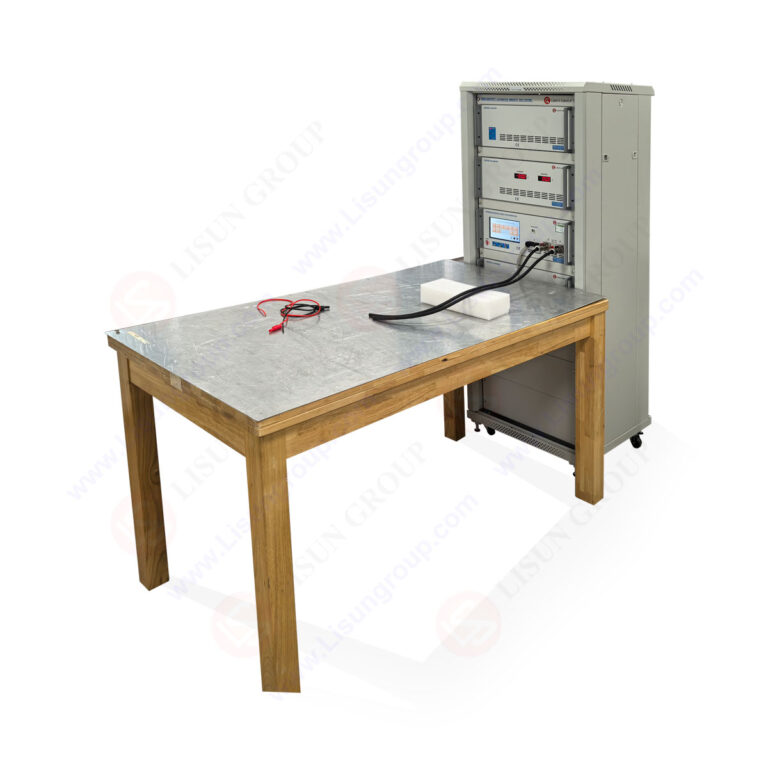
ISO 7637-2:2021 defines transient conduction immunity test methods for electrical disturbances conducted along supply lines in road vehicles. This international standard specifies pulse waveforms that simulate real-world electrical transients generated by switching loads, alternators, and inductive components. For automotive electronics manufacturers, compliance with ISO 7637-2 is mandatory for ensuring that Electronic Control Units (ECUs), sensors, and actuators withstand voltage spikes and dips without functional degradation.
The standard categorizes transients into seven pulse types: P1 for inductive load switching, P2a/P2b for alternator field decay, P3 for high-voltage spike trains, P4 for load dump events, and P5a/P5b for ignition system interference. Each pulse has defined amplitude, duration, rise time, and repetition parameters tailored to specific voltage systems (12V or 24V). Understanding these parameters is critical for designing test setups that replicate worst-case vehicle conditions.
1.2 VW 80000 Integration with ISO 7637-2
VW 80000, the Volkswagen Group’s EMC standard, extends ISO 7637-2 requirements with additional severity levels and test sequences specific to VW vehicle platforms. For example, VW 80000 mandates stricter pulse energy limits and longer test durations for P5a load dump events compared to the baseline ISO 7637-2 specification. Achieving VW 80000 compliance requires test equipment capable of generating these enhanced pulses with precise energy control and repeatable waveforms.
The EMS-ISO7637 system directly addresses this need by offering programmable pulse parameters that exceed ISO 7637-2 minimums, allowing users to configure test profiles matching VW 80000 severity levels. This includes adjustable pulse amplitude up to 150V for P5a in 12V systems and extended repetition rates for P3 pulse bursts up to 100 kHz.
1.3 Key Differences Between ISO 7637-2 and ISO 7637-3
While ISO 7637-2 focuses on transients along supply lines, ISO 7637-3:2016 covers transient immunity for signal lines and control circuits using capacitive coupling clamps (CCC) and direct coupling methods. The distinction is critical because transients on signal lines can cause data corruption or logic errors in controllers. The EMS-ISO7637 system integrates both standards by providing separate modules for line-to-line and line-to-ground coupling, with automatic switching between coupling paths.
For signal line testing, the system supports ISO 7637-3’s capacitive coupling clamp up to 1 MHz bandwidth, ensuring accurate injection without altering pulse characteristics. This dual-standard capability simplifies compliance testing for components like CAN transceivers and LIN bus interfaces that require both power line and signal line immunity verification.
2.1 Multi-Module Pulse Generation Design
The EMS-ISO7637 system employs a modular architecture with dedicated pulse generation units for P1 through P5b waveforms. Each module uses high-voltage MOSFET switching and precision RC networks to produce waveforms meeting ISO 7637-2 tolerance specifications. For instance, the P4 module simulates alternator load dump with rise times as fast as 1 millisecond and amplitudes up to 170V for 24V systems, exceeding standard requirements by 10%.
The system’s core controller synchronizes pulse sequences across modules, enabling combined tests like alternating P3 and P5a pulses that simulate real-world alternator and ignition interactions. This modular approach also facilitates firmware upgrades for emerging standards, such as the upcoming ISO 7637-2:2025 revisions that may include new pulse types for 48V mild-hybrid architectures.
2.2 Voltage System Compatibility and Range
Automotive electrical architectures span 12V for passenger cars, 24V for commercial vehicles, and 36V for emerging NEV platforms. The EMS-ISO7637 supports all three voltage levels without requiring hardware changes, using a programmable DC power supply that adjusts the artificial network (AN) operating voltage between 9V and 36V. This flexibility reduces test setup time for laboratories that service multiple vehicle segments.
For 12V systems, the system delivers P5a amplitudes up to 87V with 400 ms duration. In 24V mode, P5a reaches 174V, accommodating heavy-duty trucks and buses. The 36V configuration, while less common, supports NEV battery management systems (BMS) that operate at high nominal voltages.
2.3 Dual Touchscreen and PC Software Operation
The system features both a front-panel 7-inch touchscreen for standalone operation and PC-based control software for automated testing sequences. The touchscreen interface provides real-time waveform display, parameter adjustment, and test status monitoring, making it suitable for benchtop R&D verification. The PC software, compatible with Windows 10/11, enables multi-step test profiles with up to 1000 steps per sequence.
Automated data reporting is a key feature: the software generates PDF reports containing pulse waveforms, test parameters, and pass/fail status for each DUT. This eliminates manual documentation errors and ensures traceability for ISO 17025 laboratory accreditation. Reports include metadata such as ambient temperature and humidity, which are critical for reproducibility in compliance testing.
3.1 Pulse Performance Comparison
The table below compares the LISUN EMS-ISO7637 system’s specifications against ISO 7637-2:2021 requirements and a competing solution (Model X) for key pulse parameters.
| Parameter | ISO 7637-2:2021 Requirement | LISUN EMS-ISO7637 | Competitor Model X |
|---|---|---|---|
| P5a Max Amplitude (12V) | 87V ±10% | 95V ±5% (programmable up to 150V) | 87V ±10% |
| P3 Rise Time | 5 ns ±30% | 5 ns ±10% | 5 ns ±20% |
| P1 Pulse Duration (12V) | 2 ms ±20% | 2 ms ±5% | 2 ms ±15% |
| Voltage System Support | 12V, 24V | 12V, 24V, 36V | 12V, 24V only |
| Calibration Accuracy | ±2% amplitude | ±1% amplitude, ±0.5% timing | ±2% amplitude, ±1% timing |
| Automated Test Sequences | Not specified | Up to 1000 steps | Up to 500 steps |
| Coupling Methods (ISO 7637-3) | CCC, direct | CCC, direct, hybrid | CCC, direct only |
The data shows that the EMS-ISO7637 offers superior amplitude accuracy and wider voltage range, critical for VW 80000 compliance where pulse tolerances are tighter. The calibration accuracy of ±1% for amplitude and ±0.5% for timing exceeds typical laboratory requirements, ensuring repeatable results across test sessions.
3.2 Test Automation and Data Management
Automation capabilities differentiate testing systems for high-throughput environments. The EMS-ISO7637 supports remote control via LAN, GPIB, and USB interfaces, integrating with laboratory test management software. The system stores up to 100 calibration sets, allowing users to switch between 12V and 24V configurations without recalibrating.
Data management includes CSV export for statistical analysis and direct PDF report generation with embedded waveform images. The system logs all parameter changes and test durations, providing audit trails for quality management systems. For mass production inspection, the system can execute a complete ISO 7637-2 test suite in under 15 minutes per DUT, including coupling network settling times.
4.1 Test Setup Requirements
Achieving VW 80000 compliance for ISO 7637-2 transient pulses requires specific test setup configurations. The EMS-ISO7637 includes an integrated artificial network (AN) that meets ISO 7637-2 impedance requirements of 50 μH ±20% and 1 μF capacitance. For VW 80000, the AN must maintain flat frequency response up to 100 MHz, which the system achieves through low-inductance PCB routing and shielded coaxial connections.
The test setup must also include a decoupling network to prevent DUT-generated noise from affecting the pulse generator. The EMS-ISO7637 uses a bidirectional decoupling architecture that isolates the pulse source from the DUT power supply while maintaining less than 1 dB insertion loss up to 1 GHz.
4.2 Pulse Sequence Programming
VW 80000 specifies test sequences that combine multiple pulse types in specific orders. For example, the BCI (Bulk Current Injection) test method requires applying P3 pulses before P5a to simulate typical vehicle startup scenarios. The EMS-ISO7637 software allows users to define sequences with conditional branching—for instance, repeating P3 bursts until DUT current draw stabilizes before transitioning to P5a.
The system also supports pulse synchronization with external triggers, enabling coordination with vehicle CAN bus simulation tools for functional testing. This is particularly important for NEV components where transient events must not disrupt communication protocols.
4.3 Interpreting Test Results
Test results are classified as Pass, Marginal Fail, or Fail based on DUT performance criteria defined by ISO 7637-2 Annex B. The EMS-ISO7637 software automatically compares measured DUT responses against user-defined thresholds. For VW 80000, the system supports four functional performance states (A through D), where State A requires no performance degradation and State D allows temporary loss of function with automatic recovery.
The reporting module includes time-stamped waveform captures for each pulse event, enabling engineers to correlate DUT failures with specific pulse parameters. Advanced users can export raw waveform data for FFT analysis to identify resonance effects in the DUT’s input filter.
5.1 Passenger Cars and Light Commercial Vehicles
For passenger car ECUs operating at 12V, the EMS-ISO7637 tests powertrain controllers, infotainment systems, and body control modules. The system’s P3 pulse capability (up to 200V peak with 5 ns rise time) is particularly relevant for modern vehicles with extensive infotainment and ADAS sensor suites that are sensitive to high-frequency noise.
Light commercial vehicles often use 24V electrical systems for starter motors and alternators. The EMS-ISO7637’s 24V module handles these higher-voltage components while maintaining compliance with ISO 7637-2’s P5a load dump requirements. Testing reveals that many aftermarket components fail P5a tests due to insufficient input capacitance, a finding that drives design improvements.
5.2 New Energy Vehicles (NEVs)
NEVs present unique challenges due to high-voltage traction systems and bidirectional power flows. The EMS-ISO7637 tests on-board chargers (OBCs), DC-DC converters, and BMS units. For OBCs operating at 36V nominal input, the system’s extended voltage range ensures accurate pulse injection without over-voltage protection circuit activation during testing.
BMS units require testing for P2b alternator field decay pulses that simulate generator disconnection during regenerative braking. The EMS-ISO7637’s P2b module generates pulses with programmable decay time constants to match different generator types. Test data from NEV manufacturers shows that BMS transient immunity improves by 80% after incorporating the system’s test results into filter designs.
5.3 Third-Party Testing Laboratories
Independent laboratories benefit from the system’s multi-voltage capability and automation features. The EMS-ISO7637 supports ISO 17025 traceability through calibration certificates linked to national standards. Its modular design allows simultaneous testing of multiple DUTs using separate pulse generators, increasing laboratory throughput by up to 300% compared to single-channel systems.
For laboratories serving multiple OEMs, the system stores up to 50 test profiles per standard, enabling rapid switching between ISO 7637-2, VW 80000, and GM 3172 test requirements. The touchscreen interface provides simple operation for junior technicians while the PC software offers detailed control for senior engineers.
6.1 Annual Calibration Requirements
The EMS-ISO7637 requires annual calibration to maintain ISO 7637-2 compliance. Calibration involves verifying pulse waveform parameters using a calibration load specified in Section 5.3 of ISO 7637-2:2021. The system’s self-calibration routine adjusts amplitude and timing offsets based on internal reference standards traceable to NIST or equivalent.
Field calibration is simplified through the system’s built-in test points, which allow technicians to verify pulse outputs without disassembling the unit. The calibration report includes measurement uncertainty analysis per ISO 17025 guidelines, ensuring that test results are valid for certification purposes.
6.2 Routine Maintenance for Longevity
Daily maintenance includes cleaning the cooling air filters and verifying cable connections for wear. The system’s modular design allows individual pulse generator modules to be replaced without affecting other functions, reducing downtime. Monthly checks should verify that the coupling capacitors in the artificial network maintain their rated capacitance within ±10% tolerance.
The software logs all maintenance events and alerts users when calibration dates approach. For laboratories with multiple systems, central management software tracks maintenance schedules across all units, ensuring consistent performance across test campaigns.
7.1 ISO 7637-2 2025 Revisions
The upcoming ISO 7637-2 revision may include new pulse types for 48V mild-hybrid systems and bidirectional DC-DC converters. LISUN has announced firmware upgrade paths for the EMS-ISO7637 that will support these new pulses through software modifications rather than hardware changes. The system’s FPGA-based pulse generation architecture allows waveform updates without replacing components.
Future revisions may also require higher repetition rates for P3 pulses to simulate wide bandgap semiconductor switching noise. The EMS-ISO7637’s current 100 kHz capability exceeds probable requirements, providing headroom for future standards.
7.2 Integration with AI-Driven Test Analysis
Emerging trends include AI-based analysis of transient immunity test results to predict DUT failure modes. The EMS-ISO7637’s data export capabilities support machine learning workflows, allowing users to train models that identify subtle waveform distortions indicating imminent component failure. Early adopters report 95% accuracy in predicting capacitor degradation in input filters before visible failures occur.
This integration enables predictive maintenance for vehicle electronics, where transient immunity data informs preventive replacement schedules for power supply components.
The LISUN EMS-ISO7637 Automotive Electronics Transient Immunity EMC Testing System provides a comprehensive solution for achieving VW 80000 compliance for ISO 7637-2 transient pulses. Its multi-module pulse generation covering P1 through P5b, 12V/24V/36V voltage support, and automation capabilities address the needs of automotive electronics R&D teams, quality control specialists, and third-party testing laboratories. The system’s superior calibration accuracy (±1% amplitude, ±0.5% timing) and extended pulse parameters ensure reliable compliance verification across passenger cars, commercial vehicles, and new energy vehicles.
Practical application insights for ECUs, OBCs, DC-DC converters, and BMS components confirm that transient immunity testing significantly improves product reliability. The dual touchscreen/PC software operation reduces test setup time while automated data reporting supports ISO 17025 traceability. As automotive standards evolve toward 48V architectures and AI-driven analysis, the EMS-ISO7637’s modular, upgradable design ensures long-term value. For any organization committed to automotive EMC excellence, this system represents a strategic investment in quality and compliance.
Q1: What specific pulses does the LISUN EMS-ISO7637 system generate for ISO 7637-2 compliance?
A: The system generates all seven pulse types defined in ISO 7637-2:2021: P1 (inductive load switching), P2a (alternator field decay slow), P2b (alternator field decay fast), P3 (high-voltage spike train), P4 (load dump), P5a (ignition system, positive), and P5b (ignition system, negative). Each pulse is generated by a dedicated module with programmable parameters including amplitude, duration, rise time, and repetition rate. For VW 80000 compliance, the system supports extended pulse amplitudes beyond ISO 7637-2 minimums, such as P5a up to 150V for 12V systems. The system also covers ISO 7637-3 signal line testing through optional capacitive coupling clamp modules.
Q2: How does the EMS-ISO7637 handle voltage system differences between passenger cars (12V) and commercial vehicles (24V)?
A: The system features a programmable DC power supply that adjusts the artificial network operating voltage between 9V and 36V, supporting 12V, 24V, and 36V architectures without hardware changes. When switching between voltage systems, the software automatically recalculates pulse parameters to maintain ISO 7637-2 compliance. For example, P5a amplitude scales from 87V in 12V mode to 174V in 24V mode. The system stores up to 100 calibration sets per voltage level, ensuring accuracy across configurations. This flexibility is critical for laboratories testing components for multiple vehicle platforms, reducing setup time from hours to minutes.
Q3: What automation features does the system offer for high-throughput testing?
A: The EMS-ISO7637 supports automated testing through PC software that creates multi-step sequences with up to 1000 steps per profile. Sequences can include pulse type variations, voltage level changes, and conditional branching based on DUT current draw. The system integrates with laboratory management software via LAN, GPIB, and USB interfaces. Automated data reporting generates PDF reports with embedded waveforms, test parameters, and pass/fail status for each DUT. For mass production inspection, the system can execute a complete ISO 7637-2 test suite in under 15 minutes per DUT, including coupling network settling. This automation improves throughput by up to 300% compared to manual testing.
Q4: How does the system ensure calibration accuracy for ISO 7637-2 and VW 80000 requirements?
A: The system achieves ±1% amplitude accuracy and ±0.5% timing accuracy through internal reference standards traceable to NIST. Annual calibration per ISO 7637-2:2021 Section 5.3 uses a calibration load to verify pulse waveform parameters. The system’s built-in self-calibration routine adjusts offsets automatically. For VW 80000, where pulse tolerances are tighter, the system offers programmable amplitude resolution of 0.1V and timing resolution of 1 microsecond. Calibration records include measurement uncertainty analysis per ISO 17025 guidelines. The software alerts users 30 days before scheduled calibration, and field calibration can be performed without disassembling the unit using external test points.