









Here is the comprehensive technical article generated according to your instructions.
Abstract
Understanding What Is LED Lumen Maintenance Testing? LISUN Optical Aging Test Guide provides the foundational knowledge required for LED manufacturers and testing labs to predict product lifespan accurately. Lumen maintenance testing measures the light output degradation of LEDs over time, a critical parameter governed by standards like IES LM-80 and TM-21. This guide delves into the technical specifics of accelerated aging testing, explaining how systems like the LISUN LEDLM-80PL and LEDLM-84PL utilize the Arrhenius Model to project L70 and L50 metrics. Readers will gain insights into mandatory 6000-hour test durations, dual testing modes, and the integration of separate temperature chambers for obtaining reliable, industry-compliant reliability data.
1.1 The Principle of Lumen Depreciation
LED lumen maintenance quantifies how a light source retains its initial luminous flux (measured in lumens) over operational time. Unlike incandescent bulbs that fail abruptly, LEDs gradually dim. This depreciation, driven by junction temperature and current density, is the primary failure mechanism. Testing validates whether a product will meet its rated lifetime, typically defined as L70 (70% of initial lumens) or L50 (50% of initial lumens). Reliable data requires strict adherence to standardized test environments and durations.
1.2 Why Lumen Maintenance Test Matters for Product Reliability
For R&D engineers, lumen maintenance data is not merely academic; it dictates warranty periods and product compliance. A 10% error in projecting L70 can translate to a 5,000-hour miscalculation in stated lifetime. For third-party labs, precise testing validates marketing claims against LM-80 data. LISUN systems provide the controlled photometric and thermal environment necessary to generate defensible data that withstands regulatory scrutiny.
2.1 IES LM-80 and TM-21: The Golden Standard for LED Packages
The IES LM-80-15 standard specifies the method for measuring lumen maintenance of solid-state light source packages. It mandates a minimum of 6,000 hours of testing at three case temperatures (e.g., 55°C, 85°C, and a selected third temperature per TM-21). The companion standard, TM-21-19, provides the mathematical model for extrapolating long-term lumen maintenance from this LM-80 data. The LEDLM-80PL is specifically designed to execute these protocols, logging photometric data at required intervals.
2.2 LM-84 and TM-28: Testing for Integrated LED Lamps
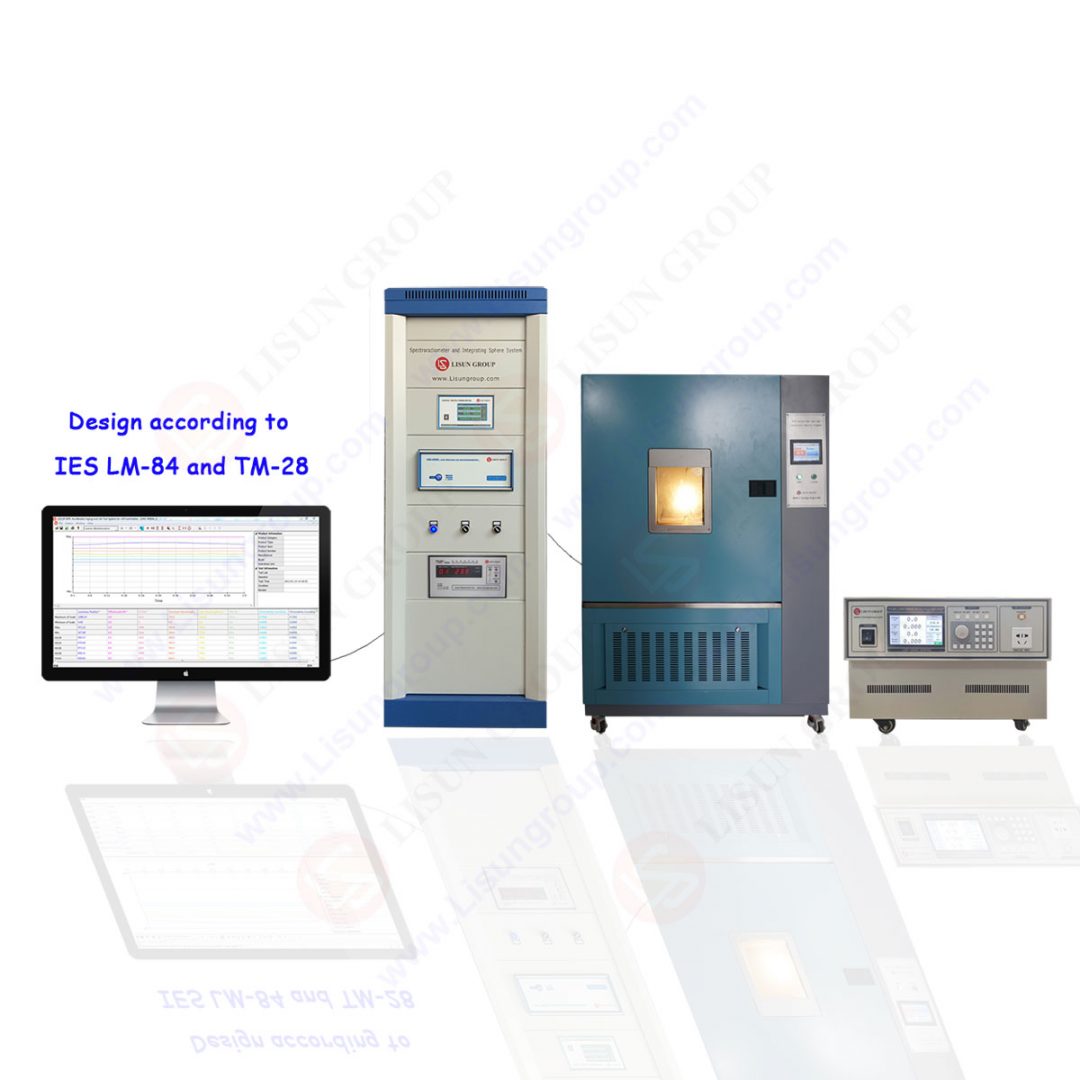
For finished LED luminaires and lamps, IES LM-84-20 governs the testing methodology. This standard requires testing in ambient air, unlike the controlled thermal pad environment of LM-80. TM-28-19 then provides the extrapolation projection model for these integrated products. The LEDLM-84PL system is tailored for this application, featuring larger integration spaces and ambient temperature control to handle the thermal mass of assembled products.
2.3 Ancillary Standards: CIE 70 and CIE 127
While LM-80 focuses on maintenance, CIE 70 provides fundamental methods for measuring luminous flux, and CIE 127 details measurement of LED intensity. These are referenced for photometric calibration accuracy. Furthermore, IES LM-79-19 is critical for electrical and photometric testing of solid-state lighting products before aging begins, establishing the initial flux baseline that all future measurements are compared against.
3.1 Dual System Architecture: LEDLM-80PL vs. LEDLM-84PL
The LISUN system offers two hardware variants to match the specific test standard:
- LEDLM-80PL: Designed for discrete LED packages and modules. It features a precise thermal control plate for maintaining junction temperature as defined by LM-80.
- LEDLM-84PL: Designed for integrated LED lamps and luminaires. It operates within an ambient temperature chamber.
| Feature | LEDLM-80PL (LM-80/TM-21) | LEDLM-84PL (LM-84/TM-28) |
|---|---|---|
| Test Object | LED Packages, Arrays, Modules | Integrated LED Lamps, Luminaires |
| Primary Standard | IES LM-80-15 | IES LM-84-20 |
| Temperature Control | Thermal Plate (TC point) | Ambient Air Chamber |
| Typical Test Duration | 6,000+ Hours | 6,000+ Hours |
| Max. Connected Chambers | Up to 3 | Up to 3 |
3.2 Customizable Hardware for Diverse Sample Sizes
These systems support up to 3 connected temperature chambers, allowing simultaneous testing of samples at different temperatures (e.g., 55°C, 85°C, and 105°C for LM-80). Each aging rack is customizable to accommodate different sample geometries. The system integrates a CCD-spectroradiometer within an integrating sphere for high-speed measurements, measuring spectral distribution, CCT, and flux in less than one second to minimize thermal disturbance of the sample during measurement.
4.1 Dual Testing Modes: In-Situ vs. Time-Sequential
The LISUN software controls two distinct testing methodologies:
- In-Situ Mode: Samples remain mounted in the integrating sphere or temperature chamber during the entire aging process. The system measures photometric parameters at user-defined intervals (e.g., every 1000 hours). This is the preferred method for continuous data logging.
- Time-Sequential Mode: Samples are moved between an aging chamber and a separate measurement sphere at scheduled intervals. This is beneficial for testing samples that cannot be permanently installed inside a sphere or when testing at extremely high currents.
4.2 Arrhenius Model-Based Analysis Software
The core of the LISUN software is its compliance with the Arrhenius Model for accelerated life testing. The software automatically:
- Collects raw lumen degradation data for each channel.
- Calculates the average lumen maintenance per test group.
- Applies TM-21 or TM-28 projection algorithms to extrapolate L70 and L50 lifetimes.
- Generates a complete, auditable test report that includes the original data, the projected curve, and the calculated life metrics.
5.1 Initial Baseline Measurement and Sample Setup
Before aging begins, each LED sample must be stabilized and measured according to IES LM-79-19 to establish the 100% lumen point. The samples are then mounted onto the temperature-controlled plate (LEDLM-80PL) or within the chamber (LEDLM-84PL). The case temperature is verified using thermocouples. The aging current is set to the rated drive current for the LED.
5.2 Data Acquisition Intervals and Lifespan Calculation
The system is programmed for measurements at 0 (baseline), 1000, 2000, 3000, 4000, 5000, and 6000 hours. For accelerated testing, this 6000-hour dataset allows TM-21 to project six-times (36,000 hours) or more of real-world performance. The software tracks individual channel failures–if a module fails before 6000 hours, the data is still used for statistics. The final L70 value is calculated by fitting the exponential decay curve (I = A * exp(-αt)) to the measured data points.
6.1 Understanding L70 and L50 Metrics
- L70: The time at which the LED light output has depreciated to 70% of its initial value. This is the standard for general lighting (e.g., indoor downlights, streetlights).
- L50: The time to 50% of initial output. This is more common for decorative or non-critical lighting. For instance, a TM-21 report might state an L70(6k) of >50,000 hours, meaning the projected time to 70% output is over 50,000 hours.
6.2 Failure Analysis and Data Integrity
A test is considered invalid if the chamber temperature violates the tolerance or if there is a power interruption. The LISUN system logs any such anomalies. Non-catastrophic failures (e.g., an individual LED string dimming prematurely) are flagged. The software distinguishes between sudden failures (opens/shorts) and gradual lumen depreciation failures. Regulations often require that 90% of samples pass the L70 point before a product can claim the rated lifetime.
7.1 Matching the System to Your Standard
Engineers must select the correct LISUN system based on the product. Testing a COB (Chip-on-Board) package on an LM-84 system will yield invalid data, as the ambient air control does not meet the thermal pad requirement of LM-80. Conversely, testing a finished luminaire on an LM-80 plate is impractical due to size and thermal interface issues.
7.2 Ensuring Repeatability through Environmental Control
The accuracy of the Arrhenius Model depends on temperature stability. Fluctuations in the chamber temperature of more than ±1°C can introduce significant error into the projected lifetime. Users must ensure that the temperature chamber is properly calibrated. LISUN’s system features redundant thermal sensors for each sample channel, ensuring that the “T” in the Arrhenius equation is accurate.
What Is LED Lumen Maintenance Testing? LISUN Optical Aging Test Guide provides engineers with a definitive pathway to validate LED reliability. By adhering strictly to IES LM-80/TM-21 and LM-84/TM-28 protocols, the LISUN system delivers the high-accuracy, long-duration data necessary for accurate lifetime projections. The dual-platform hardware (LEDLM-80PL and LEDLM-84PL) ensures that whether testing a single package or a complete luminaire, the thermal and photometric conditions are precisely controlled. The software’s automation of the Arrhenius Model simplifies the complex mathematics of failure prediction, translating raw data into actionable L70/L50 metrics. For R&D and QC teams, this capability is essential for minimizing warranty risk and ensuring product claims are backed by rigorous, standard-compliant evidence. Ultimately, this testing framework is not just a compliance exercise but a fundamental engineering discipline for delivering lasting, reliable LED products.
Q1: What is the minimum test duration required to obtain a valid TM-21 projection?
A: According to IES TM-21-19, the minimum test duration is 6,000 hours. However, the standard also requires that the total operating time must be at least 5,000 hours, and the length of the projected lifetime cannot exceed six times the total test duration (e.g., a 6,000-hour test can project up to 36,000 hours). LISUN’s automated system is set by default to run this exact 6,000-hour cycle, but it can be extended for highly predictive models if needed.
Q2: When should I use the LEDLM-80PL instead of the LEDLM-84PL?
A: Use the LEDLM-80PL when testing bare LED packages, modules, or arrays that operate on a thermal pad. This system controls the case temperature (Tc) precisely as required by IES LM-80. Use the LEDLM-84PL when testing complete LED lamps or luminaires (e.g., a bulb or a track light) that dissipate heat into ambient air. Choosing the correct system is critical; using the wrong standard invalidates the test data for regulatory submission.
Q3: How does the LISUN system calculate the L70 value using the Arrhenius Model?
A: The LISUN software collects lumen data over time. It then applies non-linear regression to fit the data to an exponential decay model. For thermal acceleration, the Arrhenius Model relates the tested temperature (e.g., 85°C) to a lower use temperature (e.g., 25°C). The software uses the slope of the decay curve and the activation energy (calculated from data at multiple temperatures) to shift the curve along the time axis, predicting exactly when the 70% threshold will be crossed at the use temperature.
Q4: What tolerances are required for the temperature chamber during an LM-80 test?
A: The IES LM-80 standard requires precise control. The case temperature (Tcase) for the LED must be maintained within ±2°C of the set point during measurement periods. The ambient temperature inside the chamber must not fluctuate by more than ±2°C. The LISUN system exceeds these requirements by using PID control loops and dedicated sensors on the thermal plate or within the ambient air chamber.
Q5: Can this system test LEDs under pulse-width modulation (PWM) dimming?
A: Yes. The LISUN system can handle PWM dimmed LEDs. However, the measurement must be synchronized correctly. Our software allows for a specific “sampling window” to capture the correct average photometric data. The engineer must define the dimming level (e.g., 10% duty cycle) in the test plan, and the system will log the electrical and photometric data specifically at that driver setting, ensuring the lumen maintenance data is accurate for dimmed operating conditions.