









Abstract
Accurately predicting the long-term lumen maintenance of LED packages, modules, and complete luminaires is a critical challenge for ensuring product reliability and warranty validation. This technical article provides an in-depth analysis of the IEC 60335-1 LED Optical Aging Test Instrument by LISUN | LM-80 Compliance, a sophisticated dual-system solution designed for rigorous accelerated life testing. We explore its core architecture, including the dedicated LEDLM-80PL and LEDLM-84PL systems for LM-80/TM-21 and LM-84/TM-28 compliance, respectively. The discussion covers the integration of the Arrhenius Model for temperature acceleration, dual operational modes for efficiency, and the system’s capability to support extended 6000-hour tests and project L70/L50 metrics. This article delivers essential insights for engineers and lab technicians tasked with validating LED product longevity against stringent industry standards.
1.1 The Imperative of Predictive Lumen Maintenance Testing
The transition to solid-state lighting has shifted reliability concerns from catastrophic failure to gradual photometric degradation. For manufacturers and specifiers, predicting when an LED’s light output will depreciate to a critical threshold (e.g., 70% or L70 of initial lumens) is paramount for product claims, warranties, and lifecycle cost analysis. Empirical long-term testing under real-world conditions is impractical, necessitating standardized, accelerated aging methodologies that yield reliable extrapolated lifetime data. This forms the foundational need for instruments like the LISUN LED Optical Aging Test System, which automates and standardizes this critical validation process.
1.2 The Regulatory Framework: IES LM-80, LM-84, and Beyond
Compliance with established industry standards is non-negotiable for global market access. The IES LM-80 standard defines the approved method for measuring the lumen depreciation of LED packages, arrays, and modules. Its counterpart, IES LM-84, extends this methodology to complete, integrated LED luminaires and light engines. These standards mandate testing at multiple controlled case or ambient temperatures (e.g., 55°C, 85°C) for a minimum of 6000 hours, with data collection at prescribed intervals. The subsequent TM-21 and TM-28 technical memoranda provide the mathematical procedures for extrapolating the collected LM-80 and LM-84 data, respectively, to project long-term lumen maintenance. The LISUN system is engineered explicitly to fulfill the data collection requirements of these standards, enabling seamless compliance.
2.1 Dual-System Configuration: LEDLM-80PL vs. LEDLM-84PL
LISUN’s solution addresses the distinct testing requirements for components versus finished products through two specialized variants. The LEDLM-80PL system is configured for testing LED packages, arrays, and modules per IES LM-80 and TM-21. It typically interfaces with temperature-controlled chambers that manage the LED case temperature (Ts). Conversely, the LEDLM-84PL system is designed for complete luminaires per IES LM-84 and TM-28, managing ambient temperature (Ta) conditions within an environmental chamber. This bifurcated architecture ensures that the specific thermal management and photometric measurement setups mandated by each standard are correctly implemented.
2.2 Core Hardware Components and Integration
The system’s hardware is built for precision and scalability. At its heart is a high-accuracy spectroradiometer or photometer coupled with an integrating sphere, adhering to measurement standards like IES LM-79-19 and CIE 127 for spatial photometry. The system can connect to and control up to three independent temperature/humidity chambers simultaneously, allowing parallel testing at different stress conditions. Customizable sample fixture boards and power supply integration modules accommodate diverse LED form factors and electrical requirements, from low-power SMDs to high-brightness COBs and complete luminaires.
3.1 Intelligent Dual Testing Mode Strategy
To optimize laboratory efficiency and equipment utilization, the system software incorporates two operational modes. The Continuous Test Mode is used for the initial, uninterrupted 6000-hour qualification period required by LM-80/LM-84. The Interval Test Mode is designed for ongoing quality assurance or lower-intensity monitoring, where samples are aged in standalone chambers and periodically transferred to the system for measurement. This flexibility allows labs to maximize throughput by dedicating the core optical instrument to measurement tasks while aging continues elsewhere.
3.2 Data Analysis and the Arrhenius Acceleration Model
The software transcends simple data logging by incorporating advanced analytical engines. It automatically plots lumen maintenance curves against time. Crucially, it implements the Arrhenius Model, which quantifies the relationship between temperature and the chemical degradation rates within the LED. By testing at elevated temperatures (e.g., 85°C, 105°C), the model calculates an acceleration factor, allowing the projection of lifetime data at normal operating temperatures. This enables meaningful lifetime predictions (e.g., L70, L50) from accelerated test data, a core requirement of TM-21 and TM-28 extrapolation.
4.1 Key System Capabilities and Numerical Parameters
The system is defined by precise technical parameters that ensure reliable, standard-compliant outputs. It supports the full minimum 6000-hour test duration and can be configured for longer-term studies. Measurement accuracy is traceable to CIE 084 and CIE 70 standards for luminous flux and colorimetric parameters. The system directly calculates and reports critical lifetime metrics such as L70 (time to 70% lumen maintenance) and L50, which are foundational for product datasheets and warranty documentation. The support for multiple, synchronized environmental chambers enables the collection of the multi-temperature data sets essential for robust Arrhenius analysis.
Table 1: Comparison of LISUN LED Optical Aging Test System Configurations
| Feature / Specification | LEDLM-80PL System (LM-80/TM-21) | LEDLM-84PL System (LM-84/TM-28) |
| :— | :— | :— |
| Primary Compliance Standard | IES LM-80, IES TM-21 | IES LM-84, IES TM-28 |
| Device Under Test (DUT) | LED Packages, Arrays, Modules | Complete LED Luminaires & Light Engines |
| Controlled Temperature Parameter | Case Temperature (Ts) | Ambient Temperature (Ta) |
| Typical Test Duration | 6000+ hours | 6000+ hours |
| Key Output Metric | Projected Lp (L70, L50, etc.) | Projected Lp (L70, L50, etc.) for Luminaires |
| Associated Measurement Std. | IES LM-79-19, CIE 127 | IES LM-79-19, CIE 127 |
| Max Connected Chambers | 3 | 3 |
4.2 Safety and Compliance: The Role of IEC 60335-1
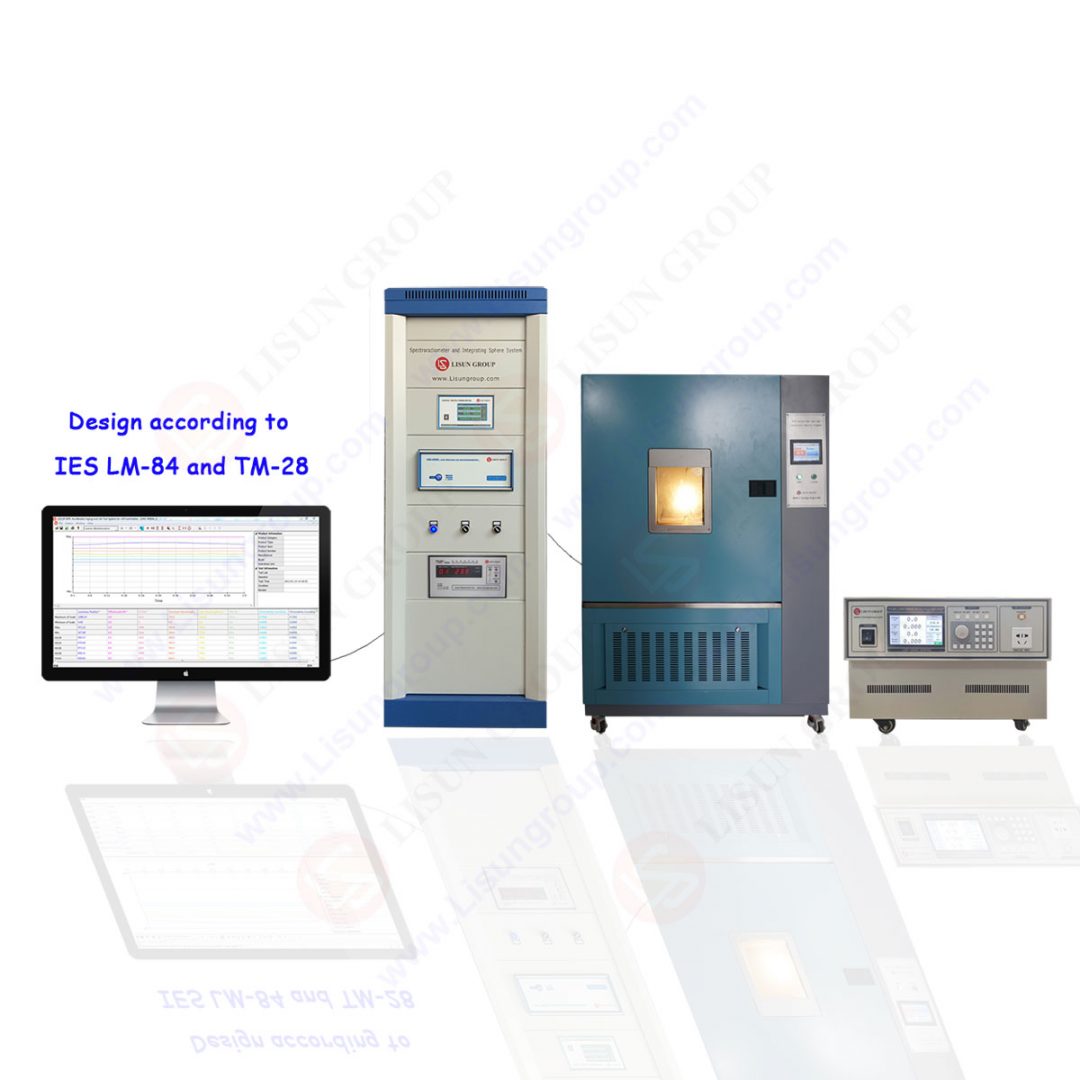
The instrument’s designation referencing IEC 60335-1 underscores its compliance with international safety standards for household and similar electrical appliances. This is critical as the system operates continuously, often unattended, for thousands of hours while controlling power supplies and environmental chambers. Compliance with this standard ensures built-in protections against electrical, fire, and mechanical hazards, providing laboratories with confidence in the system’s operational safety and reliability during long-term, high-stress testing.
5.1 LED Manufacturing and Quality Assurance
For LED package and module manufacturers, the system is an essential R&D and QC tool. It is used to validate new chip/phosphor/package architectures, qualify different production batches, and generate the LM-80 data required by downstream luminaire customers. The ability to run parallel tests at multiple temperatures accelerates time-to-data, speeding up development cycles and providing a competitive edge through robust, standard-compliant lifetime claims.
5.2 Third-Party Testing Laboratories and Luminaire Manufacturers
Independent testing labs rely on such systems to offer certified LM-80 and LM-84 testing services. For luminaire manufacturers, the LEDLM-84PL system is vital for in-house validation of finished products, ensuring that thermal management, driver compatibility, and overall system design do not adversely affect the LED’s predicted lifetime. This data is indispensable for ENERGY STAR®, DLC, and other certification programs that require TM-28 projections.
6.1 Sample Preparation and Baseline Characterization
A successful test begins with meticulous sample preparation. A statistically significant sample size (per LM-80/LM-84 guidelines) must be selected and subjected to a prescribed photometric and electrical stabilization process. A critical initial step is the 0-hour baseline measurement, performed under controlled thermal conditions using an integrating sphere per IES LM-79-19. All subsequent depreciation measurements are normalized to this baseline, making its accuracy fundamental to the entire dataset.
6.2 Test Execution, Data Monitoring, and Reporting
During the extended test, the system automates periodic measurements, but engineer oversight remains crucial. Monitoring for data anomalies, ensuring chamber stability, and verifying electrical drive current consistency are key responsibilities. Upon test completion, the software compiles the data, applies the TM-21 or TM-28 extrapolation, and generates standardized reports. These reports include the lumen maintenance curves, projected lifetime values (L70, L50), and confidence intervals, forming the technical backbone for product documentation.
7.1 Mitigating Risk and Enhancing Product Credibility
Investing in a standardized automated system like the LISUN IEC 60335-1 LED Optical Aging Test Instrument directly mitigates business risk. It replaces error-prone manual processes with a repeatable, auditable methodology. The data it produces defends against warranty claims, supports marketing assertions with hard evidence, and prevents costly product recalls due to premature lumen failure. It transforms lifetime from a marketing estimate into an engineered, verifiable metric.
7.2 Driving Innovation and Time-to-Market Efficiency
The system’s acceleration capabilities and parallel testing support allow R&D teams to evaluate material and design choices more rapidly. Engineers can obtain predictive lifetime data in months rather than years, enabling faster iteration and optimization of new products. This acceleration of the development cycle is a significant strategic advantage in the fast-paced LED and lighting markets, allowing companies to innovate with confidence in their product’s long-term performance.
The rigorous validation of LED lumen maintenance is a complex but indispensable engineering discipline, mandated by global standards and market expectations. The IEC 60335-1 LED Optical Aging Test Instrument by LISUN | LM-80 Compliance provides a comprehensive, dual-platform solution that addresses the full spectrum of testing needs, from component-level LM-80 analysis to luminaire-level LM-84 validation. Its integration of precise optical measurement, multi-chamber thermal control, and intelligent software with Arrhenius-based analysis delivers reliable, extrapolated lifetime data for L70 and other critical metrics. By automating and standardizing the 6000-hour test process and ensuring compliance with IES LM-80, LM-84, TM-21, and TM-28, this system empowers LED manufacturers, luminaire integrators, and testing laboratories to build credibility, mitigate risk, and accelerate innovation. It represents not merely a test instrument, but a foundational tool for quality, reliability, and competitive advantage in the solid-state lighting industry.
Q1: What is the fundamental difference between testing per IES LM-80 versus IES LM-84, and how does the LISUN system address both?
A: The core difference lies in the Device Under Test (DUT). IES LM-80 applies to LED packages, arrays, and modules—essentially components. It controls and measures the case temperature (Ts) of the LED itself. IES LM-84 applies to complete, integrated LED luminaires or light engines. It controls the ambient temperature (Ta) surrounding the entire product. The LISUN system addresses this through two dedicated variants: the LEDLM-80PL is configured for LM-80/TM-21 compliance, focusing on Ts control, while the LEDLM-84PL is for LM-84/TM-28, managing Ta within an environmental chamber. This ensures the specific thermal and physical setup requirements of each standard are met precisely.
Q2: How does the Arrhenius Model software within the system accelerate lifetime testing, and is this method recognized by industry standards?
A: The Arrhenius Model describes how the rate of chemical degradation within an LED—which causes lumen depreciation—exponentially increases with temperature. The software uses this principle by analyzing lumen maintenance data collected at multiple elevated temperatures (e.g., 55°C, 85°C, 105°C). It calculates an activation energy and acceleration factor, allowing it to project the much slower depreciation rate expected at a lower, normal operating temperature (e.g., 25°C or 55°C). This method of temperature acceleration is the foundation of the extrapolation procedures defined in IES TM-21 and TM-28, making it the industry-recognized and standard-compliant approach for predicting long-term L70/L50 values from accelerated test data.
Q3: Can a single system handle both the required 6000-hour continuous test and ongoing production quality checks?
A: Yes, through its dual testing mode strategy. The Continuous Test Mode is designed for the formal, uninterrupted 6000-hour qualification tests required for standard compliance. For ongoing production batch checks or lower-intensity monitoring, the Interval Test Mode is ideal. In this mode, samples are aged in separate, standalone temperature chambers. They are periodically (e.g., every 1000 hours) moved to the LISUN system’s integrating sphere for precise measurement. This decouples the aging process from the optical instrument, freeing the core system for measurement tasks and significantly improving laboratory throughput and asset utilization.