




Here is the comprehensive technical article generated based on your detailed instructions.
Abstract
Achieving LED Production Line Reliability Validation: LISUN Optical Aging Test Instruments is critical for ensuring long-term lumen maintenance and compliance with global energy standards. This article provides a deep technical analysis of LISUN’s LEDLM-80PL and LEDLM-84PL optical aging test systems. It explores the dual-system architecture designed for IES LM-80/TM-21 and LM-84/TM-28 protocols, the implementation of the Arrhenius Model for accelerated life prediction, and the rigorous data analysis capabilities. Technical professionals will understand how 6000-hour test durations, L70/L50 lifetime projections, and support for up to three temperature chambers enable precise reliability validation. The article delivers actionable insights into hardware configurations, dual testing modes, and standard compliance, offering a definitive guide for engineers seeking robust, data-driven solutions for production line quality assurance.
1.1 Defining Lumen Maintenance and Lifespan Metrics
In a highly competitive market, LED reliability is non-negotiable. Lumen maintenance, the measure of light output over time, is the primary indicator of product quality. Key metrics like L70 (time to 70% of initial lumens) and L50 (time to 50% of initial lumens) are contractual and regulatory benchmarks. Relying on real-time aging is impractical. Therefore, LED Production Line Reliability Validation: LISUN Optical Aging Test Instruments utilizes accelerated aging methods to predict these metrics within feasible timeframes, typically 6,000 hours of testing followed by TM-21 extrapolation.
1.2 The Role of the Arrhenius Model in Accelerated Testing
The Arrhenius Model is the theoretical backbone for thermal acceleration in LED testing. It mathematically relates the rate of lumen depreciation to junction temperature, allowing engineers to predict failure times at normal operating conditions from data collected at elevated temperatures. LISUN’s in-house software directly integrates this model, ensuring that extrapolations are not just statistical but thermally relevant. This reduces test cycle time while maintaining the scientific validity required for IES standards, providing engineers with reliable L70 and L50 projections from a 6,000-hour dataset.
2.1 The LEDLM-80PL: Precision for LM-80 and TM-21 Compliance
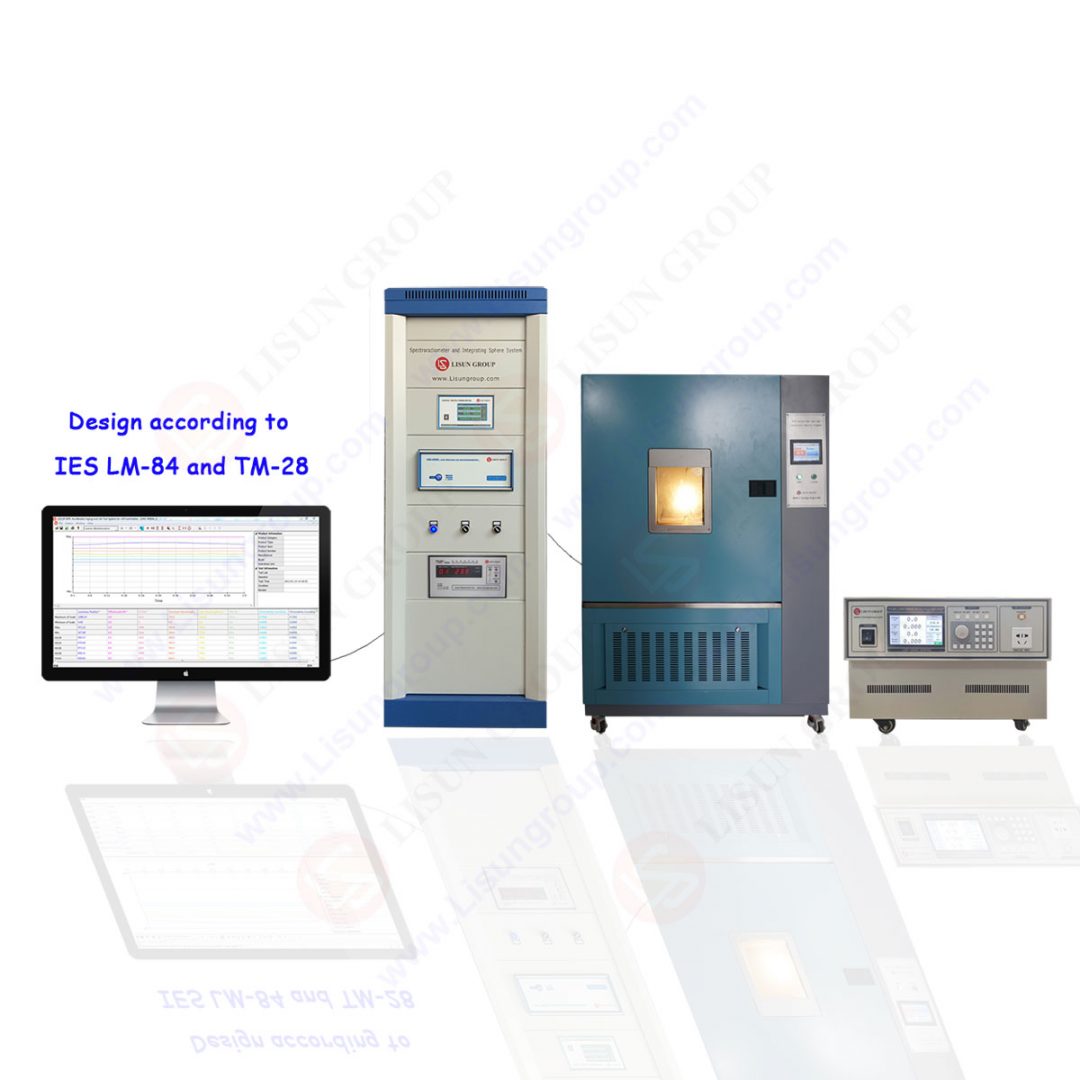
The LEDLM-80PL is specifically designed for IES LM-80-15, the standard for measuring lumen maintenance of LED light sources (packages, arrays, modules). This system is engineered for high-accuracy photometric measurement in a controlled environment. It supports multiple temperature chambers (up to three), allowing simultaneously testing at different case temperatures, e.g., 55°C, 85°C, and a user-defined third temperature as per LM-80 requirements. The system integrates a spectroradiometer and a 2-meter integrating sphere to capture complete photometric and colorimetric data at each reading interval.
2.2 The LEDLM-84PL: Adaptation for LED Luminaires and TM-28
For final luminaire assemblies, the LEDLM-84PL is the appropriate tool, following the IES LM-84-14 standard and TM-28-14 extrapolation method. While the LM-80PL focuses on components, the LEDLM-84PL tests the entire product, including driver and thermal management, under standard ambient conditions. Its integrating sphere is typically larger (3 meters) to accommodate full luminaires. This system provides validation for the final product’s performance, which combines the LED package’s intrinsic reliability with the system’s thermal and electrical engineering.
2.3 Technical Comparison: LEDLM-80PL vs. LEDLM-84PL
| Feature | LEDLM-80PL (Component Level) | LEDLM-84PL (Luminaire Level) |
|---|---|---|
| Applicable Standard | IES LM-80-15, TM-21-11 | IES LM-84-14, TM-28-14 |
| Test Specimens | LED Packages, Arrays, Modules | LED Luminaires (Full Products) |
| Typical Sphere Size | 2 meters | 3 meters |
| Temperature Control | Up to 3 chambers (e.g., 55°C, 85°C, 105°C) | Single/Ambient Chamber |
| Driver Included | External power supply required | Internal/External driver testing support |
| Key Metric | L70 / L90 at 6,000 hours | L70 / L50 at 6,000 hours |
| Standard Compliance | CIE 127, CIE 84 | CIE 70, IES LM-79-19 |
3.1 High-Precision Spectroradiometer Integration
The accuracy of LED Production Line Reliability Validation: LISUN Optical Aging Test Instruments hinges on the quality of the spectroradiometer. LISUN systems incorporate Class A spectroradiometers with wavelength ranges from 380nm to 800nm and resolution ≤ 0.5nm. This ensures precise measurement of chromaticity coordinates (CIE 1931), correlated color temperature (CCT), and color rendering index (CRI). Real-time data capture at specified intervals (every 1,000 hours as per IES LM-80) is automated, reducing operator error and ensuring traceable data for regulatory audits.
3.2 Configuring the Integrating Sphere for Accurate Total Flux
The integrating sphere is a critical optical component. For LEDLM-80PL, the sphere’s interior coating must have high reflectance (>94%) and be spectrally neutral to maintain calibration across all wavelengths. LISUN’s design complies with IES LM-79-19 for absolute photometry. The system includes an auxiliary lamp to correct for self-absorption, a common source of error when testing large samples. This correction is mandatory for maintaining measurement uncertainty below ±2%, which is vital for robust L70 calculation.
4.1 Mode 1: Constant Temperature (Standard) Mode
This mode aligns perfectly with the IES LM-80 standard. The system maintains the LED sample at a user-specified, constant case temperature (Tc) or ambient temperature (Ta) for the entire duration (e.g., 6,000 hours). LISUN’s advanced PID controllers ensure temperature stability within ±1°C. This mode is mandatory for validating the thermal performance of the LED and producing data that is directly extrapolatable by TM-21. It serves as the baseline for all formal reports required by regulatory bodies like ENERGY STAR or the DLC (DesignLights Consortium).
4.2 Mode 2: Rapid Aging (Variable Temperature) Mode
For internal R&D and production screening, the Rapid Aging mode offers a faster alternative. It employs a stepped or cycling temperature profile, often reaching higher temperatures (e.g., 105°C to 120°C) for short periods, to accelerate degradation mechanisms like phosphor browning or solder joint fatigue. While data from this mode cannot be used for official TM-21 reports, it is invaluable for quick comparative analysis across different production batches or for early detection of material defects. It can reduce a traditional 6,000-hour test to an equivalent 2,000-hour stress test for ranking reliability.
5.1 Automated TM-21 and TM-28 Extrapolation Calculations
LISUN’s software automates the complex math behind TM-21-11 (for LEDLM-80PL data) and TM-28-14 (for LEDLM-84PL data). The software applies the non-linear least-squares regression method to the collected lumen maintenance data. It calculates the projected L70 and L50 lifetimes, providing a “P” value (the number of times the extrapolation exceeds the test duration). The software also graphically presents the data with 95% upper and lower confidence bounds, offering engineers a statistical view of product reliability.
5.2 Comprehensive Reporting and Customization
A key feature for production line validation is the custom report generator. The software can produce a single report containing data from all connected temperature chambers. It tracks individual LED performance, calculates the average lumen depreciation, and flags any units that fail prematurely (outliers). Reports include tabular data on flux, CCT, and CRI at each 1,000-hour checkpoint, directly in the format required for submission to agencies. This reduces the administrative burden of LED Production Line Reliability Validation: LISUN Optical Aging Test Instruments and accelerates product certification.
6.1 Intelligent Control and Thermal Chamber Interfaces
The system architecture allows for up to three independent thermal chambers to be controlled by a single LM-80PL controller. Each chamber can be set to a different temperature (e.g., 55°C, 85°C, 105°C), allowing for parallel testing under multiple thermal stresses per the LM-80 standard. The software handles the switching matrix, connecting the spectroradiometer to each chamber’s fiber optic input sequentially. This intelligent interface is crucial for high-throughput production line validation, enabling a single team to oversee complex multi-temperature tests efficiently.
6.2 Robustness and Calibration Stability
For a production line environment, instrument drift is unacceptable. LISUN systems feature self-diagnostic routines and support for scheduled calibration. The integrating sphere and spectroradiometer are designed for long-term stability, with the spectroradiometer featuring a built-in wavelength calibration source. This ensures that over a 6,000-hour test cycle, the measurement baseline remains constant, guaranteeing the integrity of the reliability data.
7.1 Direct Relevance of Specific IES and CIE Standards
The system’s design directly addresses the nuances of multiple standards:
- IES LM-79-19: Governs the electrical and photometric measurement methods used in the integrating sphere.
- CIE 084: The fundamental standard for the measurement of luminous flux.
- CIE 127: Covers the measurement of LEDs, ensuring correct setting of the measurement distance and current.
- CIE 70: The standard for the measurement of absolute spectral responsivity, relevant for the calibration of the spectroradiometer.
7.2 Case Example: Qualifying a New SMT Production Line
A typical use case involves validating a new surface-mount technology (SMT) line. A batch of 20 LED modules is taken from the first production run. They are placed in the LEDLM-80PL system. One set is tested at 55°C, another at 85°C, and a third at 105°C (user-defined). After 6,000 hours, the TM-21 extrapolation confirms an L70 of >50,000 hours for the 55°C sample. This data instantaneously validates that the soldering process, die-attach material, and phosphor deposition are of sufficient quality, allowing the line to proceed to full production.
The LISUN LEDLM-80PL and LEDLM-84PL systems represent a sophisticated, standards-compliant solution for LED Production Line Reliability Validation: LISUN Optical Aging Test Instruments. By integrating dual testing modes, Arrhenius-based software, and support for up to three temperature chambers, these instruments address the full spectrum of reliability testing—from component-level LM-80 verification to luminaire-level LM-84 qualification. The precise integration of Class A spectroradiometers and large integrating spheres ensures data integrity for critical metrics like L70 and L50. For the LED manufacturing engineer, these tools remove the guesswork from lifespan projection, providing a clear, auditable path to product certification. By automating the complex workflows of TM-21 and TM-28 extrapolation, LISUN empowers teams to accelerate time-to-market while maintaining the highest standards of quality and regulatory compliance.
Q1: What is the difference between the TM-21 and TM-28 extrapolation methods supported by LISUN instruments?
A: TM-21-11 is used to extrapolate LM-80 test data for LED components (light sources), projecting lumen maintenance over a longer period (typically up to 6x the test time). It assumes a single exponential decay model based on the LED’s case temperature. TM-28-14, on the other hand, is used for LM-84 data from LED luminaires. It is more complex as it accounts for the effect of the luminaire’s internal thermal environment (driver and heatsink) on the overall system. The LISUN LEDLM-80PL software automates TM-21 calculations, while the LEDLM-84PL software handles TM-28. The correct standard choice is mandatory for ENERGY STAR qualification.
Q2: Can the LISUN system test different types of LEDs (e.g., COB, SMD, High-Power) simultaneously?
A: Yes, the system is highly versatile. The key is proper installation and thermal measurement. For SMD (Surface Mount Device) packages, the samples are typically soldered onto a metal-core PCB (MCPCB) to ensure good thermal contact. For COB (Chip-on-Board) modules, they are mounted on a temperature-controlled plate in the thermal chamber. The system provides individual constant current drivers for each test board, allowing you to test a mix of component types within a single run, provided they are in the same temperature chamber. The software keeps track of each sample individually.
Q3: My production line requires a 3,000-hour screening test instead of a full 6,000-hour qualification. Can the system handle these shorter runs?
A: Absolutely. While the IES LM-80 standard specifies a minimum of 6,000 hours for a formal report, the LISUN system is fully configurable for any test duration. For internal production line screening or R&D, you can set test intervals (e.g., 1,000 hours) and a total test duration (e.g., 3,000 hours). The software will still perform TM-21 extrapolation, but the reported “P” value (extrapolation time / test time) will be smaller. This data is excellent for internal quality control and early detection of reliability issues, allowing you to stop poor-performing batches immediately.