




The LISUN SW Series Power Cord Flexibility Bending Tester represents a critical advancement in electrical safety testing methodology, specifically designed for evaluating power cord reliability under repetitive mechanical stress. This article examines the SW-6 Flexibility Tester: Power Cord Bending Test Methodology, detailing its operational principles, compliance with international standards including IEC 60884-1 and IEC 60335-1, and technical specifications that enable precise, repeatable testing. For R&D and quality control engineers in household appliance manufacturing, power tool production, and component supply chains, understanding the bending test methodology is essential for ensuring product durability and safety certification. The SW-6 six-station configuration provides simultaneous multi-sample testing capability, significantly improving laboratory throughput while maintaining measurement accuracy through PLC-controlled servo drive systems and real-time current monitoring for automatic failure detection.
1.1 Mechanical Fatigue Mechanisms in Power Cords
Power cords undergo repeated flexural stress during normal product use, particularly at the junction where the cord enters the appliance body or plug connector. The bending test methodology replicates this wear mechanism by cyclically flexing the cord through a defined angular range under controlled load conditions. The mechanical stress induces conductor strand fatigue, insulation abrasion, and potential failure points that compromise electrical safety. Testing parameters including bending angle, frequency, and number of cycles must be precisely controlled to correlate with real-world usage patterns while maintaining repeatability across different test samples. The SW-6 system addresses these requirements through programmable servo motor control that maintains angular accuracy within ±1 degree across all six test stations simultaneously.
1.2 Standards Framework for Cord Flexibility Validation
International standards establish specific requirements for power cord bending tests to ensure consistent evaluation methodology across the industry. IEC 60884-1 Clause 23.2 specifies the bending test procedure for plugs and socket-outlets, defining the test apparatus configuration, bending angle of 90 degrees, and the required number of cycles based on cord cross-sectional area. IEC 60335-1 Clause 25.14 applies similar methodology for household appliances, while IEC 60745-1 addresses hand-held power tools with additional requirements for cord anchorage and strain relief testing. The SW-6 Flexibility Tester complies with these standards through adjustable parameters that allow engineers to configure test protocols matching the specific standard requirements for their product category.
2.1 Mechanical Configuration and Multi-Station Layout
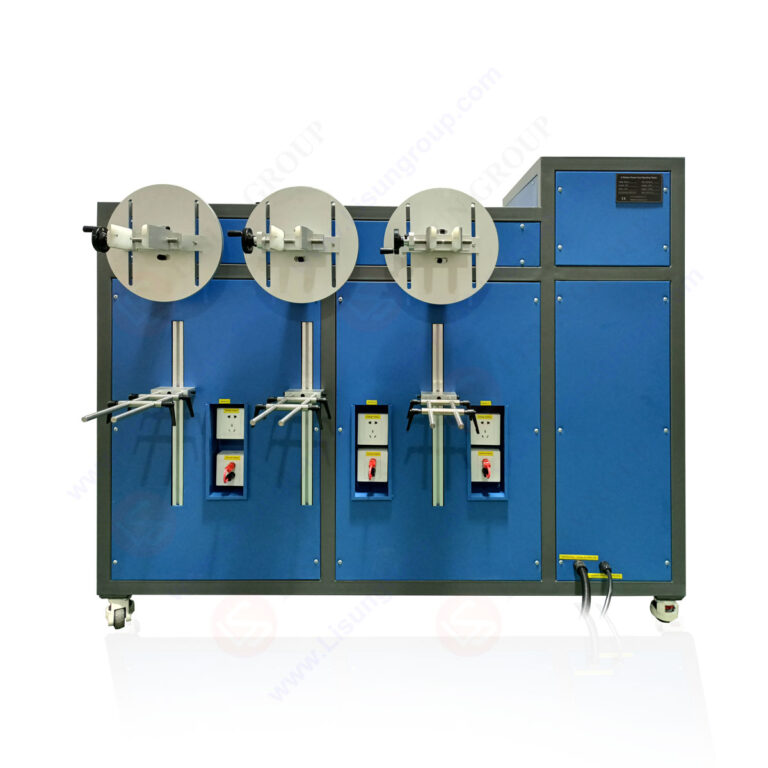
The SW-6 test system incorporates six independent test stations arranged in a modular configuration, each equipped with its own cord clamping mechanism, bending arm assembly, and load current monitoring circuit. The mechanical design utilizes a rigid steel frame construction that minimizes vibration transfer between adjacent stations during simultaneous operation. Each station features adjustable mounting positions to accommodate different cord diameters ranging from 6 mm to 20 mm, with pneumatic or manual clamping systems that ensure consistent grip pressure without damaging the cord insulation. The bending arm travels through a programmable angular range from 0 to 180 degrees, with adjustable dwell time at each extreme position to simulate realistic usage patterns.
2.2 Control System and Servo Drive Integration
The control architecture employs a Programmable Logic Controller (PLC) as the central processing unit, coordinating servo motor drives for each test station independently. This distributed control approach enables engineers to run different test protocols on separate stations simultaneously, maximizing laboratory flexibility. The servo motors provide precise angular positioning with feedback resolution of 0.1 degrees, ensuring that cumulative angular errors remain within specification even after millions of cycles. The PLC supports storage of up to 50 test programs, each defining parameters including bending angle, frequency, cycle count, load current, and failure detection thresholds. A 7-inch touchscreen interface provides real-time display of test status, cycle progress, and any fault conditions across all active stations.
3.1 Sample Preparation and Mounting Procedure
Proper sample preparation is essential for generating valid test results using the SW-6 Flexibility Tester. Power cord samples should be conditioned at standard laboratory conditions for a minimum of 24 hours prior to testing to ensure material equilibrium. The cord is mounted with the specified bending zone positioned at the pivot point of the bending arm, with the strain relief or cord anchorage point aligned according to the applicable standard requirements. For IEC 60884-1 testing, the cord is loaded with a hanging mass corresponding to the cord’s cross-sectional area, typically 50 N for cords up to 1.5 mm² and 100 N for larger diameters. The current carrying capacity must be set to match the rated current of the cord, with test voltages applied through the bending system to detect conductor discontinuity.
3.2 Cycle Parameter Selection and Test Execution
The SW-6 system allows configuration of bending frequency from 10 to 60 cycles per minute, with the standard test protocol typically requiring 10,000 cycles for most product categories. Engineers must select the appropriate bending angle based on the product type: 90 degrees for plugs and socket-outlets per IEC 60884-1, or 135 degrees for some appliance applications. The test proceeds through the programmed cycle count while continuously monitoring continuity through each conductor. When a conductor failure occurs, the corresponding station automatically stops and records the cycle count at failure, while remaining stations continue unaffected. This selective stop feature prevents one sample failure from compromising the entire test run.
4.1 Real-Time Conductor Continuity Verification
The SW-6 employs a proprietary current monitoring system that detects conductor degradation before complete failure occurs. Each test station applies a load current through the power cord while measuring voltage drop across the conductor. When the voltage drop exceeds a programmable threshold, indicating increased resistance from partial strand breakage, the system can either trigger an alarm or stop the test depending on the configured failure criteria. This capability provides early warning of impending failure and enables engineers to analyze failure progression over the test duration. The monitoring circuit operates with 1 millisecond response time, capable of detecting interruptions as brief as 10 microseconds during the bending cycle.
4.2 Data Recording and Traceability
The SW-6 datalogging system records cycle count, instantaneous current, cumulative failures, and timestamps for each event across all six stations. Data is stored in CSV format on removable USB storage or can be transferred via Ethernet to laboratory management systems. The recorded information supports detailed statistical analysis of failure modes, including identification of any systematic patterns that may indicate design weaknesses in cord construction, strain relief geometry, or material selection. Engineers can generate test reports directly from the system interface, including graphical representation of current variation over the test duration.
5.1 Technical Specifications Across Product Range
The LISUN SW series includes three primary configurations designed to accommodate different testing requirements and laboratory throughput needs. The following table provides a comparative analysis of key technical parameters:
| Parameter | SW-1 Single Station | SW-2 Dual Station | SW-6 Six Station | IEC 60884-1 Minimum Requirement |
|---|---|---|---|---|
| Number of test stations | 1 | 2 | 6 | 1 (minimum for validation) |
| Maximum bending angle | 180° | 180° | 180° | 90° (standard test) |
| Bending frequency range | 10-60 cycles/min | 10-60 cycles/min | 10-60 cycles/min | 30 cycles/min (recommended) |
| Load current capacity | 0-40 A | 0-40 A | 0-40 A | Rated current of cord |
| Test voltage | 0-300 V AC | 0-300 V AC | 0-300 V AC | 250 V (standard) |
| Cord diameter range | 6-20 mm | 6-20 mm | 6-20 mm | Dependent on plug type |
| PLC control interface | Yes | Yes | Yes | Not specified |
| Independent station control | Not applicable | Yes | Yes | Not required |
5.2 Selection Criteria for Laboratory Adoption
Laboratory managers evaluating SW series configurations should consider throughput requirements, testing diversity, and budget constraints. The SW-6 provides maximum productivity for high-volume testing operations, enabling simultaneous evaluation of six samples that may represent different production batches, design iterations, or competitive products. The SW-2 offers a balanced solution for moderate testing volumes while maintaining the independent station control feature. The SW-1 single-station configuration suits research and development applications where detailed analysis of individual sample behavior is prioritized over throughput. All models share the same core control architecture and monitoring capabilities, ensuring consistent test methodology regardless of station count.
6.1 Household Appliance Cord Reliability Validation
Manufacturers of washing machines, refrigerators, vacuum cleaners, and other household appliances must validate power cord durability through standardized bending tests per IEC 60335-1. The SW-6 enables these manufacturers to test cords from multiple suppliers simultaneously, comparing failure characteristics and identifying optimal cord construction for specific product applications. The test protocol typically involves 10,000 bending cycles at 90 degrees with rated current flowing through the conductors. Post-test inspection focuses on insulation integrity at the bending zone and any evidence of conductor exposure. The multi-station configuration allows testing of cords with different cross-sectional areas or insulation materials in a single test run.
6.2 Power Tool and Hand-Held Equipment Testing
Hand-held power tools subject power cords to more aggressive flexing conditions due to operator movement and tool positioning. IEC 60745-1 requires bending tests at increased angular ranges and frequencies to simulate this demanding usage environment. The SW-6 adjustable parameters accommodate these requirements with bending angles up to 135 degrees and frequencies up to 60 cycles per minute. The independent station control feature allows engineers to test different product types simultaneously, such as drills, grinders, and saws, each with their specific cord configurations and test parameters. The real-time current monitoring capability is particularly valuable for detecting intermittent conductor breaks that may occur during tool operation.
7.1 Routine Inspection and Wear Monitoring
The SW-6 bending arm assemblies and clamping mechanisms require periodic inspection to maintain test accuracy. Engineers should verify the angular calibration of each station using a digital protractor at weekly intervals, ensuring that the actual bending angle matches the programmed value within the ±1 degree specification. The cord clamping surfaces should be inspected for signs of wear or deformation that could affect grip consistency. Pneumatic clamping system components, including seals and valves, require monthly leakage testing and replacement as needed. The servo motor bearings and drive belts should be lubricated according to the manufacturer’s schedule, typically every 500,000 cycles.
7.2 Electrical Safety Verification and Sensor Calibration
The current monitoring circuits and continuity detection systems require calibration verification using precision resistors and current sources. The voltage drop measurement accuracy should be verified at quarterly intervals using a calibrated multimeter. The test voltage output must be checked for stability and accuracy, particularly when operating at higher current levels that may cause thermal drift. Safety interlocks, including emergency stop circuits and enclosure grounding, require monthly verification per laboratory safety protocols. The SW-6 system includes self-diagnostic routines that can be executed during maintenance procedures to identify any developing issues before they affect test results.
The SW-6 Flexibility Tester with Power Cord Bending Test Methodology provides a comprehensive solution for validating power cord reliability across household appliances, power tools, and electrical components. Its six-station configuration delivers significant productivity advantages while maintaining the precision required by IEC 60884-1, IEC 60335-1, and IEC 60745-1 testing standards. The PLC-controlled servo drive system ensures angular accuracy within ±1 degree, while real-time current monitoring enables early detection of conductor degradation and automatic test termination upon failure. For R&D and quality control engineers, the SW-6 offers the flexibility to configure custom test protocols, the capacity to evaluate multiple samples simultaneously, and the data recording capabilities necessary for thorough failure analysis. Third-party testing laboratories benefit from the high throughput and traceable documentation, while manufacturers gain confidence that their power cord designs will meet global safety requirements. The integration of robust mechanical construction, precise control electronics, and comprehensive monitoring technology positions the SW-6 as an essential tool for any organization committed to electrical product safety and reliability validation.
Q1: What is the difference between the SW-6 bending test methodology and the pendulum-style bending test specified in IEC 60884-1?
A: The SW-6 test methodology replicates the mechanical bending action specified in IEC 60884-1 Clause 23.2 through a servo-driven bending arm that moves the power cord through a programmed angular displacement. While traditional pendulum-style testers rely on gravitational force to return the cord to its starting position, the SW-6 uses controlled servo motor motion to achieve precise angular positioning, adjustable dwell times, and consistent bending frequency across all test cycles. The SW-6 methodology maintains the same bending angle of 90 degrees as specified in the standard but offers the advantage of programmable parameters that can accommodate different testing requirements. Additionally, the SW-6 incorporates real-time current monitoring that detects conductor failure at the exact moment it occurs, providing more precise failure cycle data than systems that only verify continuity at fixed intervals. The multi-station design also enables simultaneous testing of multiple samples under identical conditions, improving statistical validity of results.
Q2: How does the SW-6 handle different cord diameters and insulation materials during bending testing?
A: The SW-6 accommodates cord diameters ranging from 6 mm to 20 mm through adjustable clamping mechanisms that apply consistent grip pressure without damaging the insulation. The clamping jaws are available in multiple configurations matched to common cord geometries, including flat or round cord types. For different insulation materials such as PVC, rubber, or thermoplastic elastomers, the test methodology remains consistent, but engineers should consider material-specific conditioning requirements prior to testing. The SW-6 bending arm pivot point can be adjusted vertically to ensure the cord bending zone aligns with the clamping point, regardless of cord diameter. The clamping pressure is controlled to prevent cord deformation while maintaining sufficient grip to prevent slippage during repeated bending cycles. For cords with specialized insulation or unusual cross-sectional shapes, custom clamping inserts can be fabricated to ensure proper sample mounting.
Q3: What are the recommended test parameters for evaluating power cords according to IEC 60335-1 for household appliances?
A: IEC 60335-1 Clause 25.14 specifies that power cords for household appliances should undergo a bending test of 10,000 cycles at a frequency of 30 cycles per minute, with a bending angle of 90 degrees measured from the vertical position. The cord should be loaded with a mass based on its cross-sectional area: 50 N for cords up to 1.5 mm², and 100 N for larger diameters. During the test, rated current should flow through the conductors at rated voltage to detect any intermittent failures. The SW-6 can be programmed with these parameters as preset test protocols, allowing engineers to initiate testing with a single touch. For products that undergo more severe flexing during normal use, such as vacuum cleaners or portable heaters, engineers may increase the cycle count to 20,000 or 30,000 cycles to ensure sufficient safety margin. The SW-6 data recording capability enables engineers to correlate failure cycles with specific product design features and make informed material or geometry improvements.
Q4: Can the SW-6 be used for testing USB cables, coaxial cables, or other low-voltage signal cables?
A: While the SW-6 is primarily designed for power cord testing per IEC and GB standards, its adjustable parameters and current monitoring capabilities allow adaptation for testing low-voltage cables including USB cables, coaxial cables, and signal cables. For these applications, engineers must ensure that the load current settings are configured to match the cable’s rated current capacity, typically lower than power cord values. The continuity monitoring system can detect conductor breaks in signal cables with minimal current flow, provided the detection sensitivity is properly calibrated. The SW-6 bending angle and frequency adjustments remain applicable for signal cables, though cycle counts may be adjusted based on the expected flex life of the specific cable type. However, users should verify that the test methodology aligns with any applicable standards for the specific cable category, as some signal cable testing standards require different test apparatus configurations. For specialized cable testing, consultation with the manufacturer regarding optional accessories or custom configurations is recommended.