




Abstract
Accelerated LED aging testing has become a critical requirement for manufacturers seeking to validate long-term lumen maintenance performance within compressed development timelines. This article provides a comprehensive technical examination of accelerated LED aging testing with LISUN optical aging test instruments, focusing on the LEDLM-80PL and LEDLM-84PL systems designed for IES LM-80/TM-21 and IES LM-84/TM-28 compliance respectively. We explore the Arrhenius Model-based prediction software, dual testing modes, and customizable hardware configurations that enable precise L70/L50 lifetime projections from 6000-hour test durations. Technical professionals will gain insights into standard-aligned methodologies, system architecture optimization, and practical implementation strategies for integrating these instruments into existing quality assurance workflows. The article addresses the critical intersection of accelerated testing theory, photometric measurement accuracy, and regulatory compliance in the LED manufacturing ecosystem.
1.1 The Physics of LED Lumen Depreciation
LED lumen depreciation follows a predictable exponential decay pattern governed by junction temperature, drive current, and phosphor degradation kinetics. At the semiconductor junction, non-radiative recombination centers accumulate over time due to crystal lattice defects and dopant migration, directly reducing quantum efficiency. The degradation rate accelerates exponentially with temperature, following the Arrhenius relationship where reaction rates double for approximately every 10°C increase in junction temperature. This temperature dependency provides the scientific foundation for accelerated aging methodologies, allowing engineers to compress years of real-world operation into weeks of controlled stress testing. The IES LM-80 standard mandates minimum 6000-hour testing at three case temperatures (typically 55°C, 85°C, and a third temperature selected by the manufacturer) to establish the degradation slope required for TM-21 extrapolation to L70 or L50 lifetimes.
1.2 Accelerated Testing vs. Real-Time Aging
The fundamental distinction between accelerated and real-time aging lies in the stress factor multiplication applied to operating conditions. Real-time testing requires 6000 hours (approximately 8.3 months) minimum per LM-80, with L70 projections often extending beyond 50,000 hours. Accelerated testing elevates case temperatures to 85°C or higher while maintaining rated current, achieving degradation rates 5-10 times faster than typical operating conditions. The LISUN optical aging test instruments implement precise temperature control within ±1°C tolerance across multiple channels, ensuring the acceleration factor remains mathematically predictable. However, engineers must recognize that excessive acceleration (temperatures exceeding 130°C or currents beyond rated limits) can introduce failure mechanisms not observed under normal operation, including solder joint fatigue, encapsulant carbonization, and phosphor thermal quenching that produce invalid lifetime projections.
1.3 Standards Landscape for Lumen Maintenance Testing
The regulatory framework governing LED aging testing encompasses multiple complementary standards. IES LM-80-15 specifies the lumen depreciation test methodology for LED packages, arrays, and modules, defining test durations, temperature conditions, measurement intervals, and reporting requirements. IES LM-84-14 extends similar requirements to LED light engines and luminaires. TM-21-19 provides the mathematical extrapolation methodology for projecting long-term lumen maintenance from LM-80 data, employing exponential decay curve fitting with lower 90% confidence bounds. TM-28-14 offers an alternative projection method for luminaires tested under LM-84. Additional standards including IES LM-79-19 (electrical and photometric measurements), CIE 084 (light measurement), CIE 70 (absolute intensity distribution), and CIE 127 (LED intensity measurement) provide supporting measurement protocols essential for accurate aging test characterization.
2.1 System Variants and Target Applications
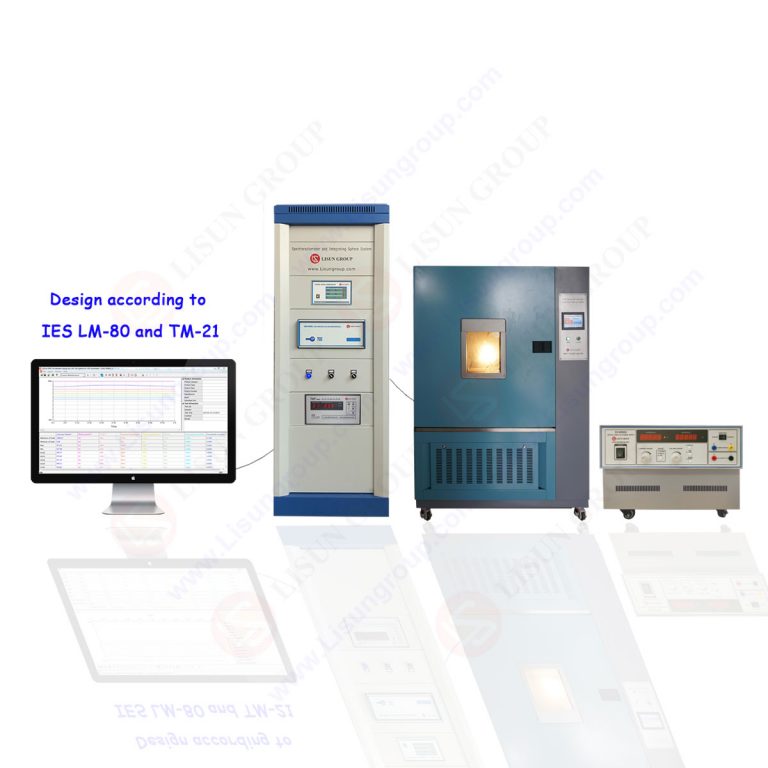
The LISUN LEDLM-80PL and LEDLM-84PL represent complementary instrument platforms engineered for specific standard compliance paths. The LEDLM-80PL targets component-level testing per IES LM-80, supporting LED packages, arrays, and modules with thermocouple attachment points for direct case temperature monitoring. The LEDLM-84PL addresses luminaire-level testing per IES LM-84, accommodating complete light engines and luminaires with integrated thermal management systems. Both variants share core architecture including the integrating sphere photometer, programmable temperature chambers, and control software, but differ in fixture design, temperature sensing configuration, and supported test sample geometries. The dual-system approach enables manufacturers to maintain consistent measurement methodologies across component and luminaire testing workflows while optimizing hardware for each standard’s specific requirements.
2.2 Integrating Sphere Photometer Specifications
Both systems utilize high-reflectance integrating spheres coated with barium sulfate or Spectralon materials achieving >96% diffuse reflectance across the visible spectrum. Sphere diameters range from 0.3 meters for component testing to 2.0 meters for luminaire applications, selected based on sample dimensions and measurement uncertainty requirements. The photometer incorporates spectroradiometric detection using array-based spectrometers with 1-2 nm wavelength resolution and photopic correction filters achieving f1′ values below 3%. Calibration traceability to national standards ensures absolute luminous flux measurements with expanded uncertainty (k=2) below 2.5% for most applications. The systems measure correlated color temperature (CCT) with ±25K precision, color rendering index (CRI) with ±0.5 units, and chromaticity coordinates with ±0.001 uncertainty, providing comprehensive photometric characterization at each measurement interval.
2.3 Temperature Chamber Integration
| Parameter | LEDLM-80PL | LEDLM-84PL |
|---|---|---|
| Temperature Range | 25°C to 130°C | 25°C to 100°C |
| Temperature Stability | ±0.5°C | ±0.5°C |
| Maximum Test Positions | 20 per chamber | 8 per chamber |
| Supported Chambers | Up to 3 connected | Up to 3 connected |
| Temperature Gradient | ≤1°C across chamber | ≤1°C across chamber |
| Sample Power Supply | 0-300V, 0-5A programmable | 0-300V, 0-10A programmable |
| Measurement Frequency | 1000-hour intervals minimum | 1000-hour intervals minimum |
The temperature chamber subsystem supports simultaneous testing at up to three distinct temperature conditions, enabling complete LM-80 compliance with 55°C, 85°C, and 105°C test groups in a single operational campaign. Each chamber incorporates independent PID temperature controllers, forced air circulation, and overtemperature protection circuits.
3.1 Mathematical Foundation of the Arrhenius Model
The Arrhenius equation establishes the relationship between temperature and degradation reaction rates: R(T) = A × exp(-Ea/(k×T)), where R(T) is the reaction rate at absolute temperature T, A is the pre-exponential factor, Ea is the activation energy in electron volts (eV), and k is Boltzmann’s constant (8.617×10⁻⁵ eV/K). For LED lumen depreciation, the activation energy typically ranges from 0.3 to 0.7 eV for phosphor degradation and 0.2 to 0.5 eV for semiconductor junction degradation. The LISUN software applies this model to predict lifetime at use temperatures of 45°C to 85°C based on accelerated test data collected at elevated temperatures. The extrapolation requires establishing the degradation rate at each test temperature, fitting the Arrhenius relationship to determine Ea, then calculating the acceleration factor (AF) between test and use conditions: AF = exp[(Ea/k) × (1/T_use – 1/T_test)].
3.2 TM-21 Extrapolation Methodology
TM-21-19 specifies the mathematical procedure for projecting L70 (time to 70% lumen maintenance) and L50 (time to 50% lumen maintenance) from LM-80 test data. The method employs exponential decay curve fitting: Φ(t) = α × exp(-β×t), where Φ(t) is the normalized luminous flux at time t, α is the initial flux (typically constrained to 1.0 or ≤1.05), and β is the decay rate constant. The LISUN software automatically performs this nonlinear regression analysis, calculating the projected life as Lp = ln(α/p)/β, where p is 0.70 for L70 or 0.50 for L50. The lower 90% confidence bound is calculated using the variance-covariance matrix of the fitted parameters, providing statistically conservative lifetime estimates. Engineers must verify the goodness-of-fit using R² values and residual analysis; TM-21 requires R² > 0.85 for valid projections.
3.3 TM-28 Alternative Projection for Luminaires
TM-28-14 offers an alternative methodology for projecting luminaire lumen maintenance from LM-84 test data, accounting for the integrated thermal management and optical systems present in complete luminaires. The projection employs a two-parameter exponential model similar to TM-21 but incorporates temperature measurement at the LED module level rather than ambient or case temperature. The LISUN LEDLM-84PL system includes thermocouple interfaces for monitoring internal luminaire temperatures, enabling accurate TM-28 projections based on actual thermal conditions experienced by the LEDs. The software allows engineers to compare TM-21 and TM-28 projections for the same test data, identifying discrepancies that may indicate thermal management issues or temperature measurement errors.
4.1 Constant Current Mode Operation
The constant current testing mode maintains precisely regulated drive current throughout the 6000-hour test duration, with less than ±0.5% variation from setpoint. This mode simulates typical LED driver operation where current regulation maintains consistent output despite component aging. The constant current approach isolates lumen depreciation due to semiconductor degradation from current-induced thermal effects, providing cleaner data for TM-21 curve fitting. Temperature chambers maintain case temperature within ±1°C of setpoint through PID-controlled heating and cooling, compensating for ambient temperature fluctuations. The system logs current, voltage, and power at each measurement interval, enabling calculation of efficacy (lm/W) degradation separate from lumen depreciation.
4.2 Constant Voltage Mode Operation
The constant voltage testing mode maintains fixed voltage across test samples, allowing current to vary as forward voltage characteristics change with aging. This mode simulates applications where voltage-regulated power supplies are employed, such as linear driver circuits or automotive lighting systems. Current typically decreases as junction temperature increases and semiconductor resistance changes, producing different degradation profiles than constant current operation. The LISUN software supports both modes simultaneously across different test channels, enabling comparative studies of degradation mechanisms under different electrical stress conditions. Engineers can evaluate which driver topology provides superior long-term lumen maintenance for their specific LED and thermal management combination.
4.3 Pulsed vs. Continuous Operation Comparison
| Operating Mode | Lumen Maintenance Trend | Failure Mechanism Focus | TM-21 Applicability |
|---|---|---|---|
| Continuous | Faster degradation | Thermal fatigue | Standard application |
| Pulsed (1-10 kHz) | Slower degradation | Die attachment stress | Requires modification |
| Pulsed (100 Hz-1 kHz) | Moderate degradation | Phosphor persistence | Limited validation |
| DC with AC ripple | Equivalent to continuous | Capacitor aging effects | Standard application |
The pulsed operation mode enables evaluation of LED performance under PWM dimming applications, where thermal cycling may accelerate solder joint fatigue. The LISUN instruments accommodate pulse frequencies from 50 Hz to 20 kHz with adjustable duty cycles from 10% to 90%.
5.1 Pre-Test Characterization Requirements
Before initiating accelerated aging testing, the LISUN systems perform comprehensive baseline characterization of each test sample. This includes full photometric measurements (luminous flux, CCT, CRI, chromaticity coordinates) at the standard operating temperature (typically 25°C), electrical parameter measurement (forward voltage, current, power), and thermal imaging to verify uniform temperature distribution. The baseline data establishes initial lumen output used to normalize all subsequent measurements to percentage maintenance values. Samples exhibiting >3% variation from nominal specifications are rejected to ensure statistical homogeneity within test groups. The system records serial numbers, manufacturer date codes, and physical dimensions for each sample, creating a complete chain of custody documentation compliant with ISO 17025 requirements.
5.2 Periodic Measurement Intervals
The IES LM-80 standard requires measurements at minimum 1000-hour intervals for the first 6000 hours, with additional intervals of 2000 hours for extended testing. The LISUN software automatically schedules measurements at user-defined intervals, initiating the transfer of samples from temperature chambers to the integrating sphere measurement position. Each measurement cycle takes approximately 2-4 hours depending on sample count and measurement resolution, during which samples stabilize at room temperature (25±2°C) for 30 minutes before photometric characterization. The system captures 10 consecutive measurements per sample, reporting the average and standard deviation to assess measurement repeatability. Data points exceeding ±3σ from the trend are flagged for investigation, with the system capable of automatically repeating measurements to verify anomalous results.
5.3 Data Integrity and Traceability
The software implements secure data storage with timestamped, encrypted records that cannot be modified after acquisition, satisfying regulatory requirements for data integrity. Each measurement file includes instrument calibration dates, spectrometer serial numbers, environmental conditions (ambient temperature, humidity, pressure), and measurement uncertainty calculations. The system generates comprehensive reports compatible with ENERGY STAR, DLC, and other certification program submission requirements. Automated backup to network storage prevents data loss, and the software supports export to CSV, XML, and PDF formats for integration with existing quality management systems. Audit trails track all user actions including measurement initiation, parameter changes, and report generation.
6.1 LM-80/TM-21 Compliance Workflow
Implementing LM-80/TM-21 compliance using the LISUN LEDLM-80PL follows a structured workflow. First, select 20 samples minimum per test condition (55°C, 85°C, and optional third temperature) from a homogeneous production lot. Mount samples on temperature-controlled heat sinks with thermocouples attached to the defined case temperature measurement point per LM-80 Figure 2. Set constant current drive at rated value (±2% tolerance) and temperature chambers to target setpoints. The system initiates a 6000-hour test with measurements at 0, 1000, 2000, 3000, 4000, 5000, and 6000 hours. After test completion, the software performs TM-21 analysis, reporting L70 and L50 projections with 90% confidence bounds. Results must demonstrate projected L70 > 25,000 hours (ENERGY STAR requirement) or > 50,000 hours (DLC requirement) depending on certification target.
6.2 Chamber Configuration for Multi-Temperature Testing
The ability to connect up to three temperature chambers enables simultaneous testing at 55°C, 85°C, and 105°C, meeting LM-80 requirements for three-temperature testing in a single campaign. Chamber configuration requires careful consideration of sample distribution: allocate 20 samples minimum per temperature, with 10 additional samples for margin. The central control unit manages sequencing across chambers, ensuring measurement intervals remain synchronized. Engineers should stagger start times by 24-48 hours between chambers to avoid simultaneous measurement bottlenecks. The software supports independent temperature, current, and measurement interval settings per chamber, enabling mixed-configuration testing where different LED types or drive conditions are evaluated simultaneously.
6.3 Accelerated Testing with LISUN Optical Aging Test Instruments: Best Practices
Successful accelerated LED aging testing with LISUN optical aging test instruments requires adherence to established best practices. Maintain consistent ambient laboratory conditions (23±3°C, 30-60% relative humidity) to minimize environmental interference with temperature chamber performance. Calibrate integrating sphere photometers every 12 months or after 500 measurements, using NIST-traceable standard lamps. Verify temperature chamber uniformity quarterly using distributed thermocouple arrays, mapping any spatial temperature gradients exceeding 1°C. Implement sample randomization by rotating measurement positions at each interval to eliminate systematic position effects. Document all equipment deviations and maintenance activities in the instrument logbook for audit readiness.
7.1 Custom Temperature Profiles for Specialized Testing
Beyond standard constant-temperature testing, the LISUN systems support customized temperature profiles simulating real-world operating conditions. Engineers can program temperature cycling profiles with adjustable ramp rates (0.5-5.0°C/min), dwell times, and cycle counts. Thermal cycling testing evaluates solder joint reliability and die attach integrity under repeated thermal stress, complementing constant temperature lumen maintenance data. Humidity-controlled testing (20-90% RH) assesses phosphor degradation under accelerated moisture exposure, important for outdoor and high-humidity applications. The software logs temperature and humidity throughout cycling tests, correlating degradation events with environmental stress conditions.
7.2 Multi-Criteria Degradation Analysis
The software extends beyond simple lumen maintenance to analyze correlated degradation parameters including CCT shift, chromaticity drift (Δu’v’), and CRI changes over time. These secondary parameters often indicate specific failure mechanisms: phosphor degradation manifests as CCT increase (blue shift), while encapsulant yellowing produces CCT decrease. The system tracks these parameters at each measurement interval, enabling comprehensive degradation analysis. The software can flag samples exceeding specified tolerance limits for any parameter, providing early warning of potential failure modes. This multi-criteria approach supports compliance with TM-30-18 color fidelity requirements and ENERGY STAR chromaticity maintenance criteria.
7.3 Extended Testing Beyond 6000 Hours
For applications requiring L70 projections beyond 50,000 hours or extended warranty validation, the systems support testing beyond the standard 6000-hour duration. Extended testing to 10,000 or 20,000 hours provides higher confidence in TM-21 projections, particularly for LEDs with very slow degradation rates. The software automatically recalculates TM-21 projections as data accumulates, showing convergence of lifetime estimates with increasing test duration. Engineers can specify conditional test termination when specified confidence intervals (e.g., ±10% of projected L70) are achieved. The system adjusts measurement intervals to 2000 hours after the initial 6000-hour period, optimizing testing efficiency for extended campaigns.
Accelerated LED aging testing with LISUN optical aging test instruments provides LED manufacturers and testing laboratories with a robust, standards-compliant solution for validating long-term lumen maintenance performance. The LEDLM-80PL and LEDLM-84PL systems address the distinct requirements of component-level and luminaire-level testing per IES LM-80/TM-21 and IES LM-84/TM-28, respectively, while the integrated Arrhenius Model-based software enables accurate lifetime projections from 6000-hour test durations. The dual testing modes (constant current and constant voltage) combined with customizable temperature chamber configurations support up to three simultaneous test conditions, accelerating compliance workflows while maintaining measurement precision. Technical professionals benefit from comprehensive data acquisition systems that track not only L70/L50 metrics but also correlated parameters including CCT, CRI, and chromaticity drift, enabling multi-faceted degradation analysis. The systems’ support for extended testing beyond 6000 hours and customized temperature profiles addresses specialized validation requirements for automotive, aerospace, and high-reliability applications. By implementing best practices for calibration, sample management, and data integrity, engineers can achieve certification-ready results that satisfy ENERGY STAR, DLC, and international regulatory requirements. LISUN’s commitment to measurement accuracy, standard compliance, and technical support positions these instruments as essential tools for advancing LED reliability engineering in an increasingly demanding marketplace.
Q1: What are the minimum test durations required for LM-80 compliance using the LISUN optical aging test instruments?
A: The IES LM-80-15 standard mandates a minimum 6000-hour test duration for lumen maintenance characterization of LED packages, arrays, and modules. The LISUN LEDLM-80PL system is designed to support this requirement with automated measurement intervals at 0, 1000, 2000, 3000, 4000, 5000, and 6000 hours. For extended testing beyond 6000 hours (recommended for L70 projections exceeding 50,000 hours), the system supports testing to 10,000 or 20,000 hours with measurement intervals adjusted to 2000 hours. The TM-21 extrapolation methodology requires data from at least three temperature conditions (typically 55°C, 85°C, and one additional temperature) tested for the minimum 6000-hour duration. The LISUN system’s ability to connect up to three temperature chambers enables simultaneous testing at all required temperatures, completing the full compliance test campaign within 8-9 months for the standard 6000-hour duration.
Q2: How does the Arrhenius Model-based software improve lifetime prediction accuracy compared to simple exponential extrapolation?
A: The Arrhenius Model incorporated in LISUN’s software provides significant advantages over simple exponential extrapolation by accounting for the temperature dependency of LED degradation mechanisms. Simple exponential extrapolation assumes degradation rates remain constant across all temperatures, leading to inaccurate projections when test temperatures differ from use temperatures. The Arrhenius Model establishes the mathematical relationship between temperature and degradation rate by fitting activation energy (Ea) values from data collected at multiple temperatures. This enables accurate prediction of lumen maintenance at any use temperature within the validated temperature range. The software automatically calculates acceleration factors, allowing engineers to convert accelerated test results to equivalent real-world lifetimes. For example, testing at 85°C with an activation energy of 0.5 eV yields an acceleration factor of approximately 4.5× relative to 55°C operation, meaning 6000 hours of accelerated testing represents approximately 27,000 hours of real-world operation. The software also calculates lower 90% confidence bounds per TM-21 requirements, providing statistically conservative lifetime estimates that account for measurement uncertainty and sample variation.
Q3: Can the LISUN LEDLM-84PL system be used for testing integrated LED luminaires with built-in drivers?
A: Yes, the LEDLM-84PL system is specifically designed for testing complete LED light engines and luminaires per IES LM-84 requirements. The system accommodates luminaires with integrated drivers by providing programmable AC or DC power supplies (0-300V, 0-10A) that support a wide range of driver types including constant current, constant voltage, and dimmable drivers. The system’s integrating sphere sizes (0.5m to 2.0m diameter) accommodate luminaires up to 500mm in maximum dimension for the 1.0m sphere, and larger luminaires for the 2.0m sphere. Temperature monitoring is accomplished using thermocouples attached to the LED module inside the luminaire, providing accurate thermal data for TM-28 projection. The software supports testing of dimmable luminaires at multiple dimming levels (100%, 75%, 50%, 25%) to evaluate lumen maintenance under different operating conditions. The system can also accommodate luminaires with external drivers by providing separate driver compartments and cable feedthroughs that maintain thermal isolation between the driver and luminaire under test.