




Here is the comprehensive technical article on the LISUN EMS-ISO7637 system, formatted to your specifications.
Abstract
This article provides a detailed technical analysis of the LISUN Automotive EMC Immunity Test System | Latest ISO 16750-2 Compliance, focusing on the LISUN EMS-ISO7637 Automotive Electronics Transient Immunity EMC Testing System. Designed for modern automotive electronics R&D and quality assurance, this system addresses the rigorous challenges of transient conduction immunity. We explore its architecture, pulse generation capabilities, and compliance with critical standards such as ISO 7637-2:2021 and ISO 16750-2:2023. By examining system specifications, automation features, and application scenarios across passenger cars, commercial vehicles, and new energy vehicles (NEVs), this article demonstrates how the LISUN Automotive EMC Immunity Test System | Latest ISO 16750-2 Compliance provides engineers with a reliable, cost-effective solution for verifying the robustness of ECUs, OBCs, BMS, and DC-DC converters against power line transients.
1.1 The Critical Role of ISO 7637 and ISO 16750-2
The electromagnetic environment within modern vehicles is increasingly hostile due to the proliferation of high-power electronics and communication networks. Standards like ISO 7637-2:2021 and ISO 16750-2:2023 define the test pulses that simulate real-world transients caused by load dump, inductive switching, and alternator field decay. These standards are the de-facto benchmark for ensuring component reliability and system safety. The LISUN Automotive EMC Immunity Test System | Latest ISO 16750-2 Compliance is engineered to replicate these specific pulse waveforms with high fidelity, covering P1 through P5b as defined in ISO 7637-2. For 48V mild-hybrid systems, the system also supports testing per VW 80000 and GM 3172 requirements, making it a versatile platform for global OEM approval processes.
1.2 Key Challenges for R&D and QA Teams
R&D teams face the challenge of balancing design performance with immunity to transients that can cause microcontroller resets or communication bus errors. QA departments require reproducible test results for consistent quality audits. The LISUN EMS-ISO7637 system addresses these challenges by providing multi-module pulse generation (P1/P2a/P2b/P3/P4/P5a/P5b) with precise amplitude and duration control. This eliminates the variability found in discrete generator setups, ensuring that test results are both accurate and repeatable. The system’s ability to support 12V, 24V, and 36V systems allows a single test platform to cover passenger cars, heavy trucks, and emerging NEV architectures.
1.3 The LISUN EMS-ISO7637 Solution Overview
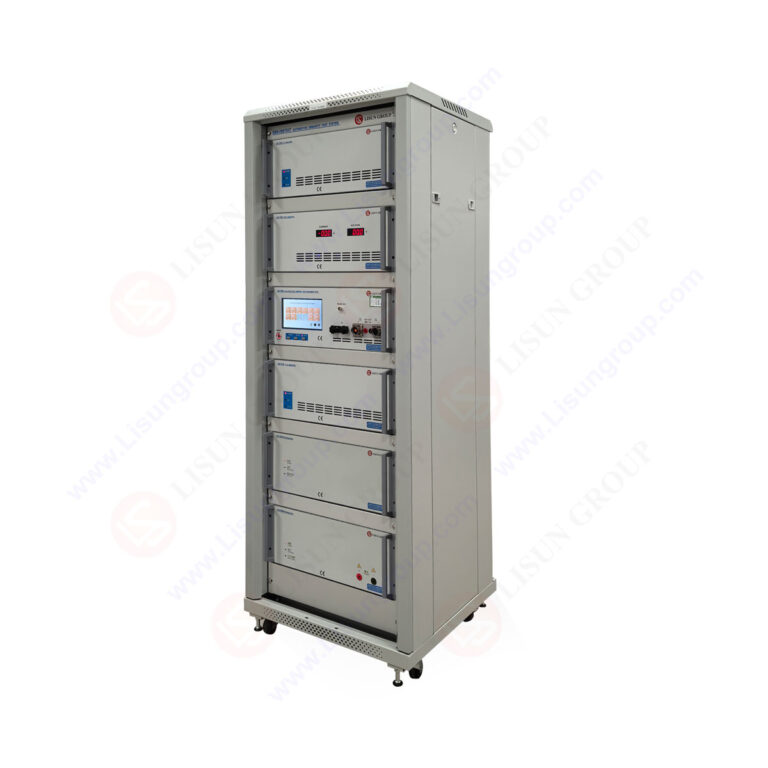
The LISUN Automotive EMC Immunity Test System | Latest ISO 16750-2 Compliance integrates a high-voltage pulse generator, an electronic switch, and a coupling network into a single chassis. This modularity reduces system footprint and cabling complexity, which are common sources of error in transient testing. The system includes built-in calibration routines and automated reporting, significantly reducing manual setup time. By referencing GB/T 21437.2-2021 and GB/T 21437.3-2021 for the Chinese market, LISUN ensures global applicability. The dual operation mode—via a front-panel touchscreen or remote PC software—offers flexibility for both bench-top R&D testing and automated production line integration.
2.1 Comprehensive Pulse Generation Capabilities
The LISUN EMS-ISO7637 system generates all mandatory test pulses for ISO 7637-2:2021 and ISO 7637-3:2016. This includes Pulse 1 (simulating inductive load switching), Pulse 2a/b (simulating current interruptions and load dump), and the critical Pulse 5a/b (simulating alternator load dump). The pulse parameters, such as rise time (tr), duration (td), and amplitude (Us), are fully programmable to meet both severity levels (I-IV) defined in the standard. For Pulse 3a/3b testing, the system uses a fast transient generator capable of burst frequencies up to 100 kHz, matching the requirements for capacitive coupling clamp (CCC) testing per ISO 7637-3.
2.2 Voltage System Compatibility and Calibration Accuracy
A key differentiating feature is the system’s ability to operate across 12V, 24V, and 36V nominal voltage systems without hardware reconfiguration. This is critical for manufacturers producing components for diverse vehicle platforms. The internal voltage measurement and calibration circuitry achieves an accuracy of better than ±2% of the set pulse amplitude, exceeding the ±10% tolerance required by ISO 16750-2. Table 1 below compares the LISUN EMS-ISO7637’s specifications to the minimum requirements of the relevant standards.
Table 1: LISUN EMS-ISO7637 vs. Standard Requirements
| Parameter | ISO 7637-2:2021 Requirement | LISUN EMS-ISO7637 Specification | Advantage |
| :— | :— | :— | :— |
| Pulse 1 Amplitude (12V sys) | -75V to -150V (Severity III) | -150V max, adjustable 1V step | Exceeds standard range for high-end testing |
| Pulse 5a Amplitude (24V sys) | +123V ± 10% (Severity IV) | +200V max, adjustable 1V step | Covers future 48V system requirements |
| Rise Time (Pulse 1) | < 1 µs | < 0.5 µs | Faster edge for more stringent coupling tests |
| Pulse Repetition Frequency (P3) | 5 kHz – 100 kHz | 0.1 kHz – 200 kHz, adjustable | Extended frequency range for research |
| Calibration Validation | External calibration per ISO 7637-2 | Internal self-calibration + external | Reduced calibration downtime |
3.1 Dual-Mode Operation: Touchscreen and PC Software
The LISUN Automotive EMC Immunity Test System | Latest ISO 16750-2 Compliance features a user-friendly 7-inch color touchscreen for standalone operation, allowing engineers to quickly configure pulse parameters, start tests, and monitor real-time voltage and current waveforms. For complex test sequences involving multiple pulses (e.g., ISO 16750-2 Section 4.2.1 requiring sequential application of P1, P2a, P3), the included PC software provides an intuitive test sequence editor. This software allows users to define test plans, automate switching between different coupling networks (e.g., CCC for lines vs. direct coupling for power), and generate comprehensive PDF test reports with pass/fail criteria. The automation reduces manual intervention, which is a major source of human error in long-duration immunity tests.
3.2 Automated Data Logging and Report Generation
One of the most time-consuming tasks in EMC compliance is documentation. The LISUN system automatically records all test parameters, including pulse amplitude, repetition rate, DUT voltage, and ambient temperature. This data is stored in a non-volatile format. The built-in report generator creates a standardized report that directly references the specific clauses of ISO 7637-2 or ISO 16750-2 that were tested. This feature is invaluable for third-party testing laboratories and component suppliers who must provide rigorous compliance documentation to OEMs. The system’s data integrity also supports 21 CFR Part 11 requirements for electronic signatures in regulated industries.
4.1 Passenger Cars and Commercial Vehicles
For passenger car components operating on 12V systems (e.g., infotainment units, engine control units – ECUs, body control modules – BCMs), the LISUN EMS-ISO7637 system provides the necessary pulses to verify immunity against transients from the battery and alternator. Commercial vehicles with 24V electrical systems benefit from the system’s high-voltage capability (Pulse 5b up to +200V), which is essential for testing components like trailer ECUs and braking systems. The system supports testing of both power lines and signal lines per ISO 7637-3:2016, using the capacitive coupling clamp for lines up to 5A and direct coupling for higher current circuits.
4.2 New Energy Vehicles (NEVs) and High-Voltage Components
The emergence of 48V mild-hybrid systems and high-voltage (400V/800V) traction batteries introduces new transient profiles. The LISUN Automotive EMC Immunity Test System | Latest ISO 16750-2 Compliance is applicable for testing low-voltage auxiliary circuits (12V/24V) within NEVs, such as the On-Board Charger (OBC) control electronics, Battery Management System (BMS) monitoring circuits, and DC-DC converter output stages. While the system itself tests low-voltage ports, its adherence to ISO 16750-2 Section 4.2 (load dump) is critical for verifying the robustness of the low-voltage bus during a high-voltage battery disconnect event. This ensures that the control electronics survive the worst-case transient conditions encountered in electric vehicles.
5.1 Integrated System vs. Discrete Generators
Traditional transient immunity setups often consist of separate pulse generators (e.g., P1 generator, P2a generator) and coupling networks. This requires significant laboratory space and cabling, and synchronization between generators can be problematic. The LISUN EMS-ISO7637 integrates all pulse generation modules into a single 19-inch rack unit, saving valuable bench space and reducing setup time by over 50%. The integrated design ensures that pulse timing and synchronization are inherently perfect, as all modules share a common clock and triggering system.
5.2 Software Automation vs. Manual Switching
Manual testing requires an operator to adjust pulse amplitude for each severity level, switch between coupling modes (e.g., from direct coupling to CCC), and record results manually. The LISUN system’s PC software automates this entire workflow. A single test plan can automatically step through all required pulses (P1, P2a, P2b, P3, P4, P5a) at the specified severity levels for a given standard. This automation not only saves significant test time (up to 70% for a full ISO 7637-2 sequence) but also eliminates the risk of operator fatigue leading to missed test conditions. The script-based control allows for easy integration into automated production test environments.
6.1 Coupling Networks and DUT Protection
The system includes a built-in 50 µH + 1 µF coupling network for direct injection on power lines per ISO 7637-2. For signal lines, a capacitive coupling clamp (CCC) is provided as an accessory. The system’s output stage is protected against accidental short circuits and DUT overloads, ensuring operational safety during testing. A key practical feature is the adjustable pulse repetition time, which allows engineers to slow down the test for thermal protection of the DUT or to speed it up for accelerated life testing, provided the DUT’s thermal capacity allows.
6.2 Calibration and Verification Procedures
To maintain compliance with accreditation bodies (e.g., ISO 17025 for laboratories), the LISUN Automotive EMC Immunity Test System | Latest ISO 16750-2 Compliance supports both internal and external calibration. The internal calibration routine checks the pulse generator’s voltage and timing against an internal reference. For external certification, the system provides accessible test points for an external oscilloscope and voltage probe, allowing a metrology lab to verify the pulse parameters at the DUT’s power terminals. The system firmware logs calibration dates and results, which is essential for maintaining a valid calibration chain.
7.1 Readiness for ISO 16750-2:2023 Updates
The latest revision of ISO 16750-2 (2023) introduced more stringent requirements for Pulse 5 (load dump), including a longer pulse duration (up to 400 ms) and a more complex waveform shape for active load dump suppression systems. The LISUN EMS-ISO7637 system’s firmware is field-upgradable, allowing it to support these new waveform definitions without hardware changes. This ensures that laboratories and OEMs can adapt to the latest standard revisions without purchasing new capital equipment. The system’s memory can store multiple standard revisions, allowing testing to both legacy and current requirements on the same hardware.
7.2 Expanding Capabilities for VW 80000 and GM 3172
Many OEM-specific standards, such as VW 80000 (Lifelong EMC) and GM 3172, define additional pulse shapes or severity levels beyond the base ISO 7637 requirements. The programmable nature of the LISUN system’s pulse generator allows users to create custom waveforms, such as the slow-decay Pulse 5a required by some German OEMs. The PC software includes pre-loaded test profiles for these common standards, simplifying the setup process for engineers who must adhere to multiple global requirements. This flexibility makes the LISUN EMS-ISO7637 a single solution for global homologation.
The LISUN EMS-ISO7637 Automotive Electronics Transient Immunity EMC Testing System represents a significant advancement in automotive EMC testing. By integrating comprehensive pulse generation, multi-voltage support, and advanced automation into a single platform, it directly addresses the needs of modern R&D, QA, and compliance testing. The system’s compliance with ISO 7637-2:2021 and ISO 16750-2:2023, combined with its user-friendly dual-mode operation, reduces test time and improves repeatability. For engineers developing components for passenger cars, commercial vehicles, and new energy vehicles, this system offers a reliable path to global market access. The ability to customize test sequences and report generation ensures that the LISUN Automotive EMC Immunity Test System | Latest ISO 16750-2 Compliance is not just a test instrument, but a strategic investment in product quality and reliability engineering.
Q1: What is the difference between ISO 7637-2 and ISO 16750-2 testing, and can the LISUN EMS-ISO7637 system perform both?
A: Yes, the LISUN system is fully capable of performing tests to both standards. ISO 7637-2:2021 focuses specifically on the conducted transients along power lines from a transient generator, defining the pulse shapes (P1 to P5b) and their application. ISO 16750-2:2023 is a broader environmental standard that includes these transient tests as one of many stress factors, often referencing ISO 7637-2 for the specific test methods. The key difference is that ISO 16750-2 may define stricter application sequences or specific DUT loading conditions during the transient event. The LISUN EMS-ISO7637 system’s PC software allows users to select the governing standard for the test plan, automatically applying the correct pulse amplitude, duration, and sequence per the relevant clause (e.g., ISO 16750-2 Section 4.2.1 for load dump).
Q2: How does the LISUN system handle testing of 48V components per VW 80000?
A: Testing 48V components per VW 80000 requires higher voltage pulse amplitudes and specific pulse shapes that differ slightly from the standard 12V/24V ISO 7637-2 pulses. The LISUN EMS-ISO7637 system supports a 60V maximum operating voltage for the DUT power supply, which is sufficient for 48V systems (typically 48V ± 20%). For Pulse 5 (load dump) in a 48V system, the required amplitude can reach up to +95V. The LISUN system’s pulse generator can output up to +200V, easily covering this requirement. Additionally, the software includes a pre-defined test profile for VW 80000 Pulse 5a (slow decay), which is a requirement of that standard. The system’s programmable rise time and amplitude allow exact reproduction of the OEM-specific waveform parameters.
Q3: Is the capacitive coupling clamp (CCC) included with the LISUN EMS-ISO7637 system for ISO 7637-3 testing?
A: Yes, the standard system package is typically supplied with a capacitive coupling clamp (CCC) designed per ISO 7637-3:2016 specifications. This clamp is used to inject fast transients (Pulse 3a/3b) onto signal lines and I/O ports. The clamp has a coupling capacitance of approximately 100 pF to 1 nF, as defined in the standard. The LISUN system’s generator operates in a mode specifically configured for CCC testing, outputting the high-frequency burst pulses. For direct coupling to low-current lines (under 5A), the system also includes a separate coupling network. This comprehensive accessory set allows laboratories to perform both power line and signal line transient immunity tests without needing to purchase separate hardware from different vendors.
Q4: How is test repeatability ensured when using the automated software?
A: The LISUN PC software ensures repeatability through several mechanisms. First, all test parameters (pulse amplitude, duration, rise time, repetition rate, number of pulses) are stored in a machine-readable test plan file. This eliminates manual entry errors. Second, the software controls the DUT power supply via a GPIB or RS-232 interface, setting the nominal voltage (e.g., 13.5V for a 12V system) automatically before applying pulses. Third, the software can log the actual voltage and current waveforms from the generator’s built-in measurement system, providing a record of the exact stress applied. Finally, the software implements a defined sequence and pause timing, ensuring that the thermal and electrical stress is identical for each DUT tested, which is critical for statistical analysis of pass/fail criteria as per ISO 16750-2.