




Abstract
This comprehensive Temperature Humidity Chamber Applications Guide provides LED manufacturing engineers and testing laboratory technicians with technical insights into accelerated aging validation using advanced environmental simulation systems. Drawing on LISUN’s LED Optical Aging Test Instrument, this guide explores how temperature humidity chambers integrate with IES LM-80, IES LM-84, TM-21, and TM-28 standards to predict LED lumen maintenance and lifespan. The article details dual system variants (LEDLM-80PL for LM-80/TM-21 and LEDLM-84PL for LM-84/TM-28), Arrhenius Model-based software enabling 6000-hour test extrapolation to L70/L50 metrics, and customizable hardware configurations supporting up to three connected chambers. Technical professionals will gain actionable knowledge for optimizing reliability testing protocols.
1.1 Role of Environmental Chambers in Lumen Maintenance Validation
Temperature humidity chambers are critical tools for simulating operational stressors that accelerate LED degradation mechanisms. By precisely controlling temperature (typically -40°C to +150°C) and relative humidity (20% to 98% RH), engineers replicate years of field exposure within weeks. Chambers apply thermal cycling, moisture ingress, and combined stress conditions to induce failure modes such as phosphor degradation, solder joint fatigue, and encapsulant discoloration. These tests generate degradation data that underpins lumen maintenance projections under IES standards.
1.2 Integration with LISUN’s Optical Aging Test Systems
LISUN’s LED Optical Aging Test Instrument bridges environmental simulation with photometric measurement through its dual-system architecture. The LEDLM-80PL system focuses on LM-80/TM-21 compliance for high-power LEDs, supporting 6000-hour test durations. The LEDLM-84PL variant aligns with LM-84/TM-28 for organic LEDs (OLEDs) and light engines. Both systems interface with up to three connected temperature chambers, enabling multi-condition testing simultaneously—critical for generating the datasets needed for Arrhenius Model-based extrapolation.
1.3 Standards Compliance Overview
Reliability testing mandates adherence to established standards: IES LM-80 defines lumen maintenance measurement protocols for LEDs; IES LM-84 extends this to light engines and OLEDs; TM-21 provides mathematical methods for projecting long-term lumen maintenance; and TM-28 addresses projections for OLED sources. Additional standards like IES LM-79-19, CIE 084, CIE 70, and CIE 127 govern photometric measurements. Temperature humidity chamber applications must align with these frameworks to ensure data acceptance by regulatory bodies.
2.1 IES LM-80: Lumen Maintenance Measurement for LEDs
IES LM-80-15 specifies a 6000-hour minimum test duration at temperatures of 55°C, 85°C, and a manufacturer-defined temperature (e.g., 105°C). Temperature humidity chambers must maintain ±2°C stability and <50% RH (unless specifying humidity). LISUN’s LEDLM-80PL system integrates directly with chambers, automating photometric measurements via an integrating sphere (0.3m to 2m diameter) at defined intervals (1000 hours). Data on luminous flux depreciation forms the foundation for TM-21 extrapolations.
2.2 IES LM-84: Light Engine and OLED Testing
IES LM-84-17 extends LM-80 concepts to light engines, modules, and OLEDs. Testing requires combined thermal and humidity control (typically 85°C/85% RH for accelerated aging). LISUN’s LEDLM-84PL variant supports this by offering dual testing modes—constant current and pulsed measurement—to isolate thermal effects. The system monitors photometric parameters (luminous flux, chromaticity shift) across 6000 hours, enabling compliance with TM-28 projections.
2.3 TM-21 and TM-28: Extrapolation and Lifespan Prediction
TM-21-19 applies nonlinear regression (Arrhenius Model) to LM-80 data, projecting L70 (time to 70% lumen maintenance) or L50 (time to 50%) for up to 6x the test duration. TM-28-17 uses similar methods for OLEDs but incorporates exponential decay models. LISUN’s software automates these calculations, requiring only temperature chamber test data. For example, 6000 hours at 85°C/85% RH yields TM-21 L70 projections exceeding 36,000 hours for quality LEDs, validating product reliability.
2.4 Supporting Photometric Standards
IES LM-79-19 governs electrical and photometric measurements for SSL products, specifying integrating sphere or goniophotometer use. CIE 084 defines luminous flux measurement methods. CIE 70 addresses LED color characterization, while CIE 127 covers photobiological safety. Temperature humidity chamber integration requires adherence to these for accurate in-situ photometric readings, especially when measuring through optical ports during thermal cycling.
3.1 Dual System Variants: LEDLM-80PL vs. LEDLM-84PL
The LISUN system distinguishes two product lines:
| Feature | LEDLM-80PL (LM-80/TM-21) | LEDLM-84PL (LM-84/TM-28) |
|---|---|---|
| Target Sources | High-power LEDs (packages, arrays) | Light engines, modules, OLEDs |
| Test Duration | 6000 hours (min.) | 6000 hours (min.) |
| Temperature Range | -40°C to +150°C | -40°C to +150°C |
| Humidity Control | 20%-98% RH | 20%-98% RH |
| Connected Chambers | Up to 3 | Up to 3 |
| Measurement Mode | Dual (constant current & pulsed) | Dual (constant current & pulsed) |
| Photometry | Integrating sphere (0.3m-2m) | Integrating sphere or goniophotometer |
| Software Output | TM-21 extrapolation (L70/L50) | TM-28 extrapolation (L70/L50) |
This bifurcation ensures dedicated compliance paths, as LM-80/TM-21 and LM-84/TM-28 have distinct test requirements.
3.2 Arrhenius Model-Based Software Engine
LISUN’s software implements the Arrhenius Model: L(t) = A exp(-Ea/(kT)), where L(t) is lumen maintenance over time, Ea is activation energy (typically 0.5-1.0 eV), k is Boltzmann’s constant, and T is absolute temperature. The system derives Ea from multi-temperature test data, projecting L70/L50 at different use conditions. For example, data from 55°C and 85°C chambers yields Ea = 0.7 eV, enabling projection to field temperatures (30°C-50°C) with 95% confidence bounds.
3.3 Dual Testing Modes: Constant Current and Pulsed Measurement
Constant current mode applies steady drive current (e.g., 350 mA or 700 mA) during aging, with periodic photometric measurements. Pulsed measurement mode uses short-duration current pulses (e.g., 1 ms at rated current) to minimize self-heating during measurement, providing junction-temperature-independent readings. This dual-mode capability enhances data accuracy for both LM-80 and LM-84 tests, as temperature humidity chambers may induce thermal gradients affecting optical readings.
3.4 Customizable Hardware Configurations
Users configure systems with: (a) integrating sphere diameters from 0.3m to 2m, selected based on sample size; (b) spectrometer wavelength ranges (380-780 nm or 200-1050 nm); (c) up to three temperature chambers (e.g., 55°C, 85°C, and 105°C simultaneously); and (d) optional relay units for multi-sample switching. This flexibility supports R&D labs testing several LED families under different stress conditions concurrently, accelerating qualification cycles.
4.1 Chamber Specifications for LM-80/LM-84 Testing
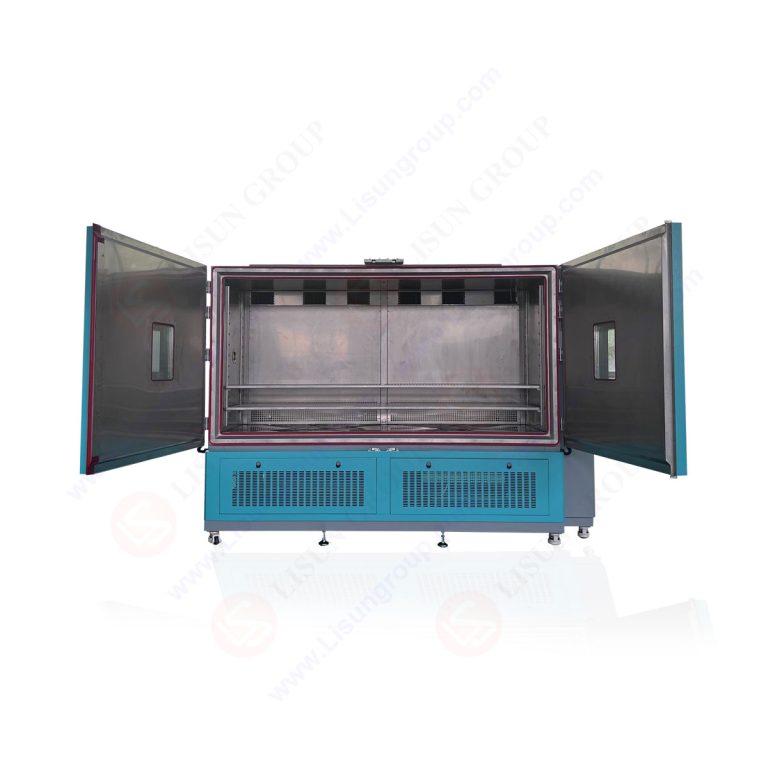
Ideal chambers feature: temperature accuracy ±0.5°C, humidity accuracy ±2% RH, and uniform air distribution (<5% variation in chamber volume). LISUN’s systems interface via RS-232 or Ethernet, enabling automated setpoint control and data logging. Chambers must have optical ports (quartz windows) for in-situ photometric measurements, avoiding sample removal that disrupts thermal equilibrium.
4.2 Calibration Protocols and Traceability
Regular calibration using NIST-traceable standards ensures chamber performance. For temperature, platinum resistance thermometers (PRTs) should be placed at sample locations. For humidity, chilled mirror hygrometers provide accurate dew point measurements. LISUN’s software logs environmental parameters (temperature, humidity, chamber setpoint) alongside photometric data, creating auditable records for regulatory submissions.
4.3 Sample Mounting and Thermal Management
LED samples should be mounted on thermally conductive substrates (e.g., aluminum heat sinks) mimicking final product conditions. Thermal paste ensures low-thermal-resistance contact. For high-power LEDs (e.g., 1-5W), active cooling (e.g., Peltier devices) may be necessary to maintain junction temperatures within ±1°C of chamber setpoint, as required by LM-80.
4.4 Data Acquisition and Error Minimization
Automatic photometric measurements at 1000-hour intervals reduce human error. LISUN’s system corrects for integrating sphere spectral response using a reference lamp (calibrated for luminous flux). During humidity testing (e.g., 85% RH), condensation on optical ports may absorb flux; engineers should use heated windows or software corrections. The system records humidity as a percentage of saturation at chamber temperature.
5.1 6000-Hour Test Protocols for Lumen Maintenance
LM-80 mandates a minimum 6000 hours at three temperatures: 55°C (reference), 85°C (accelerated), and a manufacturer-defined temperature (e.g., 105°C for higher-stress LEDs). LISUN’s system allows simultaneous testing in up to three chambers. Measurements occur at 0, 1000, 2000, 3000, 4000, 5000, and 6000 hours, with optional intermediate points. Humidity is set to <50% RH unless specified by the manufacturer.
5.2 TM-21 Extrapolation: L70/L50 Projections
TM-21 uses exponential decay fitting: L(t) = α exp(-βt), where α is initial luminous flux and β is decay rate. For LEDs with stable early degradation, β from 6000 hours at 85°C enables projecting L70 (time to 70% maintenance) up to 36,000 hours. LISUN’s software calculates confidence intervals (95%) based on residual analysis. For example, data showing 5% depreciation at 6000 hours yields L70 = 6000 * ln(0.7)/ln(0.95) ≈ 36,000 hours.
5.3 Combined Temperature-Humidity Stress Testing
For LM-84 light engines, temperature humidity chamber applications include 85°C/85% RH tests to simulate moisture-induced degradation. LISUN’s LEDLM-84PL monitors both luminous flux and chromaticity shift (Δu‘v’). TM-28 projections account for combined stresses using modified Arrhenius models with humidity acceleration factors. Data from 85°C/85% RH tests may show 20% faster depreciation compared to dry conditions at same temperature.
5.4 Data Integrity and Statistical Validation
LISUN’s software includes outlier detection (Dixon’s Q test) and sample size determination (min. 20 units per temperature, per LM-80). For each test group, the system calculates mean lumen maintenance, standard deviation, and 95% confidence intervals. Data from different chambers are normalized to initial measurements, correcting for minor photometric setup variations.
6.1 LED Manufacturing Quality Control
Manufacturers use temperature humidity chamber applications to qualify new LED designs before production. For example, a 6000-hour test at 85°C/50% RH on 100 LED samples (20 per chamber) identifies defective materials (e.g., phosphor instability) causing premature depreciation. LISUN’s system automates pass/fail decision based on L70 thresholds (e.g., L70 > 25,000 hours for residential use).
6.2 Third-Party Testing Laboratory Accreditation
Accredited labs (e.g., UL, CSA) rely on LM-80/TM-21 reports for marking approval. LISUN’s dual-system ensures compliance: LEDLM-80PL for LED packages, LEDLM-84PL for light engines. Labs benefit from multi-chamber support (up to 3 chambers), allowing simultaneous tests on different client samples. Automated reporting reduces turnaround time from 8-12 weeks to 4-6 weeks.
6.3 Automotive Electronics Component Testing
Automotive LEDs must withstand harsh environments: -40°C to +125°C thermal cycling and high humidity (85% RH). LISUN’s chambers with temperature humidity control enable AEC-Q102 qualification tests, including 1000 hours of combined stress. The Arrhenius Model-based software projects L70 at board-level temperatures (e.g., 85°C), ensuring headlamp or ambient lighting reliability.
6.4 Regulatory Compliance and Certification
Standards like IEC 62717 for LED modules require LM-84 data for lifetime claims. Temperature humidity chamber applications thus underpin Energy Star, DLC, and CE certifications. LISUN’s system provides auditable test records, including chamber setpoints, measurement timestamps, and extrapolation results, streamlining submissions to regulatory bodies.
7.1 Multi-Chamber Synchronization and Remote Monitoring
LISUN’s software synchronizes up to three chambers, enabling simultaneous testing at different temperatures (e.g., 55°C, 85°C, 105°C) with humidity control (20-98% RH). Engineers monitor via web interface, receiving alerts when measurements are due or when chamber parameters deviate (e.g., temperature drift >1°C). This supports 24/7 unattended operation.
7.2 Integration with Spectrometer and Chromaticity Analysis
The system integrates high-resolution spectrometers (e.g., LISUN’s LPCE-2) for spectral power distribution (SPD) measurement from 380-780 nm. Chromaticity coordinates (CIE 1931 x,y) and correlated color temperature (CCT) are recorded at each interval. This allows detecting color shift (Δu‘v’ < 0.007 for TM-21 compliance) alongside lumen maintenance, critical for architectural lighting applications.
7.3 Optional Relay Units for Multi-Sample Testing
Relay units connect up to 20 samples per chamber, with automatic switching between photometric measurements. This scales testing throughput—for example, testing 60 LEDs (3 chambers × 20 samples) simultaneously. Each sample is measured sequentially via the integrating sphere, taking 30 minutes per cycle (e.g., 10-hour total for full dataset).
7.4 Customizable Test Profiles
Users define temperature and humidity profiles including: constant conditions (e.g., 85°C/85% RH for 6000 hours), thermal cycling (e.g., -40°C to +125°C with 15-minute dwells), and step-stress (e.g., increasing temperature by 10°C every 500 hours). LISUN’s software logs all profile changes with timestamps, enabling retroactive analysis of degradation inflection points.
This Temperature Humidity Chamber Applications Guide demonstrates how LISUN’s LED Optical Aging Test Instrument integrates environmental chambers to enforce IES LM-80, IES LM-84, TM-21, and TM-28 standards for accelerated LED reliability testing. By leveraging dual system variants (LEDLM-80PL for high-power LEDs, LEDLM-84PL for light engines), Arrhenius Model-based software, and dual testing modes (constant current and pulsed measurement), engineers achieve 6000-hour test durations with accurate L70/L50 projections. The ability to connect up to three temperature chambers simultaneously accelerates qualification cycles, reduces costs, and ensures regulatory compliance for applications ranging from LED manufacturing to automotive electronics. Customizable configurations—including integrating sphere diameters, spectrometer ranges, and relay units—tailor systems to specific lab needs. For technical professionals, adopting these tools bridges the gap between laboratory simulation and real-world reliability, safeguarding product performance in demanding environments.
Q1: What is the minimum test duration required for LM-80 compliance, and how does LISUN’s system support it?
A: IES LM-80-15 mandates a minimum 6000-hour test duration at three temperatures (55°C, 85°C, and a manufacturer-defined temperature) with photometric measurements at 1000-hour intervals. LISUN’s LEDLM-80PL system automates this process by integrating up to three temperature humidity chambers (e.g., one per temperature condition) and connecting them to an integrating sphere for in-situ luminous flux measurements. The software automatically schedules measurements, corrects for spectral response, and logs environmental parameters (temperature, humidity) alongside photometric data. For accelerated testing, 6000 hours at 85°C with TM-21 extrapolation can project L70 lifetimes up to 36,000 hours, enabling manufacturers to meet Energy Star or DLC requirements without extended real-time testing. The system also adheres to LM-80’s humidity specification (<50% RH unless otherwise defined) by regulating chamber conditions via RS-232 control.
Q2: How does the Arrhenius Model improve lifespan projection accuracy in temperature humidity chamber testing?
A: The Arrhenius Model predicts LED degradation by assuming lumen maintenance follows an exponential decay function: L(t) = A exp(-Ea/(kT)), where Ea (activation energy) is derived from multi-temperature test data. LISUN’s software integrates this model with TM-21/TM-28 extrapolation algorithms, using data from 55°C and 85°C chambers to solve for Ea (typically 0.5-1.0 eV). For example, if degradation at 85°C is 5% within 6000 hours, the program calculates that at a field-use temperature of 40°C, L70 (70% maintenance) is achieved at approximately 36,000 hours, assuming Ea = 0.7 eV. The software accounts for humidity acceleration factors (e.g., 85°C/85% RH reduces L70 by 20% compared to dry conditions) by incorporating empirical correction coefficients. This enables engineers to set warranty thresholds for specific drive currents and ambient conditions, reducing over-engineering costs.
Q3: Can LISUN’s system test OLEDs or light engines under LM-84 standards, and what are the key differences from LM-80 testing?
A: Yes, the LEDLM-84PL variant is designed specifically for LM-84/TM-28 compliance, covering organic LEDs (OLEDs) and light engines. Key differences from LM-80 (LEDLM-80PL) include: (a) test duration—LM-84 requires 6000 hours minimum, similar to LM-80, but may incorporate humidity testing (e.g., 85°C/85% RH) for moisture-sensitive all-organic structures. (b) photometric measurement—LM-84 allows use of integrating spheres or goniophotometers, whereas LM-80 typically uses integrating spheres only. (c) Extrapolation—TM-28 uses exponential decay models tailored for OLEDs, which exhibit different degradation kinetics (e.g., faster initial drop followed by stabilization). LISUN’s software automatically selects the appropriate model based on test configuration, and the system supports up to three temperature humidity chambers, enabling simultaneous testing of OLED and LED samples for comparative analysis.
Q4: What are the best practices for mounting LED samples inside temperature humidity chambers to ensure accurate results?
A: Proper sample mounting is critical for LM-80 and LM-84 compliance. LEDs should be soldered onto thermal test boards (SPICE-aware thermal designs) with low-resistance paths to heat sinks. Thermal paste (e.g., thermal conductivity >3 W/mK) must be applied uniformly to minimize junction-to-case resistance. For high-power LEDs (≥1W), active Peltier cooling may be included if chamber air circulation is insufficient to maintain junction temperature within ±1°C of setpoint. Samples should be spaced >2 cm apart to avoid thermal crosstalk. LISUN’s system accommodates up to 20 samples per chamber via relay units, each connected to the integrating sphere via optical fibers. For humidity testing (e.g., 85% RH), use corrosion-resistant mounting materials (e.g., stainless steel) to avoid moisture-induced interference. Regular verification via thermocouple attachment at sample case points ensures chamber uniformity.
Q5: How does LISUN’s system handle data from multiple chambers, and can it generate a single report for LM-80 or LM-84 submissions?
A: LISUN’s software consolidates data from up to three connected temperature humidity chambers into a unified database, each channel logged separately with timestamps and environmental parameters. For LM-80 submissions, the system generates a report including: (a) test conditions (temperature, humidity, drive current for each chamber), (b) luminous flux measurements at 0, 1000, 2000, 3000, 4000, 5000, and 6000 hours, (c) normalized lumen maintenance values with standard deviations, (d) TM-21 extrapolation results (L70, L50 with 95% confidence intervals), and (e) activation energy (Ea) derived from multi-temperature data. The report format adheres to IES LM-80-15 Annex B templates, including graphical plots of degradation curves. For LM-84 submissions, the software adds chromaticity shift data (Δu‘v’) and humidity acceleration factors. Reports are exportable as PDF or CSV, with all raw data auditable. This streamlines third-party review processes, reducing regulatory approval time.