









Abstract
In the rigorous world of electrical accessory compliance testing, the accurate simulation of real-world loads is paramount. The LISUN DFX series Externally Ballasted Fluorescent Lamp Test Load Cabinet is engineered to meet this critical need, providing a precision, programmable solution for testing AC power supplies, switches, sockets, and connectors. This article details its core capabilities in simulating resistive (R), inductive (L), and capacitive (C) loads with high resolution, enabling manufacturers and third-party laboratories to validate performance against stringent international standards like IEC 60669-1 and IEC 60884-1. By offering a stable, repeatable, and configurable load environment, the DFX series ensures reliable verification of electrical safety, endurance, and power delivery characteristics, directly addressing the quality control challenges faced by engineers in the lighting and electrical accessory industries.
1.1 Core Function and Application Scope
The LISUN DFX series serves as a specialized, externally ballasted load simulator designed explicitly for the compliance and performance testing of AC-powered electrical accessories and components. Its primary function is to replace actual, variable, and often unstable fluorescent lamp ballasts with a precise, programmable RLC (Resistive, Inductive, Capacitive) load. This is critical for executing standardized life cycle tests, electrical endurance tests, and normal operation tests on products such as wall switches, socket-outlets, appliance couplers, and connectors. By providing a consistent and measurable load, it eliminates the uncertainty introduced by physical lamps and ballasts, ensuring test results are reproducible and directly attributable to the device under test (DUT).
1.2 Addressing Key Industry Testing Challenges
Traditional testing methods using physical fluorescent lamp loads present significant challenges, including load instability due to component aging, temperature drift, and inherent manufacturing tolerances. These variables can lead to inconsistent test results, failed compliance audits, and prolonged product development cycles. The DFX-40 RLC Load Cabinet and its sibling models overcome these issues by offering digital control over load parameters. Engineers can precisely set power factor, current, and load type, creating a stable test condition that accurately simulates the specified worst-case scenarios mandated by standards. This digital transformation enhances testing accuracy, repeatability, and overall laboratory efficiency.
2.1 RLC Load Simulation Mechanism
At its core, the DFX series utilizes high-precision, non-inductive power resistors, high-stability air-core inductors, and low-loss capacitors to construct its simulated load. A sophisticated microcontroller unit (MCU) manages relay matrices to switch these discrete components in and out of the circuit in precise combinations. This allows the cabinet to synthesize any load within its specified range, mimicking the complex impedance characteristics of real ballasted lamp circuits. The system can independently or jointly simulate resistive, inductive, and capacitive loads, enabling the creation of both linear and non-linear load conditions for comprehensive testing.
2.2 Control System and Human-Machine Interface (HMI)
Operation is centralized through a user-friendly touchscreen HMI or compatible software. The interface allows for direct input of target test parameters: output current (A), power factor (PF), and load type (R, L, C, or any combination). The system’s internal processor calculates the required component configuration in real-time and executes the switching. Real-time monitoring displays key parameters including actual output voltage, current, power, power factor, and frequency. This closed-loop control ensures the set load conditions are maintained consistently throughout the test duration, regardless of minor fluctuations in the input supply or DUT characteristics.
3.1 Alignment with Key IEC and GB Standards
The design and performance specifications of the DFX series are meticulously aligned with global and national compliance frameworks. It is engineered to fulfill the specific load simulation requirements outlined in major standards for electrical accessories. Key cited standards include:
- IEC 60669-1 (Switches for Household and Similar Fixed-Electrical Installations): Clause 19.2, which specifies the test circuit and load conditions for mechanical and electrical endurance testing of switches.
- IEC 60884-1 (Plugs and Socket-Outlets for Household and Similar Purposes): Clause 20, detailing the requirements for normal operation tests, including the specified resistive and inductive loads.
- IEC 60320-1 (Appliance Couplers for Household and Similar General Purposes): Relevant clauses for electrical endurance and temperature rise tests under load.
- GB 2099.1 & GB 16915.1: The Chinese national standards harmonized with IEC 60884-1 and IEC 60669-1, respectively, ensuring compliance for the Chinese market.
3.2 Enabling Standardized Test Procedures
By pre-configuring load settings to match standard clauses, the DFX cabinet simplifies the test setup process. For example, to test a switch per IEC 60669-1 Clause 19.2, an engineer can simply select the appropriate current rating and the prescribed inductive load (cos φ = 0.3, 0.6, or 0.8) from the instrument’s memory or input it directly. This eliminates manual calculation and guesswork, ensuring the test is performed exactly as the standard requires. The cabinet’s measurement system also provides the data logging necessary for compliance reports, documenting that the DUT was subjected to the correct conditions for the required number of cycles.
4.1 Core Performance Parameters
The DFX series delivers high precision across its operational range. Typical performance specifications include a current setting resolution as fine as 0.01A and a power factor adjustment range from 0.30 to 1.00, with a resolution of 0.01. Measurement accuracy for key parameters is critical: voltage and current are typically within ±(0.5% reading + 0.2% range), while power factor accuracy is within ±0.03. Load capacitance values are selectable to simulate specific capacitive loads as needed. This level of precision ensures that even minor deviations in DUT performance can be detected and quantified.
4.2 DFX Series Model Comparison
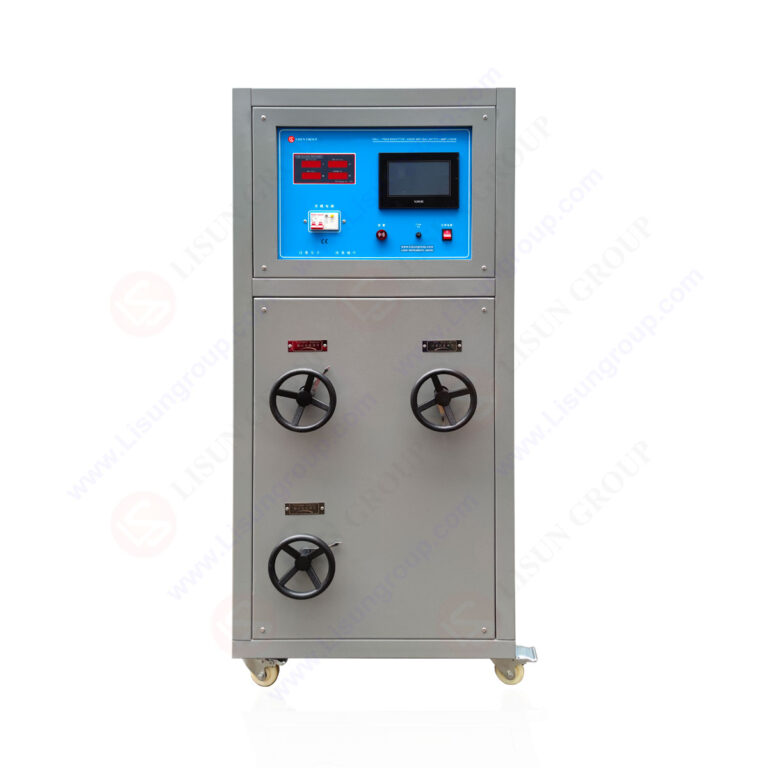
The series offers multiple models to suit different laboratory scales and testing throughput requirements. The primary differentiators are maximum output current capacity and the number of independent test channels.
| Model | Max. Output Current per Channel | Channel Configuration | Typical Input Voltage | Core Application Focus |
|---|---|---|---|---|
| DFX-20 | 20A | 1 Channel | 250V AC | Basic compliance testing for single devices. |
| DFX-20-3CH | 20A | 3 Independent Channels | 250V AC | High-throughput testing of multiple samples simultaneously. |
| DFX-40 | 40A | 1 Channel | 250V AC | Testing higher-current accessories, industrial connectors. |
| DFX-60 | 60A | 1 Channel | 250V AC | Heavy-duty applications and high-power devices. |
| DFX-80 | 80A | 1 Channel | 250V AC | Maximum capacity testing for specialized, high-current equipment. |
5.1 Synergy with LISUN Test Systems
The DFX-40 RLC Load Cabinet is not a standalone instrument but a key component within LISUN’s integrated testing ecosystem. It is designed for seamless interoperability with other specialized testers to automate complete qualification procedures. For instance, it can be directly connected to and controlled by the LISUN CZKS series Multi-Station Life Testers. In this setup, the CZKS automates the mechanical actuation (ON/OFF cycling) of switches or connectors, while the DFX provides the precise electrical load for each cycle, fully automating electrical endurance tests per standards.
5.2 Complementary Equipment for Full Validation
Beyond life testers, the DFX cabinet’s stable load output is crucial for other tests. When paired with a LISUN SW-6 Bending Tester, it can provide a constant load to a flexible cord or connector during dynamic flexing tests, measuring voltage drop or checking for breaks under realistic conditions. This integration allows laboratories to build comprehensive, automated test stations that validate mechanical, electrical, and thermal performance in a synchronized manner, drastically reducing manual intervention and test cycle time.
6.1 Enhanced Accuracy and Repeatability
The transition from analog ballast loads to the digitally-controlled DFX series represents a significant leap in measurement integrity. The system’s high-stability components and digital calibration eliminate the drift associated with magnetic ballasts. Every test cycle is performed under identical electrical conditions, ensuring that performance variations are solely due to the DUT. This level of repeatability is essential for comparative analysis, quality trending, and defending test results during certification audits.
6.2 Improved Efficiency and Safety
Operational efficiency gains are substantial. Engineers save time previously spent sourcing, aging, and calibrating physical lamp loads. Test setups are faster and more reliable through digital presets. Furthermore, the cabinet enhances laboratory safety. It contains potentially high-energy circuits within a robust, interlocked enclosure, protecting operators from exposed terminals. It also prevents the risks associated with rupturing fluorescent lamps (e.g., mercury exposure, glass shards) during high-cycle endurance testing.
7.1 System Setup and Calibration
Proper installation involves connecting the DFX cabinet to a stable AC power source and the output terminals to the DUT. Initial configuration requires setting the system parameters, such as nominal voltage and frequency, to match the local supply and test standard. Regular calibration against a traceable reference standard is crucial to maintain its specified accuracy. LISUN provides calibration procedures and recommendations for periodicity based on usage intensity and laboratory quality protocols (e.g., ISO/IEC 17025).
7.2 Developing Test Profiles and Schedules
For optimal use, laboratories should develop and save standardized test profiles corresponding to common standards and product categories. For example, a profile for “16A Switch, cos φ=0.6” would pre-set the current and inductive load. The cabinet can also execute complex test schedules, such as alternating between different load conditions for set numbers of cycles, which is valuable for simulating varied real-world operating conditions beyond the basic standard requirements.
The LISUN DFX series Externally Ballasted Fluorescent Lamp Test Load Cabinet is an indispensable tool for modern electrical compliance and quality assurance laboratories. By replacing unpredictable physical loads with a precise, programmable, and stable RLC simulator, it solves fundamental challenges in testing accuracy and repeatability. Its direct alignment with critical clauses in IEC, GB, and other international standards, such as IEC 60669-1 Clause 19.2 and IEC 60884-1 Clause 20, provides engineers with a reliable and auditable method for validating product safety and endurance. The ability to integrate seamlessly with complementary equipment like CZKS life testers creates powerful, automated testing workstations that enhance throughput and data integrity. For manufacturers and third-party test labs committed to rigorous product validation, the DFX series represents a strategic investment that ensures compliance, reduces time-to-market, and ultimately safeguards product reliability in the field.
Q1: How does the DFX series improve upon traditional fluorescent lamp and ballast load banks for compliance testing?
A: Traditional fluorescent lamp loads suffer from inherent instability—their electrical characteristics drift with temperature, aging, and manufacturing variances. This introduces uncontrolled variables, compromising test repeatability. The LISUN DFX Load Cabinet replaces these with solid-state, digitally-switched RLC components. It provides exact, programmable control over current (e.g., 0.01A resolution) and power factor (0.30-1.00 range). This ensures the load specified in a standard (like a 16A, cos φ=0.6 inductive load per IEC 60669-1) is applied with precision and maintained consistently for every cycle of a 40,000-operation endurance test, guaranteeing results are accurate, repeatable, and fully compliant.
Q2: Can the DFX-40 simulate purely resistive loads, and why is this important for testing sockets and connectors?
A: Absolutely. While designed for complex ballast simulation, the DFX series can independently simulate pure resistive (R), inductive (L), or capacitive (C) loads. This is crucial for standards like IEC 60884-1 for socket-outlets, where Clause 20 specifies normal operation tests using a resistive load at rated current. Using the DFX-40, an engineer can set a pure 16A resistive load at a power factor of 1.00 to perform these tests accurately. This versatility allows a single cabinet to cover all load types required by various accessory standards, consolidating equipment needs in the lab.
Q3: What is the advantage of the multi-channel DFX-20-3CH model compared to a single higher-amperage model?
A: The advantage is parallel testing throughput, not increased current capacity. The DFX-20-3CH provides three independent 20A channels. This allows a laboratory to simultaneously test three separate devices—for example, three different switch models or three samples of the same switch—under the same or different load conditions. This is ideal for production batch sampling, comparative testing, or simply maximizing the utilization of an automated life tester (like a CZKS unit with multiple stations). A single-channel DFX-40 (40A) is designed for testing one higher-current device, not for parallel sample throughput.
Q4: How does the DFX cabinet interface with automated test equipment for unattended operation?
A: The DFX series typically features standard communication interfaces such as RS-232, RS-485, or Ethernet (LAN). These allow it to be integrated into a automated test system and controlled by a host computer or a master tester like the LISUN CZKS life tester. Test profiles (current, PF, duration) can be sent via command, and the cabinet can return real-time measurement data (V, I, PF). This enables fully unattended endurance tests where the life tester controls the mechanical cycling while the DFX applies and monitors the electrical load, logging all data for the entire test duration without operator intervention.