









Abstract
The LISUN SW Series Power Cord Flexibility Bending Tester is a critical instrument for validating the mechanical endurance and electrical safety of flexible cords and cables under repeated bending stress. This article provides a technical deep-dive into the SW-6 model, a six-station benchtop system designed for high-throughput reliability testing. The equipment automates the rigorous bending cycles mandated by international standards such as IEC 60884-1 and IEC 60745-1, simulating years of real-world use in a controlled laboratory environment. For R&D and quality assurance professionals in appliance manufacturing and component supply, the SW-6 offers precise, repeatable, and efficient validation of power cord flexibility and durability, ensuring product compliance and reducing field failure risks.
1.1 The Critical Role of Flex Endurance in Product Safety
The flexible power cord is often the most mechanically stressed component of any portable electrical device. Repeated bending, twisting, and pulling during normal use can lead to conductor strand breakage, insulation degradation, and ultimately, electrical failure or safety hazards like short circuits. Compliance testing through standardized bending cycles is therefore not merely a regulatory checkbox but a fundamental exercise in product liability and reliability engineering. It provides quantitative data on a cord assembly’s lifespan and failure modes.
1.2 Overview of the LISUN SW Series Bending Testers
The LISUN SW Series represents a family of automated test equipment engineered to perform standardized flexing tests on power supply cords, cordsets, and appliance inlets. The series scales from single-station (SW-1) to dual-station (SW-2) and high-capacity six-station (SW-6) configurations. Each station operates independently, allowing for simultaneous testing of different cord types or under different parameters. Core to the design is the integration of programmable logic controller (PLC) automation, servo motor drives for smooth motion control, and real-time electrical monitoring to detect failure precisely at the moment it occurs.
2.1 Mechanical Drive and Motion Control System
At the heart of the SW-6 tester is a servo motor-driven mechanical system. Unlike simpler crank-based testers, the servo system provides highly controllable, consistent, and reversible motion. The test cord is clamped at a specified distance from the appliance inlet or plug, and a standardized weight is attached. The servo drive then moves the cord through a defined arc (typically 90°, 135°, or 180°) at a programmable speed, simulating the bending action. This closed-loop control ensures each cycle is identical, eliminating variability inherent in manual or less sophisticated automated systems.
2.2 PLC-Based Automation and Parameter Configuration
System operation is governed by a PLC, which serves as the central brain. Through a human-machine interface (HMI) touchscreen, engineers configure all critical test parameters: number of bending cycles (e.g., 10,000 to 50,000+), bending speed, dwell time at extreme positions, and the arc angle. The PLC executes the sequence flawlessly, logging cycle count and monitoring for fault conditions. This programmability allows the SW-6 to be adapted for a wide range of standards and internal corporate test protocols beyond the baseline requirements.
2.3 Real-Time Electrical Monitoring and Failure Detection
The most significant advancement in modern testers like the SW-6 is the integration of electrical monitoring into the bending process. During the test, a load current is passed through the cord under test. The system continuously monitors this current. If a break in the conductor occurs—even a single strand—the current flow is interrupted. The PLC detects this interruption instantly and halts the test for that specific station, recording the exact cycle count at failure. This method, specified in standards like IEC 60884-1 clause 23, provides an objective, repeatable, and unambiguous failure criterion.
3.1 Primary Applicable Standards and Key Clauses
The SW-6 is designed to meet the exacting requirements of major global safety standards. These include IEC 60884-1 (Plugs and socket-outlets for household and similar purposes), clause 23; IEC 60745-1 (Hand-held motor-operated electric tools), clause 22; IEC 60335-1 (Household and similar electrical appliances), clause 25.14; and the Chinese national standard GB/T 2099.1, which is harmonized with IEC 60884-1. Each standard specifies the test weight, bending arc, cycle rate, and pass/fail criteria (e.g., no break in conductors after a set number of cycles).
3.2 Configuring the Tester for Different Standards
A key operational advantage is the tester’s flexibility to accommodate varying standard requirements. For instance, testing a heavy-duty tool cord per IEC 60745-1 may require a different weight (e.g., 2.5 kg) and angle than testing a household appliance cord per IEC 60335-1. The SW-6’s programmable HMI allows the operator to create and save distinct test profiles for each standard or product category. Adjustable clamps and fixtures enable secure mounting of different plug types, appliance inlets, or cord anchorage points as defined in the test specifications.
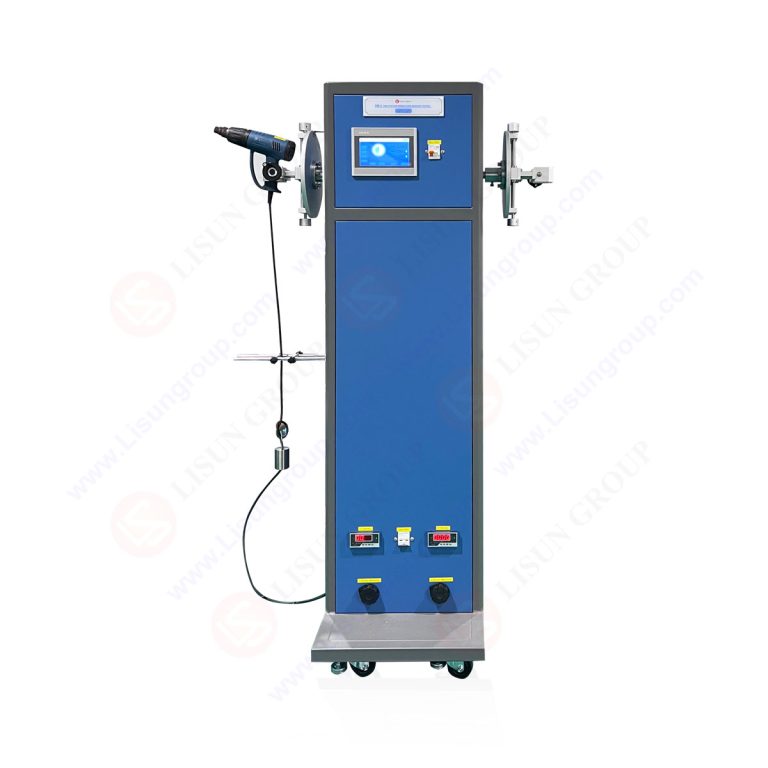
4.1 Key Performance Parameters of the SW-6
The SW-6 Bending Tester is characterized by high-precision mechanical and electrical specifications. Each of its six independent stations can be programmed for up to 999,999 cycles. The bending speed is adjustable within a range, typically from 5 to 30 cycles per minute. The system operates from a standard AC power supply and includes safety features like emergency stop buttons and protective covers. The integrated current monitoring circuit can be set to a typical load current, such as 0.5A or 10A, depending on the standard’s requirement for fault detection sensitivity.
4.2 Comparative Analysis of SW Series Models
The choice between SW series models depends on laboratory throughput needs and testing volume. The following table compares key parameters across the range and benchmarks them against a core standard requirement.
| Parameter | SW-1 Single Station | SW-2 Dual Station | SW-6 Six Station | IEC 60884-1 Clause 23 Reference |
|---|---|---|---|---|
| Test Stations | 1 | 2 | 6 | 1 (per test sample) |
| Max Bending Cycles | 999,999 | 999,999 per station | 999,999 per station | As specified (e.g., 10,000) |
| Bending Angle | 90° / 135° / 180° adjustable | 90° / 135° / 180° adjustable | 90° / 135° / 180° adjustable | 90° (for certain tests) |
| Load Current for Monitoring | 0.1A – 10A adjustable | 0.1A – 10A adjustable | 0.1A – 10A adjustable | A non-inductive load applied |
| Primary Application | R&D, low-volume QA | Medium-volume QA, compliance labs | High-volume production QA, third-party labs | Compliance verification |
5.1 Household Appliance and Power Tool Manufacturing
For manufacturers of vacuum cleaners, power drills, blenders, and similar products, cord reliability is paramount. The SW-6 enables production quality control batches to be tested simultaneously, providing statistical data on cord assembly quality from different suppliers. R&D departments use it to validate new cord designs, different conductor gauges, or improved strain relief mechanisms before product launch, ensuring they meet the 10,000 to 25,000 cycle requirements of applicable standards.
5.2 Plug, Socket, and Cordset Component Suppliers
Component manufacturers must demonstrate that their products meet the performance criteria required by their OEM customers. A six-station bending tester like the SW-6 allows a supplier to perform rigorous lot acceptance testing, providing certified test reports that serve as a key quality differentiator. It is especially useful for testing polarized, multi-standard, or specialized connectors under repeated stress.
5.3 Third-Party Testing and Certification Laboratories
Independent labs require robust, auditable, and standard-compliant equipment to issue recognized test reports. The SW-6’s automated operation, precise cycle counting, and objective electrical failure detection create an unambiguous test record. Its multi-station design maximizes lab efficiency and throughput, allowing multiple client samples to be processed in parallel under identical environmental and parametric conditions.
6.1 Sample Preparation and Fixturing
Accurate testing begins with correct sample preparation. The cord is cut to a specified length, and the plug or connector is securely fastened in the stationary clamp. The specified test weight is attached at the free end. The distance from the clamp to the weight attachment point (the bending moment arm) must be set precisely as per the standard, often 100mm or 150mm. Proper fixturing ensures the bending stress is applied at the correct location, typically near the cord anchorage point.
6.2 Test Execution and Data Interpretation
Once configured, the test runs automatically. The HMI displays real-time status for each station: current cycle count, operational state, and any fault alarms. Upon failure detection, the station stops and logs the final count. A pass is recorded if the sample completes the prescribed cycle count without an electrical break. The resulting data—cycle-to-failure or confirmation of endurance—provides actionable intelligence for quality scoring, supplier evaluation, and design improvement.
6.3 Maintenance and Calibration
To ensure long-term accuracy and repeatability, periodic maintenance is essential. This includes mechanical checks for wear on moving parts, verification of clamp alignment, and calibration of the weight masses. The electrical monitoring circuit should be validated using a known resistance or break-simulation tool. A formal calibration schedule, traceable to national standards, is critical for laboratories operating under ISO/IEC 17025 accreditation.
The LISUN SW-6 Power Cord Flexibility Bending Tester embodies a sophisticated integration of mechanical simulation and electrical diagnostics to address a fundamental product safety requirement. Its six-station parallel testing capability delivers unmatched efficiency for high-volume quality assurance and compliance validation, while its programmable PLC and servo drive system ensures strict adherence to the parameters of major international standards like IEC 60884-1 and IEC 60335-1. For engineers, the value lies in obtaining objective, repeatable data on cord durability, enabling informed decisions on component selection and design robustness. For testing laboratories, it provides the throughput and audit trail necessary for accredited certification work. Ultimately, by rigorously validating power cord flexibility and durability, the SW-6 serves as a vital tool in mitigating field failure risks, enhancing product longevity, and ensuring end-user safety across the consumer electrical goods industry.
Q1: How does the current monitoring system determine a “failure” during a bending test?
A: The system operates by passing a constant, low-level load current (e.g., 0.5A or 10A, as configurable) through the live and neutral conductors of the cord under test. This circuit is monitored continuously by the PLC. As the cord is bent, internal conductor strands may fatigue and break. When a sufficient number of strands break to interrupt the continuous electrical path, the monitored current drops to zero. The PLC detects this open-circuit condition within milliseconds, immediately stops the bending mechanism for that station, and records the exact cycle count. This method, prescribed in standards like IEC 60884-1 clause 23.3, provides a clear, electrical-based failure criterion that is more reliable than visual inspection or post-test resistance measurement.
Q2: Can the SW-6 tester be used for standards that require a different bending angle, like 180 degrees instead of 90?
A: Yes, a key feature of the SW-6 is its programmable bending angle. The servo-driven mechanism can be set via the HMI to execute bends at precisely 90, 135, or 180 degrees, as required by different test specifications. For example, some tests in IEC 60745-1 for hand-held tools may specify a 180-degree bend. The operator simply selects the appropriate angle in the test profile. The machine’s mechanical design and software ensure the arm moves to the exact programmed position for each cycle, maintaining consistency and repeatability regardless of the selected angle.
Q3: What is the advantage of a multi-station tester like the SW-6 over multiple single-station units?
A: The primary advantages are efficiency, consistency, and space utilization. A single SW-6 unit controls six tests from one central PLC and HMI, requiring only one power connection and occupying less bench space than six independent units. This centralized control guarantees that all stations operate under identical parametric settings (speed, angle, dwell time), eliminating unit-to-unit variation. It also simplifies data logging and operator supervision. For production QA or a busy test lab, this means higher throughput with reduced operational overhead and a more streamlined, auditable testing process compared to managing multiple discrete machines.